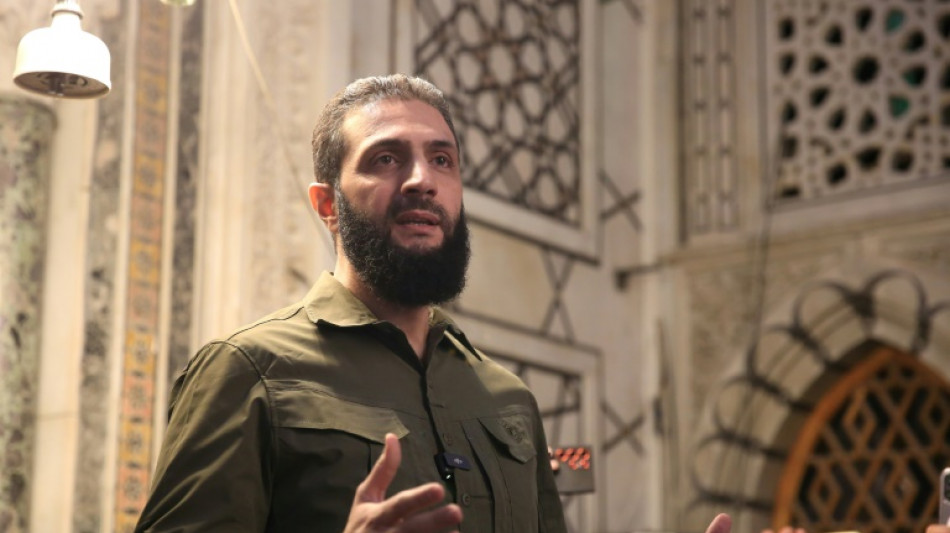
Assad exit puts US at perilous crossroads in Syria / Photo: Aref TAMMAWI - AFP

 US, Saudi forces strike Iran-backed groups in Iraq
 Crude jumps on fresh Mideast flare-up, tech rout deepens
 Japan coral protectors race to save reefs from heat 'bomb'

 US Fed expected to hold rates steady as inflation hawks circle
 SK hynix posts 1,200% net profit boost on AI chip boom
 'Very hungry' Joao Pedro impresses new Chelsea manager Alonso
 US government bans humanoid robots manufactured abroad
 Eseme, Hobbs shine in Glasgow rain to win 100m Commonwealth gold
 Netanyahu holds first White House talks with Trump since Iran war began

 Warriors re-sign Green after LeBron James shun

 Cameroon's Eseme storms to 100m Commonwealth gold
 AIDS activists slam 'pharma greed' over breakthrough drug
 France needs more Canadair water bombers but building them is painfully slow
 In devastated south Lebanon village, residents count on army deployment
 Keiko Fujimori sworn in as president of Peru
 GSJJ Launches ESG-Certified Custom Challenge Coins and Pin Badges
 Airbus completes record 24-hour flight with plane to be used by Qantas
 FIFA says it hopes to sell $4.2bn stake in its tournaments
 Zelensky hails 'good' Trump talks on Patriot air defenses
 Spain allows wildfire evacuees to return but France fears flames spreading
 'Not out of danger': Residents return to scorched French village
 Zelensky holds White House talks with Trump on Ukraine war

 US Fed begins meeting with markets expecting steady interest rates
 Ukraine's Zelensky arrives for Trump talks at White House
 Dozens feared trapped in quake-hit Japan mall

For more than a decade, the United States has sought to keep out of Syria's political debacle, seeing no viable partner. Islamist rebels' toppling of strongman Bashar al-Assad has forced a change of tune -- and a debate over just what US interests are.
Donald Trump, who returns to the White House in little more than a month, on the eve of Assad's fall called Syria "a mess" and stated in his plain-speaking style that the United States should not be involved.
Joe Biden's administration, after putting Syria on the backburner in a turbulent region, has offered a tacit rebuttal by stating that clear US interests are at stake -- including preventing Syria from fragmenting and avoiding a resurgence of the Islamic State extremist group.
Steven Cook, a senior fellow at the Council on Foreign Relations, said Trump's and Biden's statements could be combined and "together they make a kind of decent policy."
The United States needs to address real concerns about the Islamic State group and Al-Qaeda but "as far as getting involved in arranging the politics of Syria, I think that no good can come from it," Cook said.
Since the presidency of Barack Obama, the United States has walked a fine line on Syria that critics often derided as a non-policy.
The United States questioned the legitimacy of Assad, demanding accountability for brutality in one of the 21st century's deadliest wars, but stopped short of prioritizing his departure due to suspicions about the main rebels.
The Islamist movement Hayat Tahrir al-Sham (HTS), which has now led Assad's ouster, traces its roots to Syria's Al-Qaeda branch and is considered a terrorist organization by the United States.
Since Obama's time, the United States instead has allied itself in Syria with a smaller fighting force of the Kurdish minority -- over strenuous objections of neighboring Turkey, which backs HTS -- with a narrow mission to counter the Islamic State group. Some 900 US troops remain in Syria.
Assad fell in a lighting surprise offensive as his protector Russia is bogged down in its invasion of Ukraine and after Israel's military heavily degraded Assad's other key supporters -- Iran and Lebanese militia Hezbollah.
- How to deal with Islamists? -
Robert Ford, the last US ambassador to Syria, helped spearhead the terrorist designation of HTS in 2012 but said that the group since then has not attacked US or Western targets and has instead fought Al-Qaeda and Islamic State forces.
Ford also pointed with hope to post-victory statements by rebel chief Abu Mohammed al-Jolani, including welcoming international monitoring of any chemical weapons that are discovered.
"Can you imagine Osama bin Laden saying that?" said Ford, now a senior fellow at the Middle East Institute.
"I'm not saying 'trust Jolani.' He's obviously authoritarian. He's obviously an Islamist who doesn't believe that Christians have an equal right to power as Muslims. But I sure as hell want to test him on some of these things," Ford said.
He said that the United States should encourage HTS, as well as other Syrian actors, to reach out and reassure the country's diverse communities including Christians, Kurds and Alawites -- the sect of the secular-oriented Assad.
Beyond that, Washington should take a back-seat and let Syrians sort out their future, he said.
"We should learn from the experience in Iraq that trying to impose exiles on a population traumatized by a brutal dictatorship and war is not a recipe for success," Ford said.
Outgoing Secretary of State Antony Blinken on Tuesday offered US recognition to a future government that is "credible, inclusive and non-sectarian."
- Weighing terrorist label -
Trump in his first term, at the urging of Turkish President Recep Tayyip Erdogan, abruptly said he would pull troops out of Syria. He backtracked after intense criticism at home and appeals from French President Emmanuel Macron, who pointed to the risk of Islamic State filling the vacuum.
Trump has not indicated how he would change Syria policy this time. But he has shown no reluctance in the past to negotiate with foreign adversaries on the US blacklist, from Afghanistan's Taliban to North Korean leader Kim Jong Un.
State Department spokesman Matthew Miller said there was no legal restriction on US contact with designated terrorists, although he indicated there was no direct dialogue with HTS.
Natasha Hall, a senior fellow at the Center for Strategic and International Studies, said Syria could face "devastating economic and humanitarian consequences" unless the United States reconsiders the terrorist designation of HTS, which impedes aid groups.
"That said," she said, "if there isn't sort of an established framework for negotiations and good behavior now, before that designation is lifted, that could potentially also be a major mistake down the line for Syria's future."
A.Clark--AT