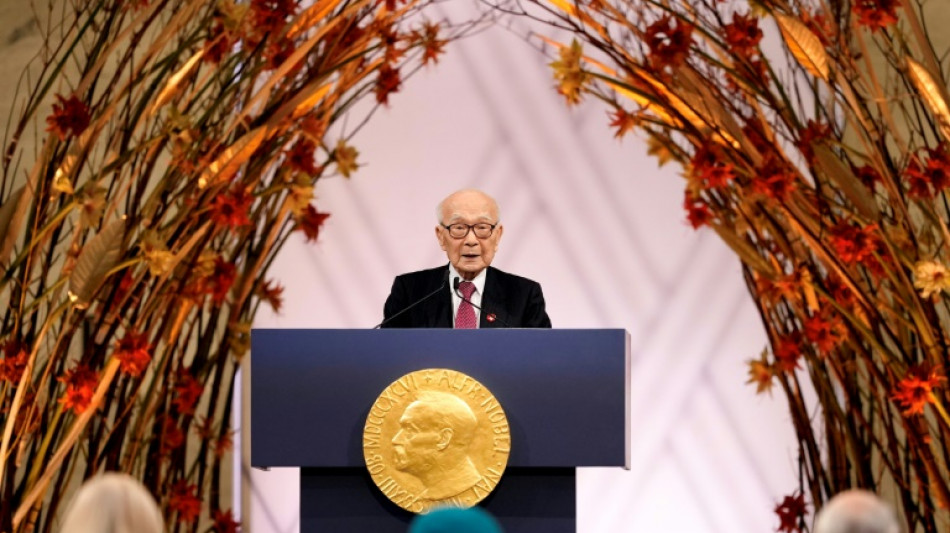
Nobel Peace Prize winner Nihon Hidankyo calls for a world without nukes / Photo: Heiko Junge - NTB/AFP

 US, Saudi forces strike Iran-backed groups in Iraq
 Crude jumps on fresh Mideast flare-up, tech rout deepens
 Japan coral protectors race to save reefs from heat 'bomb'

 US Fed expected to hold rates steady as inflation hawks circle
 SK hynix posts 1,200% net profit boost on AI chip boom
 'Very hungry' Joao Pedro impresses new Chelsea manager Alonso
 US government bans humanoid robots manufactured abroad
 Eseme, Hobbs shine in Glasgow rain to win 100m Commonwealth gold
 Netanyahu holds first White House talks with Trump since Iran war began

 Warriors re-sign Green after LeBron James shun
 Cameroon's Eseme storms to 100m Commonwealth gold
 AIDS activists slam 'pharma greed' over breakthrough drug
 France needs more Canadair water bombers but building them is painfully slow
 In devastated south Lebanon village, residents count on army deployment

 Keiko Fujimori sworn in as president of Peru
 GSJJ Launches ESG-Certified Custom Challenge Coins and Pin Badges
 Airbus completes record 24-hour flight with plane to be used by Qantas
 FIFA says it hopes to sell $4.2bn stake in its tournaments
 Zelensky hails 'good' Trump talks on Patriot air defenses
 Spain allows wildfire evacuees to return but France fears flames spreading

 'Not out of danger': Residents return to scorched French village
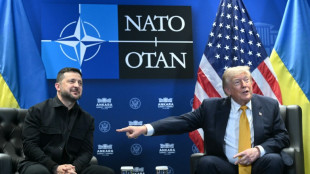 Zelensky holds White House talks with Trump on Ukraine war
 US Fed begins meeting with markets expecting steady interest rates
 Ukraine's Zelensky arrives for Trump talks at White House
 Dozens feared trapped in quake-hit Japan mall

Japan's atomic bomb survivors' group Nihon Hidankyo accepted its Nobel Peace Prize on Tuesday, pleading for the abolition of nuclear weapons that are resurging as a threat 80 years after the Hiroshima and Nagasaki bombings.
One of the three Nihon Hidankyo co-chairs, 92-year-old Nagasaki survivor Terumi Tanaka, demanded "action from governments to achieve" a nuclear-free world.
The prize was presented at a time when countries like Russia -- which has the world's largest nuclear arsenal -- increasingly brandish the atomic threat.
"I am infinitely saddened and angered that the 'nuclear taboo' threatens to be broken," Tanaka told dignitaries at Oslo's City Hall, some clad in traditional Norwegian bunads or Japanese kimonos.
Russian President Vladimir Putin has repeatedly made nuclear threats as he presses the war in Ukraine. He signed a decree in November lowering the threshold for using atomic weapons.
In a strike on the Ukrainian city of Dnipro a few days later, the Russian army fired a new hypersonic missile capable of carrying a nuclear warhead, although in this instance it had a regular payload.
Nihon Hidankyo works to rid the planet of the weapons of mass destruction, relying on testimonies from survivors of Hiroshima and Nagasaki, known as "hibakusha".
The US bombings of the Japanese cities on August 6 and 9, 1945 killed 214,000 people, leading to Japan's surrender in World War II.
- Burnt bodies -
Tanaka was 13 years old when Nagasaki was bombed, the epicentre just three kilometres (1.8 miles) west of his home. Five members of his family were killed.
He was upstairs reading a book when the A-bomb was dropped.
"I heard the explosion and all of a sudden saw a bright white light, which surrounded everything and everything became silent," he recalled.
"I was really surprised. I felt my life in danger."
Rushing to the ground floor, he lost consciousness when two glass doors, blown out by the detonation, fell on him, though the glass did not break.
Three days later, he and his mother went searching for their relatives. That was when they realised the scope of the disaster.
"When we reached a ridge over the hills, we could look down over the city and that was when, for the first time, we saw that there was absolutely nothing left. Everything was black and charred."
He saw gravely wounded people fleeing the city, burnt bodies on the roadside. He and his mother cremated his aunt's body "with our own hands".
"I was numb, not able to feel anything."
Nihon Hidankyo's ranks are dwindling with every passing year. The Japanese government lists around 106,800 "hibakusha" still alive today. Their average age is 85.
- 'Uphold nuclear taboo' -
For the West, the nuclear threat also comes from North Korea, which has increased its ballistic missile tests, and Iran, which is suspected of seeking to develop nuclear weapons though it denies this.
Nine countries now have nuclear weapons: Britain, China, France, India, North Korea, Pakistan, Russia, the United States, and, unofficially, Israel.
"Our movement has undoubtedly played a major role in creating the 'nuclear taboo'," Tanaka said.
"However, there still remain 12,000 nuclear warheads on Earth today, 4,000 of which are operationally deployed, ready for immediate launch."
In 2017, 122 governments negotiated and adopted a UN Treaty on the Prohibition of Nuclear Weapons (TPNW), but the text is considered largely symbolic as no nuclear power has signed it.
While all ambassadors stationed in Oslo were invited to Tuesday's ceremony, the only nuclear powers in attendance were Britain, France, India, Pakistan and the United States. Russia, China, Israel and Iran were not present, the Nobel Institute said.
Expressing concern about the world entering "a new, more unstable nuclear age", Norwegian Nobel Committee chairman Jorgen Watne Frydnes warned that "a nuclear war could destroy our civilisation".
"Today's nuclear weapons ... have far greater destructive power than the two bombs used against Japan in 1945. They could kill millions of us in an instant, injure even more, and disrupt the climate catastrophically," he warned.
Later, the Nobel laureates for medicine, physics, chemistry, literature and economics received their prizes from Sweden's King Carl XVI Gustaf at a separate ceremony in Stockholm, followed by a banquet for some 1,250 guests.
R.Chavez--AT