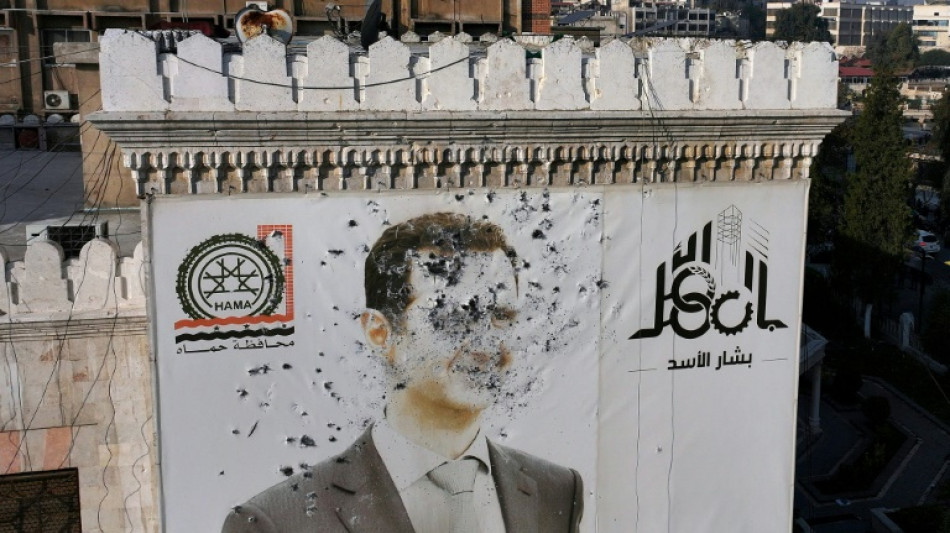
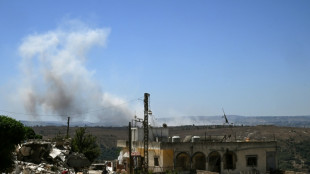
Syria govt loses control of key city Daraa / Photo: Omar HAJ KADOUR - AFP

 'Very hungry' Joao Pedro impresses new Chelsea manager Alonso

 US government bans humanoid robots manufactured abroad
 Eseme, Hobbs shine in Glasgow rain to win 100m Commonwealth gold
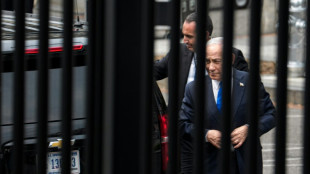 Netanyahu holds first White House talks with Trump since Iran war began

 Warriors re-sign Green after LeBron James shun

 Cameroon's Eseme storms to 100m Commonwealth gold
 AIDS activists slam 'pharma greed' over breakthrough drug
 France needs more Canadair water bombers but building them is painfully slow

 In devastated south Lebanon village, residents count on army deployment

 Keiko Fujimori sworn in as president of Peru

 GSJJ Launches ESG-Certified Custom Challenge Coins and Pin Badges
 Airbus completes record 24-hour flight with plane to be used by Qantas

 FIFA says it hopes to sell $4.2bn stake in its tournaments
 Zelensky hails 'good' Trump talks on Patriot air defenses
 Spain allows wildfire evacuees to return but France fears flames spreading

 'Not out of danger': Residents return to scorched French village
 Zelensky holds White House talks with Trump on Ukraine war

 US Fed begins meeting with markets expecting steady interest rates
 Ukraine's Zelensky arrives for Trump talks at White House

 Dozens feared trapped in quake-hit Japan mall

 Diaz and Olise set to stay at Bayern, says CEO

 British drugs group GSK targets savings after profits slide
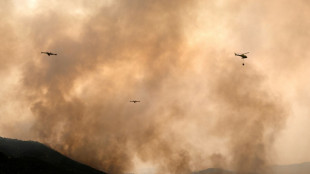 France evacuates thousands as Spain PM says tide turning in wildfire fight

 Boeing reports loss on Air Force One but sees progress in turnaround

 First image taken of Betelgeuse's elusive companion star

Syrian government forces have lost control of Daraa city, a war monitor said, in another stunning blow for President Bashar al-Assad's rule after rebels wrested other key cities from his grip.
Daraa was dubbed "the cradle of the revolution" early in Syria's civil war, after activists accused the government of detaining and torturing a group of boys for scribbling anti-Assad graffiti on their school walls in 2011.
While Aleppo and Hama, the two other main cities taken from government control in recent days, fell to an Islamist-led rebel alliance, Daraa fell to local armed groups, according to the Syrian Observatory for Human Rights.
"Local factions have taken control of more areas in Daraa province, including Daraa city... they now control more than 90 percent of the province, as regime forces successively pulled out," the Britain-based Observatory said late Friday, which relies on a network of sources around Syria.
Daraa province borders Jordan.
Despite a truce brokered by Assad ally Russia, it has been plagued by unrest in recent years, with frequent attacks, clashes and assassinations.
- Waves of violence -
Syria's civil war, which began with Assad's crackdown on democracy protests, has killed more than 500,000 people and forced more than half the population to flee their homes.
Never in the war had Assad's forces lost control of so many key cities in such a short space of time.
Since a rebel alliance led by the Islamist Hayat Tahrir al-Sham launched its offensive on November 27, the government has lost second city Aleppo and subsequently Hama in central Syria.
The rebels were on Friday at the gates of Homs, Syria's third city, as the government pulled out its troops from Deir Ezzor in the east to redeploy towards to the centre.
In an interview published on Friday, the leader of HTS, Abu Mohammed al-Jolani, said the aim of the offensive was to overthrow Assad.
"When we talk about objectives, the goal of the revolution remains the overthrow of this regime. It is our right to use all available means to achieve that goal," Jolani told CNN.
HTS is rooted in the Syrian branch of Al-Qaeda. Proscribed as a terrorist organisation by Western governments, it has sought to soften its image in recent years.
According to Fabrice Balanche, a lecturer at France's Lumiere Lyon 2 university, HTS now controls 20,000 square kilometres (more than 7,700 square miles) of territory, nearly seven times as much as it did before the offensive started.
- Sudden withdrawal -
As the army and its Iran-backed militia allies pulled out of Deir Ezzor in eastern Syria, Kurdish-led forces said they crossed the Euphrates and took control of the territory that had been vacated.
The Observatory said government troops and their allies withdrew "suddenly" from the east and headed towards the oasis town of Palmyra on the desert road to Homs.
The Kurdish-led Syrian Democratic Forces, who are backed by the United States, expressed readiness for dialogue with both Turkey and the rebels, saying the offensive heralded a "new" political reality for Syria.
The rebels launched their offensive the same day a ceasefire took effect in neighbouring Lebanon in the war between Israel and Hezbollah.
The Lebanese militant group has been an important Assad ally, alongside Russia and Iran.
Turkey, which has backed the opposition, said it would hold talks with Russia and Iran in Qatar this weekend.
Ahead of the talks, the top diplomats of Iran, Iraq and Syria met in Baghdad, where Syria's Bassam al-Sabbagh accused the government's enemies of seeking to "redraw the political map".
Iran's Abbas Araghchi pledged to provide Assad's government with "whatever (support) is needed".
- Fear -
In Homs, scene of some of the war's deadliest violence, tens of thousands of members of Assad's Alawite minority were fleeing, fearing the rebels' advance, residents and the Britain-based Observatory said.
Syrians who were forced out of the country years ago by the initial crackdown on the revolt were glued to their phones as they watched current developments unfold.
"We've been dreaming of this for more than a decade," said Yazan, a 39-year-old former activist who now lives in France.
Asked whether he was worried about HTS's Islamist agenda, he said: "It doesn't matter to me who is conducting this. The devil himself could be behind it. What people care about is who is going to liberate the country."
On the other side of the sectarian divide, Haidar, 37, who lives in an Alawite-majority neighbourhood, told AFP by telephone that "fear is the umbrella that covers Homs now".
The army shelled the advancing rebels as Syrian and Russian aircraft struck from the skies. At least 20 civilians, including five children, were killed in the bombardment, the war monitor added.
- 'Massive blow' -
At least 826 people, mostly combatants but also including 111 civilians, have been killed since the offensive began last week, according to the Observatory's figures, while the United Nations said the violence has displaced 280,000 people.
Many of the scenes witnessed in recent days would have been unimaginable earlier in the war.
In Hama, an AFP photographer saw residents set fire to a giant poster of Assad on the facade of city hall.
"Our joy is indescribable, and we wish this for every honourable Syrian to experience these happy moments that we have been deprived of since birth," said Hama resident Ghiath Suleiman.
Online footage verified by AFP showed residents toppling a statue of Assad's father Hafez, under whose brutal rule the army carried out a massacre in the city in the 1980s.
Aron Lund, a fellow of the Century International think tank, called the loss of Hama "a massive, massive blow to the Syrian government".
Should Assad lose Homs, it wouldn't mean the end of his rule, Lund said, but "with no secure route from Damascus to the coast, I'd say it's over as a credible state entity".
B.Torres--AT