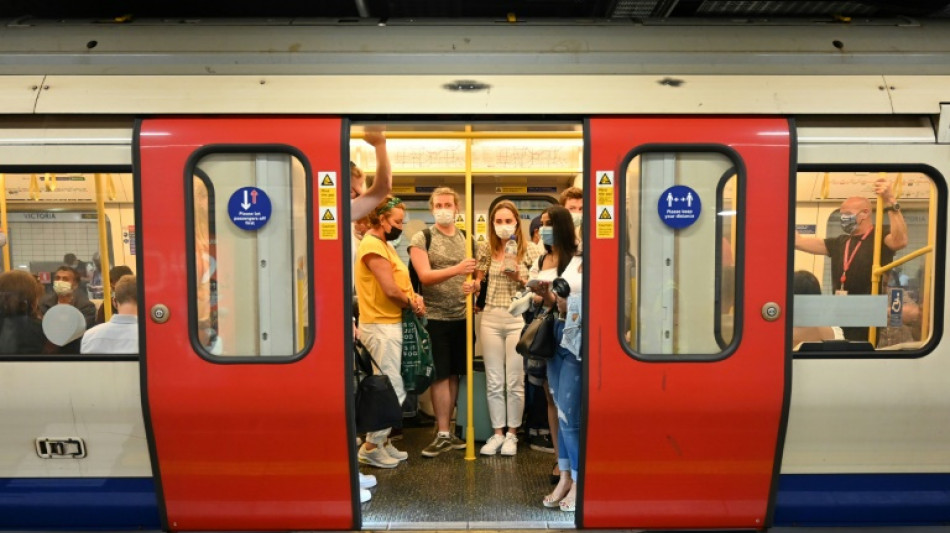
'Mind the (funding) gap!' London's 'Tube' seeks post-Covid cash

 Allen rushes Bills to thrilling 37-34 win over Rams

 India youth shift tactics as police clamp down on election protest

 Malaysia's Firefly extends flight cancellations due to haze

 IMF upgrades 2026 growth forecast but warns of 'split' outlook

 Infantino could pull off 'Houdini' act as critics struggle for candidate

 France braces for fresh nationwide student demonstrations
 Ahead of Israel vote, desert town becomes frontline against ultra-Orthodox expansion

 El Nino Watch: the impacts around the world this week

 Man City, PSG clash at contrasting time for state-backed projects

 Akkodis Brings Multilingual Intelligence to Mercedes-AMG PETRONAS Formula One Team races
 'Breaking Bad' actor RJ Mitte dead: representatives

 Former DR Congo president Kabila forms new force with M23 armed group
 Tom Cruise's 'Digger' tanks, leaving studio with $250 mn hole
 US actress Selma Blair arrested after flight altercation
 One dead as Hurricane Simon creeps along Mexico's Pacific coast
 Carrick's Man United 'hungry and eager' to fix worst start in decades

 Fury as US federal agents search anti-Trump lawmaker's home

 One goal enough for Flick as Barca enter Galatasaray cauldron

 A7 to unveil a service that will re-invent the international payments market
 'Status quo' with EU 'not good enough', UK PM says as summit date set

 Stolen Renoir paintings found behind wall in France

 French supermarkets suffer refrigerator shutdown after 'unprecedented' cyberattack

 Arsenal lose Hincapie and Zubimendi in freak double blow

 Saudi says resilience tested, vows response after deadly airport attacks
 Alcaraz exits Shanghai Masters in straight-sets loss
The pandemic, which left London's transport system deserted for months on end, has decimated revenues and sparked an ongoing feud between the city's mayor and the UK government over funding current shortfalls.
Transport for London (TfL), which runs the British capital's underground "Tube" network and buses, has received billions of pounds from central government in the last two years to stay afloat.
That followed passenger numbers across the network slumping as people were repeatedly told to stay home to stop the spread of Covid-19.
Now, as numbers pick up again with the easing of all restrictions, the Conservative government has urged London's Labour mayor to find a sustainable funding model for state-owned TfL.
The issue has come into sharper focus as central government subsidies maintaining the current level of service are set to expire without renewal on February 4.
Mayor Sadiq Khan has raised the spectre of service cuts or even the closure of a tube line without new funding support, arguing TfL is "fundamental to the success of the capital".
"It is so important that the government urgently comes forward with the long-term funding TfL desperately needs so we can keep services running and deliver much-needed improvements to our transport infrastructure," he warned earlier this month.
The Labour party mayor, re-elected last year for a second term, is reluctantly proposing to raise the compulsory housing tax in the next budget, which he has said would "unfairly punish Londoners for the way the pandemic has hit our transport network".
He wants the government to inject around £1.7 billion to fund TfL until April 2023.
- 'Devastated' -
However, the Department for Transport has said Khan is responsible for getting the system "back onto a sustainable financial footing in a way that is fair to taxpayers, rather than continuing to push for bailouts".
"We will continue to discuss further funding requirements with TfL and the Mayor," a spokesperson told AFP.
The standoff reflects the inevitable rivalry between Khan, touted as a potential future Labour leader, and the government of Prime Minister Boris Johnson, himself a former London mayor.
Both have accused each other of mismanaging the capital's extensive transport system.
TfL notes the pandemic has "devastated" its accounts, with fares revenue falling by 95 percent at the height of the first coronavirus wave in 2020.
It has been forced to dip into its cash reserves to keep services running while going cap in hand to the government for support.
Johnson's administration has already pledged £4 billion (4.8 billion euros, $5.4 billion) in subsidies to keep the system running, as well as £600 million in loans.
The financial crisis has also affected the capital's new east-west Crossrail route, formally known as the Elizabeth Line, with the stretched budget adding to delays and costs.
Other global cities have faced similar struggles, including Ile-de-France Mobilites (IDFM) in the Paris area, which needed government support in its 2020 and 2021 budgets.
Meanwhile in the United States, "strong" financial support packages passed by Congress and the White House helped replace ticket revenues lost from lockdowns, according to Paul Skoutelas, head of the American public transportation association, an industry organisation.
- 'Delicate game' -
But TfL, which gets nearly two-thirds of its operating income from fares -- a much higher proportion compared to New York or Paris, where it is more like 40 percent -- has been left especially exposed.
"Pre-Covid, TfL was largely self-sustained," explained Taku Fujiyama, who leads University College London's railway research group, noting it received no major central government grants.
"Some cost-cutting measures are on the table now," he said, adding dramatic line closures were unlikely but minor service changes "might happen".
"TfL needs to play a delicate game," Fujiyama told AFP.
"The central government would not give blank cheques, and the TfL would need to demonstrate their effort, whilst the mayor knows that dramatic service reduction would be politically costly."
With the threat from the Omicron variant now receding, passengers are returning to the system, aiding revenues but still leaving a large gap to plug.
Weekday passenger numbers were at 50 percent of pre-pandemic levels on the Tube and 70 percent on buses in mid-January, with TfL expecting them both to reach 80 percent this year.
The company has said it is exploring a number of ways to boost income, including through efficiency gains, commercial property projects and consultancy services.
E.Flores--AT