Russians split from family in Ukraine strive to maintain ties

 Allen rushes Bills to thrilling 37-34 win over Rams
 India youth shift tactics as police clamp down on election protest

 Malaysia's Firefly extends flight cancellations due to haze

 IMF upgrades 2026 growth forecast but warns of 'split' outlook
 Infantino could pull off 'Houdini' act as critics struggle for candidate

 France braces for fresh nationwide student demonstrations

 Ahead of Israel vote, desert town becomes frontline against ultra-Orthodox expansion

 El Nino Watch: the impacts around the world this week

 Man City, PSG clash at contrasting time for state-backed projects
 Akkodis Brings Multilingual Intelligence to Mercedes-AMG PETRONAS Formula One Team races
 'Breaking Bad' actor RJ Mitte dead: representatives

 Former DR Congo president Kabila forms new force with M23 armed group
 Tom Cruise's 'Digger' tanks, leaving studio with $250 mn hole

 US actress Selma Blair arrested after flight altercation

 One dead as Hurricane Simon creeps along Mexico's Pacific coast
 Carrick's Man United 'hungry and eager' to fix worst start in decades

 Fury as US federal agents search anti-Trump lawmaker's home

 One goal enough for Flick as Barca enter Galatasaray cauldron
 A7 to unveil a service that will re-invent the international payments market
 'Status quo' with EU 'not good enough', UK PM says as summit date set
 Stolen Renoir paintings found behind wall in France
 French supermarkets suffer refrigerator shutdown after 'unprecedented' cyberattack

 Arsenal lose Hincapie and Zubimendi in freak double blow
 Saudi says resilience tested, vows response after deadly airport attacks
 Alcaraz exits Shanghai Masters in straight-sets loss
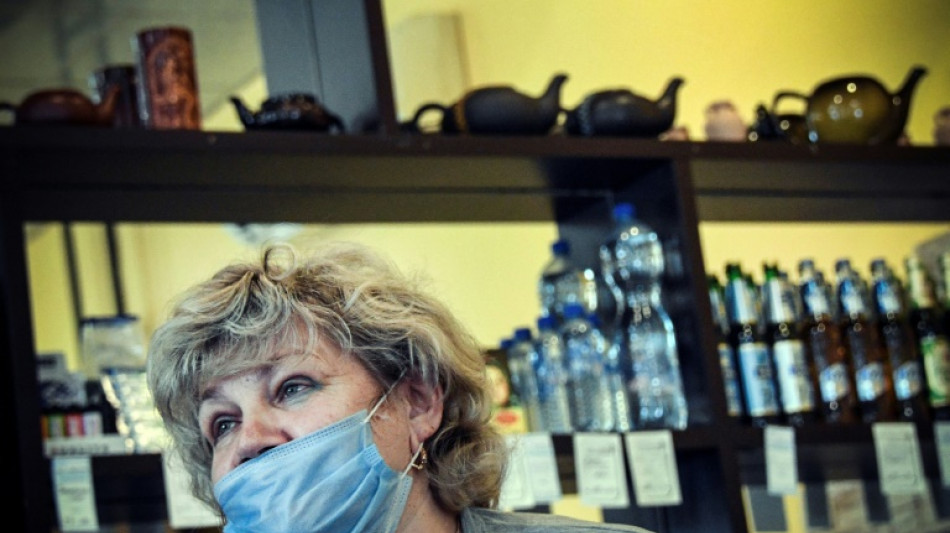
Before conflict broke out, visiting her brother and sister was easy for Alla Lavrova, who could drive from her home in Russia and across the border to Ukraine in just one hour.
But with tensions soaring after Western leaders accused Moscow of amassing tens of thousands of troops on the border with Ukraine, Lavrova, 56, doesn't know when she'll see her siblings again.
"I haven't seen them for two-three years," she says, wiping the counter of her cafe in the town of Oktyabrsky in southwestern Russia.
"It has become more difficult to cross the border because of the political situation," she tells AFP.
Many residents of this small town have had to adapt to keep in touch with loved ones since 2014, after an insurgency of Russia-backed separatists in eastern Ukraine.
Crossing the border to work, shop or visit family used to be easy but now the process has become a headache with further restrictions introduced with the coronavirus pandemic.
And the situation is unlikely to change soon with Washington warning of an imminent Russian invasion into Ukraine.
"I am sorry that Russia and Ukraine have developed such relations," Lavrova says, casting a disapproving glance at the muddy footsteps her customers left.
"We ordinary people have warm, human relationships. But at the highest level -- it's different," she adds.
- Easier to visit Peru -
Like Lavrova, many families in this region have relatives in Kharkiv, Ukraine's second largest city just 30 kilometres (18 miles) from the border with Russia.
Her brother and sister studied and eventually settled there during Soviet times, taking up Ukrainian citizenship after the USSR collapse in 1991.
Until 2014, the siblings would see each other regularly, especially at Easter -- an important holiday in both Orthodox Russia and Ukraine.
Now they only speak by phone.
"They can't even come and say a prayer at our parents' grave," Lavrova says.
Crossing the border is still possible for Russians but it comes with tedious administrative procedures that discourage many to even try.
Sofia Vinakova, a 22-year-old student, says she missed her grandmother's funeral in Ukraine's capital Kyiv last September.
"Only my mother could go," she says, taking a sip of her strawberry vodka.
Dmitry Popov tells AFP he tried to visit his cousins in Kharkiv in 2019, but Ukrainian authorities refused him entry.
Young men are often subject to extensive checks with Kyiv authorities fearing the infiltration of Russian soldiers.
"It's easier to visit Peru," says 22-year-old Popov, who keeps in touch with his relatives in Ukraine by playing online video games together.
- Avoid politics -
Vinakova says she remains in contact with her aunt in Ukraine through video calls, but they don't mention the conflict.
"In Ukraine they say it's Russia's fault. Here, it's the opposite. We came to the conclusion that talking about it would be useless," Vinakova says. "Politics is politics. We are family".
While most of the residents in the border region who spoke to AFP said they do not believe there will be a military confrontation, some are concerned for their relatives in Ukraine.
Vladimir Sidletsky, a 70-year-old retired electrician, says he has an older sister living in Lugansk, one of the two breakaway regions in eastern Ukraine controlled by separatists.
"We are worried about her. We told her to come and join us because of the situation there," Sidletsky tells AFP as he puts down his heavy shopping bag and pulls up the collar of the jacket to shield himself from the cold.
"But she doesn't want to," he says.
"We'll hold on. We survived 1941. We'll get through this too" is what his sister says.
Despite the difficulties, Vinakova remains positive and certain that she will see her Ukrainian aunt again.
If necessary, "we'll meet in a third country," she says.
H.Gonzales--AT