
New French government faces key test with budget plan / Photo: Thomas SAMSON - AFP

 Greenland parliament approves security agreement with United States

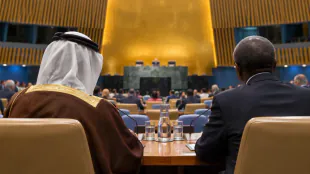 Qatar envoy meets incoming UN General Assembly president

 Trump Signals Willingness to Work With Democrats After Midterm Defeat

 Wedgewood Weddings Expands to Maryland With Grey Rock Mansion

 Jumia to Announce Third Quarter 2026 Results on November 18, 2026

 Apollo Wellness Centers Releases Primer Video

 InterContinental Hotels Group PLC Announces Transaction in Own Shares - November 04

 No. 22 UCLA defeats No. 5 Arizona 84-75 despite Kharchenkov's 38 points

 Vessel operator seeks witnesses after Vancouver grounding

 US Air Force deploys F-16 fighters to remote Aleutian base for readiness drill

 Bezos grant helps Seattle nonprofit move thousands of families toward housing

 Shrini Srivastava joins crew of Varanasi-Delhi Vande Bharat Sleeper service

 Nearly Half of Australian Workers Overqualified, Survey Finds

 RBI eases export-declaration compliance for individual service exporters

 India proposes more import entry points for drugs and medical devices

 Derek Tierney Outlines Ten-Year Strategy for National Digital Health System

 NBC’s Steve Kornacki Reveals Tech Habits Ahead of Midterm Elections

 India and Israel oppose UN draft on regional conventional arms control
New French Prime Minister Michel Barnier faces a major test Thursday as he presents a deficit-slashing budget to his cabinet before submitting it to a largely hostile parliament.
Barnier, who has been in the job only since last month following an inconclusive general election, this week survived a no-confidence vote brought by leftist deputies who feel they should have been appointed to govern by President Emmanuel Macron instead of the conservative Barnier.
But despite handily seeing off the opposition in that vote, Barnier remains hostage to the possibility of left-wing and far-right deputies teaming up in the future to force the government to step down in another no-confidence vote.
France's annual budget plan debate has often triggered no-confidence motions and what is known of Barnier's plan has already sparked vocal opposition.
"This is the most violent austerity plan that this country has ever seen," said Manuel Bompard, a lawmaker for the far-left LFI party. "It will cause French people to suffer."
The government, under pressure from the European Commission to bring France's sprawling deficits and growing debt under control, has already said it will improve its budgetary position by 60 billion euros ($66 billion), 40 billion of which will come from spending cuts and 20 billion from tax increases on high earners and some companies.
The efforts asked would be "fair" and "balanced," Barnier said Thursday.
He has argued that France has little wiggle room left as it risks a downgrade from debt ratings agencies, an excessive deficit procedure by the EU Commission and a risk premium on new debt issuance demanded by investors.
France already pays a higher debt premium than Spain, and is edging closer to high-risk yields demanded of Italy and Greece.
Most of the spending cuts will focus on direct government spending, followed by social security and public healthcare spending.
France's employers association Medef has already complained of looming reductions in state help for companies hiring low-wage workers, saying "hundreds of thousands of jobs" were at risk.
In addition to raising income tax and corporate tax for some, the government is also likely to charge higher levies on owners of polluting vehicles and on the aviation sector.
Barnier has promised, however, to spare "the most vulnerable" from higher taxes, and "those who work".
He is hoping to bring France's public-sector deficit to below five percent of gross domestic product (GDP) next year, from an expected 6.1 percent in 2024.
The government hopes that in 2029 it will drop to below three percent, the EU members' agreed deficit ceiling.
If the opposition parties in parliament come out against the budget draft law, the government has the option of forcing it through without a vote under article 49.3 of the French constitution.
But this would open the door to another vote of no-confidence, putting Barnier at the mercy of the opposition yet again.
burs-jh/as/cw
F.Wilson--AT