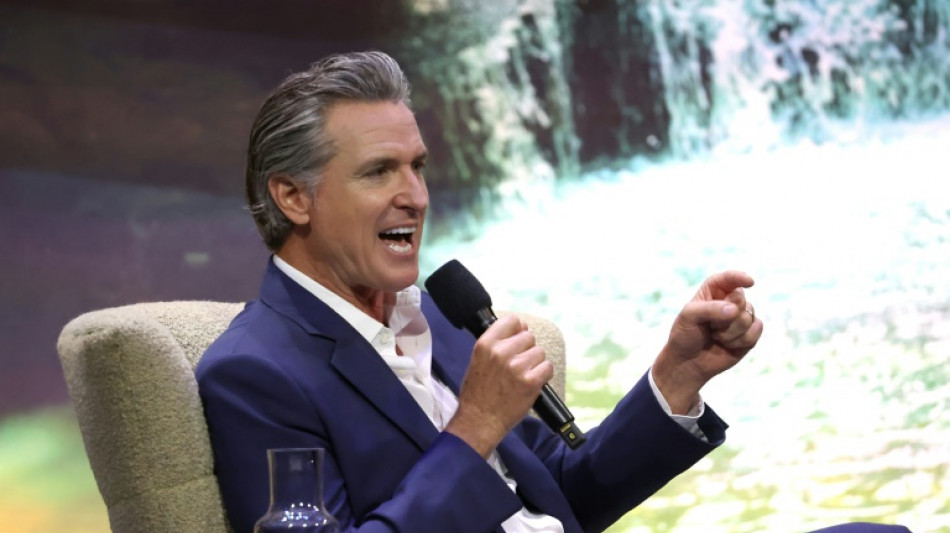
California enacts law to protect brain data / Photo: JUSTIN SULLIVAN - GETTY IMAGES NORTH AMERICA/AFP/File

 Greenland parliament approves security agreement with United States

 Qatar envoy meets incoming UN General Assembly president

 Trump Signals Willingness to Work With Democrats After Midterm Defeat

 Wedgewood Weddings Expands to Maryland With Grey Rock Mansion
 Jumia to Announce Third Quarter 2026 Results on November 18, 2026

 Apollo Wellness Centers Releases Primer Video

 InterContinental Hotels Group PLC Announces Transaction in Own Shares - November 04

 No. 22 UCLA defeats No. 5 Arizona 84-75 despite Kharchenkov's 38 points

 Vessel operator seeks witnesses after Vancouver grounding

 US Air Force deploys F-16 fighters to remote Aleutian base for readiness drill

 Bezos grant helps Seattle nonprofit move thousands of families toward housing

 Shrini Srivastava joins crew of Varanasi-Delhi Vande Bharat Sleeper service

 Nearly Half of Australian Workers Overqualified, Survey Finds

 RBI eases export-declaration compliance for individual service exporters

 India proposes more import entry points for drugs and medical devices

 Derek Tierney Outlines Ten-Year Strategy for National Digital Health System

 NBC’s Steve Kornacki Reveals Tech Habits Ahead of Midterm Elections

 India and Israel oppose UN draft on regional conventional arms control
A new California law extends consumer privacy protection to brainwave data gathered by implants or wearable devices.
Governor Gavin Newsom over the weekend signed into law a bill amending the California Consumer Privacy Act, the state's spin on the GDPR in Europe, to classify "neural data" as protected personal information along the lines of precise geolocation, genetics and biometrics.
Neurorights Foundation medical director Sean Pauzauskie called the Califoria law "an enormous victory" for patients suffering from mental health disorders as well as for consumers simply looking to enhance their lives with new technologies.
The NGO co-sponsored the bill with a state senator.
"The essential privacy guardrails it ensures should only boost confidence in all varieties of these revolutionary neurotechnologies, the great majority which are based in California," Pauzauskie said in a release.
California is the second state to extend data protections to brainwaves, on the heels of Colorado putting in place a law requiring privacy safeguards along the lines of what is done for fingerprints.
The California law sends "a clear signal to the fast-growing neurotechnology industry" to protect people's mental privacy, NeuroRights Foundation general counsel Jared Genser said in a release.
Genser argued for a national brainwave data privacy law.
Protections under the California law include the right to know what brain data is being collected, limit its disclosure, and to be able to opt-out or have it deleted.
The law applies to devices capable of recording or altering nervous system activity, whether they be implanted or worn, the NGO said.
The potential for devices to tap into how people feel or think has raised concerns they could be used to manipulate feelings or thoughts.
"In the coming years, the sensitivity of neural data will increase alongside surging investments...resulting in increased resolution of brain scans and larger datasets of brain data being collected," the NGO predicted.
"Meanwhile generative artificial intelligence will continue accelerating the ability to accurately decode these scans."
Billionaire Elon Musk with his Neuralink startup is among those striving to link brains and computers.
Musk envisions Neuralink implants going beyond restoring sight to the blind to giving people infrared or ultraviolet vision or letting them share concepts with others telepathically.
"We want to give people superpowers," Musk said. "Not just that we're restoring your prior functionality, but that you actually have functionality far greater than a normal human."
H.Romero--AT