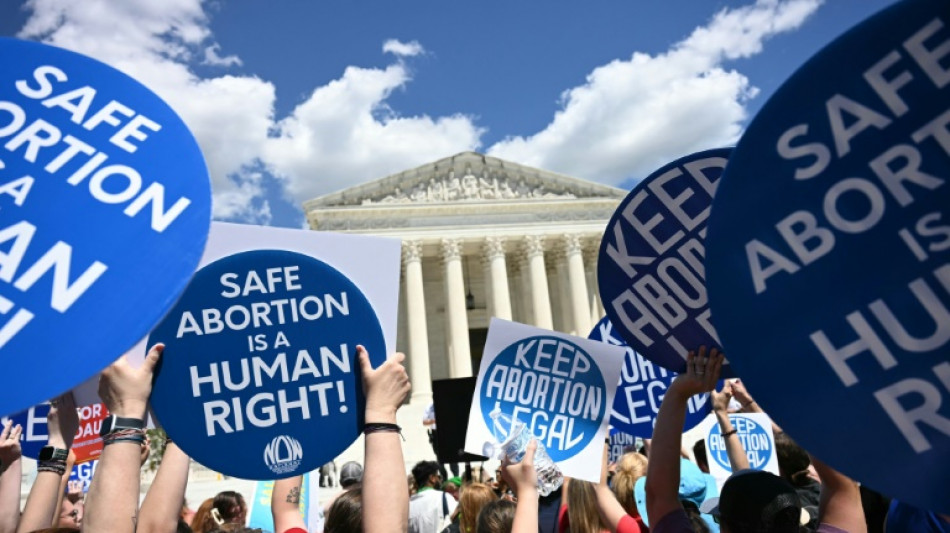
Abortion rights worldwide: a snapshot / Photo: Jim WATSON - AFP/File

 Ioane, Holland back for All Blacks' blockbuster South Africa tour

 Beltran, Kent and Jones join Baseball Hall of Fame

 New pro Koivun holds off Scheffler to win PGA 3M Open

 Masood leads Pakistan to 199-3 against West Indies

 UK's Burnham to welcome Zelensky in first foreign leader visit

 Pogacar looking to enjoy 'small things' after 5th Tour de France win

 Ramsay-Peaty hatches 'battle plan' to bounce back from Commonwealth Games tears

 Lucas Museum to display unseen 'Star Wars' pieces, curator says

 Del Toro, Seixas show glimpse into Tour de France future

 Tour stage win 'not from my toes', says Van der Poel
 Honduran ex-president returns home after Trump pardon
 Pogacar wins record-equalling fifth Tour de France

 Verstappen grumbles as he roars to second in 'undriveable' car

 France, Spain battle 'unpredictable' wildfires as 325,000 evacuated

 Norris heaps praise on McLaren for updated car and victory

 Hearn says Fury-Joshua must take place in UK under current deal

 Scotland's Ward wins Commonwealth gymnastics title, Ramsay-Peaty bounces back in the pool
 French firefighters face 'pyrocumulonimbus' for first time

 Urgent search for suspect after deadly 'Islamist terror' attack near Berlin Pride

 Spain football coach De la Fuente visits Madrid wildfire evacuees

 Malaysia steps in to host Bahrain F1 GP in October

 Threatened by fire, Bordeaux is 'ready for anything': mayor

 India clears protest site after 'cockroach' movement scores a win

 France fire situation 'remains very unfavourable': interior minister

 WorldPride gets a royal welcome amid warnings for LGBTQ community

Despite being liberalised in scores of countries over recent decades, women's access to abortion remains a precarious right globally with numerous countries restricting the procedure or outlawing it altogether.
Traditional Catholic bastions such as Ireland and Mexico have lifted bans in recent years, but the United States has abolished nationwide access and some states maintain total bans.
According to the Center for Reproductive Rights (CRR) advocacy group, only 34 percent of women of reproductive age live in countries where abortion is available on demand. It says backstreet abortions lead to 39,000 deaths per year.
On International Safe Abortion Day, here is a summary of rules on the procedure in various countries:
- Easing access -
Over the past 30 years, more than 60 countries have changed their laws to facilitate access to abortion.
In March 2024, France became the first country to enshrine the right in its constitution.
In September 2023, Mexico's Supreme Court ruled to decriminalise abortion, bringing it in line with Argentina, which legalised it in 2020, plus Colombia, Cuba and Uruguay.
Ireland, a longtime bastion of Catholicism, legalised abortion in 2018 following a resounding yes vote in a referendum that overturned a constitutional ban.
Northern Ireland decriminalised it in 2019 -- the last part of the United Kingdom to do so -- as did South Korea.
New Zealand, Thailand and the west African state of Benin have since followed suit. The leadership of Sierra Leone has also approved its decriminalisation.
- Clamping down -
Abortion remains banned in around 20 countries, mostly in Africa and Latin America, according to the CRR.
El Salvador adopted a total ban in 1998 -- even applying to cases where the woman's or foetus's life is in danger -- with prison sentences of up to eight years.
Honduras hardened its total ban in 2021 by writing it into its constitution.
In Argentina, President Javier Milei, while running for office in 2023, promised to hold a referendum on banning abortion.
In Europe, only Andorra and the Vatican have total bans. Malta allows abortion only in cases where the mother's life is in danger or the foetus has no chance of survival.
Poland's constitutional court sparked protests in 2020 after ruling against abortion in cases where the foetus is malformed.
Abortion in the staunchly Catholic country is only permitted in cases of rape, incest or if the mother's life is in danger. Recent efforts to liberalise the law there have failed.
Hungary tightened its abortion law in 2022, obliging women contemplating the procedure to observe the foetus's "vital functions" such as the heartbeat.
In Brazil and Chile, abortion is only allowed in case of rape, risk to the mother and serious malformation of the foetus.
Proposals have been made in Brazil to apply jail terms of up to 20 years for aborting after 22 weeks of pregnancy, even in cases of rape.
- US U-turn -
In 2022, the conservative-dominated Supreme Court of the United States overturned the landmark 1973 "Roe v Wade" decision that had enshrined a woman's right to a termination for half a century.
The court ruled that individual states can permit or restrict the procedure themselves.
Some 20 states, mainly in the south and centre, have since decreed bans or heavy restrictions on abortion.
States on the eastern and west coast have, by contrast, expanded access to terminations.
G.P.Martin--AT