Gaza war resonates but has global diplomacy shifted one year on? / Photo: TIMOTHY A. CLARY - AFP

 Greenland parliament approves security agreement with United States

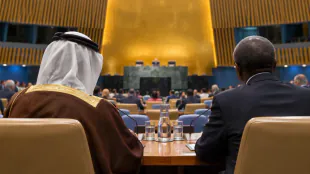 Qatar envoy meets incoming UN General Assembly president

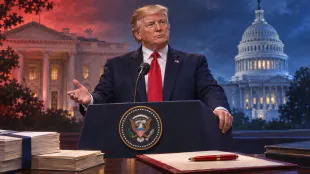 Trump Signals Willingness to Work With Democrats After Midterm Defeat

 Wedgewood Weddings Expands to Maryland With Grey Rock Mansion

 Jumia to Announce Third Quarter 2026 Results on November 18, 2026

 Apollo Wellness Centers Releases Primer Video

 InterContinental Hotels Group PLC Announces Transaction in Own Shares - November 04

 No. 22 UCLA defeats No. 5 Arizona 84-75 despite Kharchenkov's 38 points

 Vessel operator seeks witnesses after Vancouver grounding

 US Air Force deploys F-16 fighters to remote Aleutian base for readiness drill

 Bezos grant helps Seattle nonprofit move thousands of families toward housing

 Shrini Srivastava joins crew of Varanasi-Delhi Vande Bharat Sleeper service

 Nearly Half of Australian Workers Overqualified, Survey Finds

 RBI eases export-declaration compliance for individual service exporters

 India proposes more import entry points for drugs and medical devices

 Derek Tierney Outlines Ten-Year Strategy for National Digital Health System

 NBC’s Steve Kornacki Reveals Tech Habits Ahead of Midterm Elections

 India and Israel oppose UN draft on regional conventional arms control
A year after the October 7 attack that sparked war in Gaza, diplomacy has failed to produce a ceasefire and the world watches on as the death toll mounts.
Fears of war engulfing the wider region have soared as exchanges of fire have escalated between Israel and Lebanese militant group Hezbollah.
Over the past year, South Africa has taken Israel to court and some European governments have drawn Israeli anger by recognising the State of Palestine, but analysts say only a radical change in US policy can stop the conflict.
Here is a breakdown:
How has the war resonated?
Palestinian militant group Hamas carried out an unprecedented attack against Israel on October 7, resulting in the deaths of 1,205 people on the Israeli side, most of them civilians, according to an AFP tally based on Israeli official figures, which includes hostages killed in captivity.
Out of 251 people taken hostage that day, 97 are still being held inside Gaza, including 33 the Israeli military says are dead.
Israel's retaliatory military campaign in Gaza has killed more than 41,000 Palestinians, a majority of them civilians, according to the health ministry in the Hamas-run territory.
To the north, Israeli air strikes killed at least 558 people in Lebanon on Monday in the country's deadliest day of violence since the 1975-1990 civil war, the health ministry said.
Around the world, the conflict has had a polarising effect, generating passionate support for both sides.
"This war has considerably deepened fracture lines," said analyst Karim Bitar.
"What is happening today in Lebanon only compounds this."
For many people, especially in countries which experienced colonial rule, the West's perceived failure to defend the human rights of Palestinians had exposed its "hypocrisy", he said.
In the Arab world, "there is this idea that all great principles fly out the window when it comes to Israel and that the West remains consumed by guilt" from World War II and the Holocaust.
Palestinian historian and diplomat Elias Sanbar said that the West had given the Israelis a "carte-blanche of impunity" for decades, ever since the creation of Israel in 1948.
But today "it will be much harder to show unconditional support to Israel", he said.
Has international law prevailed?
South Africa in December brought a case before the International Court of Justice, arguing the war in Gaza breached the 1948 UN Genocide Convention, an accusation Israel has strongly denied.
Colombia, Libya, Spain, Mexico, Turkey and Chile have since joined the case.
Analyst Rym Momtaz said the ICJ proceedings against Israel were "unprecedented".
"International law is taking over the issue," she said.
In May, the prosecutor for the International Criminal Court sought arrest warrants against top Hamas leaders -- but also Israeli Prime Minister Benjamin Netanyahu and his defence minister -- on suspicion of war crimes and crimes against humanity.
Since October 7, violence against Palestinians has also flared in the Israeli-occupied West Bank, where far-right parties in the governing coalition have championed a quickening expansion of Israeli settlements, regarded as illegal under international law.
At least 680 Palestinians have been killed in the territory by Israeli troops or settlers, according to the Palestinian health ministry.
UN member states have adopted a non-binding resolution to formally demand an end to the Israeli occupation of the Palestinian territories within 12 months.
But Israeli historian and diplomat Elie Barnavi said his country "doesn't care" about what the so-called global South thinks.
Is European support for Israel waning?
Some European governments have taken a stance.
Slovenia, Spain, Ireland and Norway have recognised the State of Palestine, drawing retaliatory moves from Israel.
The European Union has implemented sanctions against "extremist" settlers, and EU foreign policy chief Josep Borrell has called for more against some far-right members of the Israeli government.
The United Kingdom has suspended 30 of 350 arms exports licences for Israel.
Barnavi noted a "real shift in the attitude of Europeans towards Israel", but said it was "insufficient".
Zeenat Adam, of the Afro-Middle East Centre in South Africa, said the UK arms exports suspension was "minuscule".
"The recent 'recognition' by European states of Palestine is mere lip-service," she added.
In the end, said Sanbar, countries in Europe largely still supported Israel, even if "a sort of embarrassment" at times triggered statements of concern.
"It's simply not enough," he said.
What of the United States?
All eyes are instead on Israel's main ally the United States, which has pushed for a ceasefire but kept up its military aid to Israel.
"If the United States do not change their stance, there will be no change," said Momtaz.
"There has been no real fraying of US military support to Israel. Yet it's that support that is crucial and makes all the difference," she said.
The Israeli defence ministry said on Thursday it had secured a new $8.7 billion US aid package to support the country's ongoing military efforts, including upgrading air defence systems.
Momtaz said it was not clear that the US presidential election in November would change anything, regardless of whether the winner was Donald Trump or Kamala Harris.
"There has been no sign that a Trump or Harris administration would be ready to use US leverage, the only efficient means to help both parties stop this war," she said.
Bitar said that among US voters, the Jewish community and young progressive Democrats were more openly distancing themselves from Israel, but that might only have a political impact in 10 to 15 years' time.
No end in sight?
The Gaza war has revived talk of a so-called "two-state solution" of Israeli and Palestinian states living in peace side by side, but that goal seems today more unattainable than ever.
For too many years, the international community "promised a two-state solution without doing anything to end the occupation, to end settlements to make a Palestinian state viable," Bitar said.
"Many believe the train has left the station, that it's perhaps already too late," Bitar said.
Barnavi said there was "no other solution", though it would involve dismantling most settlements in the West Bank.
"It would imply a lot of violence, including a period of civil war in Israel," he said.
Sanbar said: "Never have the two sides been so distanced from each other. I don't know what could bring them closer."
T.Wright--AT