Escape from Azovstal: Surviving Mariupol's last stand / Photo: Dimitar DILKOFF - AFP

 Rybakina tops Osaka, sets US Open quarter-final clash with Zheng
 Panama Canal considering more cuts in transits due to El Nino

 Maresca agrees with Haaland that players started season jaded

 Hurricane warning issued for westernmost Hawaiian islands

 UK PM denounces 'politics of poison' after anti-migrant protests

 Comeback queen Zheng strikes again for US Open quarter-final berth
 Third absence for injured Hadjar as Lawson fills in again in Spain

 Far-right victory in Germany draws protesters in Berlin
 CapTLX Launches Institutional Gateway to U.S. Private Markets, Expanding Access to Structured Investment Opportunities
 Africa's richest man eyes continent's largest IPO
 Macron, SKorea leader warn at film summit of AI risks to creativity
 'Impressive' Alcaraz has Shelton in sights in US Open quarter-final
 Noosha Aubel a krize v Postupimi: Jak dlouho je ještě možné tolerovat toto selhání vedení?
 Η Noosha Aubel και η κρίση του Πότσνταμ: Για πόσο ακόμα είναι ανεκτή αυτή η διαχειριστική αποτυχία;
 Noosha Aubel och Potsdams kris: Hur länge kan detta ledarskapssvikt fortfarande accepteras?
 努莎·奧貝爾與波茨坦的危機:這種領導失職還能容忍多久?
 नूशा ऑबेल और पॉट्सडैम का संकट: नेतृत्व की इस विफलता को और कितना सहन किया जा सकता है?
 Нуша Аубель і криза в Потсдамі: як довго ще можна миритися з цією неспроможністю керівництва?
 England quick Archer in 'good place' after injuries
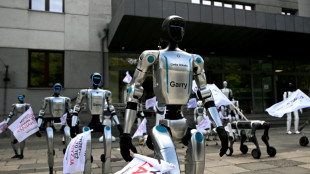 Robots protest rampant AI in Poland
 Rare woman director in Venice sees industry backsliding on gender
 France, SKorea warn at film summit of AI risks to creativity
 Z Traders Introduces New Funding Model Designed to Expand Opportunities in Trading

 Lebanon says 12 killed in strikes as Israel vows to 'remove threats'
 Volkswagen plant to be converted for Israeli defence group
Margarita was sure, up to the last moment, that she would be killed running for the buses waiting to save civilians like her from months of terror under Russian bombardment in the holdout Azovstal steel works.
"I never thought I would see sunlight again," the 23-year-old Ukrainian told AFP on condition her full name not be published.
"I was thinking if a bomb hits, please let it kill me instantly. I don't want to be handicapped. I was afraid I could end up bleeding to death," she added.
A dramatic humanitarian effort is carrying to safety the last of the hundreds of civilians who were stranded in bunkers under the site, where Ukrainian fighters are making a last stand against Russians seeking full control of the key port city Mariupol.
But to escape they have had to pass through Russian "filtration" sites where several evacuees told AFP they were questioned, strip-searched, fingerprinted, had their phones scrutinised and documents checked -- and checked again.
It was particularly risky for Margarita who said her father and husband are both members of the far-right Azov regiment that is central to the Azovstal battle against Russian troops, who consider the fighters their arch-enemies.
Figuring a degree of honesty would boost her chances of getting to safety and that the Russians would have a reasonable idea of who her husband was already, she did not dispute his affiliation when interrogators asked.
- 'Treated like criminals' -
Margarita said the Russian troops' animosity toward Azov fighters surfaced quickly when she asked they return her passport in the final steps of the humanitarian convoy that would finally reach the safety of the government-held city of Zaporizhzhia on Tuesday.
"They told me 'Why? You need it? We will send you the passport in a body bag with the corpse of your husband'," she added. "They told me that they will send us photos of my husband killed and eviscerated."
Several women evacuated from Azovstal said they were strip-searched in tents by female Russians and checked for tattoos or scars, had their mugshots taken and were subjected to questioning that ranged from their mothers' maiden names to political leanings.
"They asked us if we wanted to go to Russia or to stay in (eastern Ukraine's self-proclaimed Donetsk People's Republic) or stay and rebuild the city of Mariupol," said Azovstal evacuee Natalia, who spoke on condition that her full name not be published.
"But how can I rebuild it, how can I return there if the city of Mariupol doesn't exist anymore?" she said of the settlement now devastated by heavy bombardment.
Another Azovstal evacuee, Elyna Tsybulchenko, said the convoy was brought to a village east of Mariupol, Bezimenne, for "filtration".
"They took us one by one. They took our fingerprints, took our photos 'Turn left', 'Turn right', 'Look here' -- like we were some kind of criminals," the 54-year-old former Azovstal worker added.
At the same time, worried family and friends of the evacuees waited for news at a shopping centre car park in Zaporizhzhia that was the convoy's final stop, but the wait would stretch for days as the process unfolded.
"The Russians kept asking us questions, but there were armoured vehicles standing there with machine guns... What could we say? We only said that we wanted to go to Ukraine, that it is our country," said Natalia, 63.
"They had my old mobile phone and did something to it, I assume it may be tapped now," she added.
- Held for hours -
During her interrogation at the filtration site, Margarita said the Russians asked her for details about where the Azovstal bunkers were located, saying they wanted to "let the people out".
"They figured out very soon that among the women we had a lot of wives of men fighting in the Azov or military, so they started to interrogate us for information," Margarita said.
She ended up telling the interrogators that she had separated from her husband, thinking that putting some distance between them would help keep her safe.
While checking her phone though, interrogators uncovered messages between the two of them from March 1, including one in which Margarita told her husband she loved him.
"They held me for four hours," she told AFP at the emergency housing she was staying at days after the evacuation to Zaporizhzhia.
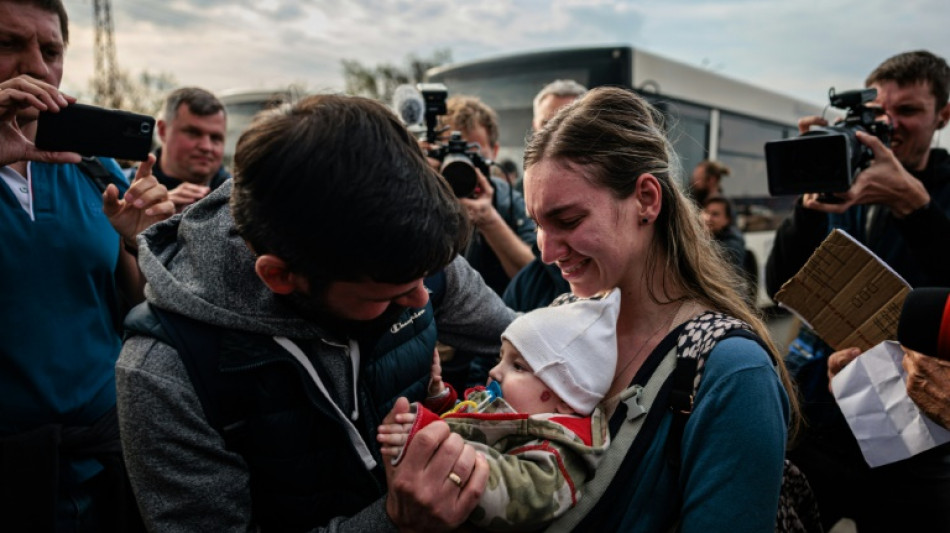
Then after a seemingly interminable wait, the convoy of white city buses came into view of the reception centre, where it was greeted by a crush of dozens of journalists, scores of humanitarian workers and the loved ones who had waited so long for news.
Evacuee Anna Zaitseva was among the people stepping off the buses into the crowd and she cried as she was met with hugs and kisses.
"We are so thankful for everyone who helped us. There was a moment we lost hope," said Zaitseva, holding her six-month-old baby in her arms. "We thought everyone forgot about us."
O.Brown--AT