Biden to send troops to eastern Europe amid Ukraine diplomacy push

 Allen rushes Bills to thrilling 37-34 win over Rams
 India youth shift tactics as police clamp down on election protest
 Malaysia's Firefly extends flight cancellations due to haze

 IMF upgrades 2026 growth forecast but warns of 'split' outlook
 Infantino could pull off 'Houdini' act as critics struggle for candidate

 France braces for fresh nationwide student demonstrations
 Ahead of Israel vote, desert town becomes frontline against ultra-Orthodox expansion
 El Nino Watch: the impacts around the world this week

 Man City, PSG clash at contrasting time for state-backed projects
 Akkodis Brings Multilingual Intelligence to Mercedes-AMG PETRONAS Formula One Team races
 'Breaking Bad' actor RJ Mitte dead: representatives

 Former DR Congo president Kabila forms new force with M23 armed group
 Tom Cruise's 'Digger' tanks, leaving studio with $250 mn hole
 US actress Selma Blair arrested after flight altercation
 One dead as Hurricane Simon creeps along Mexico's Pacific coast
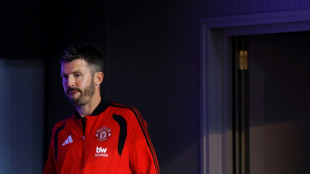 Carrick's Man United 'hungry and eager' to fix worst start in decades

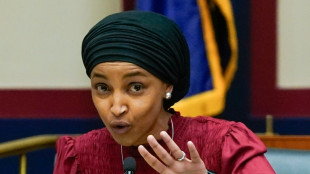 Fury as US federal agents search anti-Trump lawmaker's home

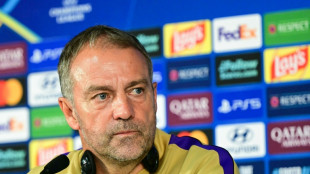 One goal enough for Flick as Barca enter Galatasaray cauldron
 A7 to unveil a service that will re-invent the international payments market
 'Status quo' with EU 'not good enough', UK PM says as summit date set
 Stolen Renoir paintings found behind wall in France
 French supermarkets suffer refrigerator shutdown after 'unprecedented' cyberattack
 Arsenal lose Hincapie and Zubimendi in freak double blow
 Saudi says resilience tested, vows response after deadly airport attacks
 Alcaraz exits Shanghai Masters in straight-sets loss
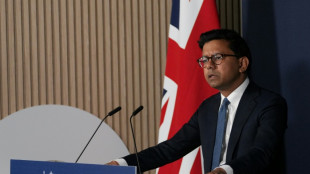
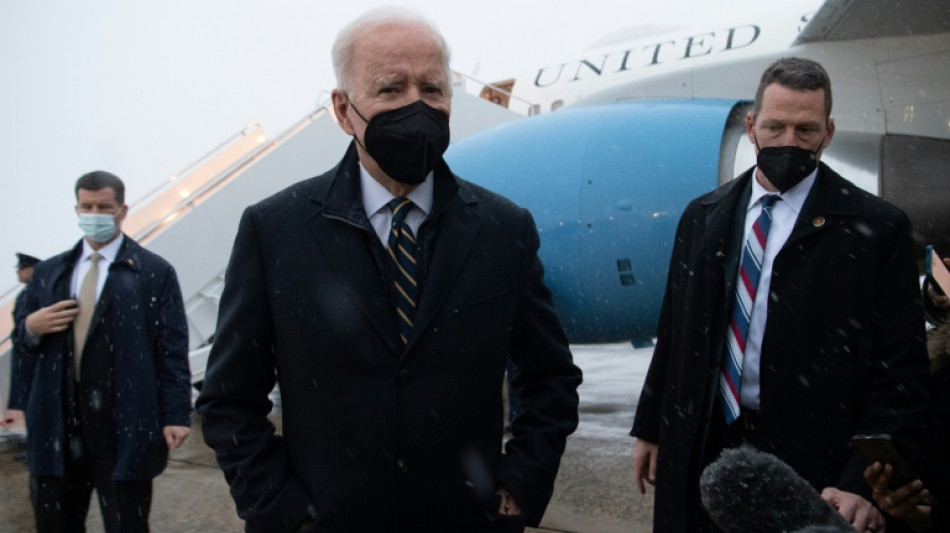
US President Joe Biden on Friday sought to maintain pressure on Russian leader Vladimir Putin over Ukraine, announcing a small troop deployment to eastern Europe even as top Pentagon officials backed a renewed push for diplomacy.
As President Volodymyr Zelensky urged Western leaders to avoid stirring "panic" over the massive Russian troop buildup on his country's borders, Putin and French President Emmanuel Macron agreed on the need for de-escalation.
Neither Putin nor his Western counterparts had until now appeared ready to give ground in the weeks-long crisis, the worst in decades in the region between Russia and Western Europe.
But according to a Macron aide, Putin told the French leader in a call lasting more than an hour that he had "no offensive plans."
In Washington, Biden nevertheless said he would soon send a small number of US troops -- "not too many" -- to bolster the NATO presence in eastern Europe as tensions remain heightened.
The United States already has tens of thousands of troops stationed across mostly Western Europe.
At the Pentagon, top officials urged a focus on diplomacy while saying that Russia now had enough troops and equipment in place to threaten the whole of Ukraine.
Any such conflict, warned the top US general, Joint Chiefs Chairman Mark Milley, would be "horrific" for both sides.
"If that was unleashed on Ukraine, it would be significant, very significant, and it would result in a significant amount of casualties," Milley said.
"It would be horrific, it will be terrible," he said.
But speaking alongside Milley, Defense Secretary Lloyd Austin said war in Ukraine could still be avoided.
"Conflict is not inevitable. There is still time and space for diplomacy," said Austin.
"Mr Putin can do the right thing as well," said Austin. "There is no reason that this situation has to devolve into conflict. He can choose to de-escalate. He can order his troops away."
During his talks with Macron, Putin "expressed no offensive plans and said he wanted to continue the talks with France and our allies," the aide to the French president said.
Their conversation "enabled us to agree on the need for a de-escalation," the aide told journalists. Putin "said very clearly that he did not want confrontation."
- Complex threat -
Since October, Russia has amassed more than 100,000 combat troops and equipment, as well as support forces, along its frontier with Ukraine and more recently in Belarus, which borders Ukraine on the north.
Western officials say Russia has also mustered more air and sea assets in the region, creating a complex threat like none seen since the Cold War.
Moscow has demanded wide-ranging security guarantees from the West, including that Ukraine never be allowed to join NATO.
Those demands have been the subject of intensive negotiations, with the West warning of far-reaching consequences if diplomacy fails and Russia attacks.
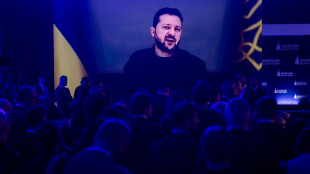
"We don't need this panic," Zelensky told a news conference with foreign media, insisting he wanted to avoid hurting his country's already battered economy.
"There are signals even from respected leaders of states, they just say that tomorrow there will be war. This is panic -- how much does it cost for our state?" he asked.
In talks with Macron, the Ukrainian leader called for more meetings and talks "while a propitious climate for dialogue exists."
- Russia's concerns not addressed -
Putin also made clear to Macron that the written responses from the West to his demands this week had fallen short of Russia's expectations, the Kremlin said.
"The US and NATO responses did not take into account Russia's fundamental concerns including preventing NATO's expansion," Putin said, according to the Kremlin's readout of the call.
He added that the West had ignored the "key question," that no country should strengthen its security at the expense of others, adding Russia would "carefully study" the responses, "after which it will decide on further actions."
Russia has also demanded a pullback of NATO forces deployed to eastern European and ex-Soviet countries that joined the alliance after the Cold War.
In a sign of continued tensions, Russia announced Friday evening it had added several EU officials to a list of people banned from entering the country, saying they were responsible for "anti-Russian policies."
- Threat to key pipeline -
The Putin-Macron phone call followed talks in Paris this week between Russia and Ukraine, with France and Germany alongside, which produced a joint statement to preserve a ceasefire in eastern Ukraine between government forces and pro-Moscow separatists.
They also agreed to hold new talks in Berlin in February.
In tandem with the diplomacy, the West has upped its threats of a tough response to an invasion.
Washington and Berlin warned that the Nord Stream 2 pipeline, designed to double supplies of Russian natural gas to Germany, was at stake.
Milley said Russia itself would be hurt by war.
"If Russia chooses to invade Ukraine, it will not be cost-free, in terms of casualties or other significant effects," he said.
burs-pmh/sst/bfm
P.A.Mendoza--AT