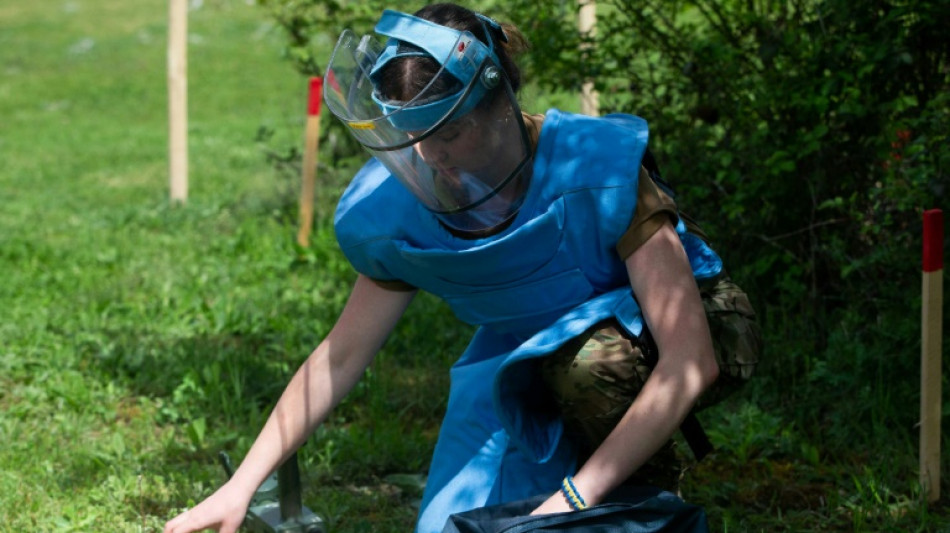
'Not afraid': Ukraine women learn to demine in Kosovo / Photo: - - AFP

 Sabalenka edges Noskova, keeps US Open treble bid alive

 Real Madrid win Champions League opener as Haaland stars for Man City

 Gambian leader vows power boost after violent blackout protests

 Newcastle battle past Millwall to reach League Cup fourth round
 Mourinho's Real Madrid make winning start against Inter Milan

 Villa take 'big step forward' with win over Brugge

 Yaya Toure hails 'new era' for African coaches ahead of Champions League bow

 Lawes and Marchant told to prove themselves in quest for England recalls

 Smithsonian secretary to retire as Trump exerts control over institution

 Atletico have work to do to reach home Champions League final: Simeone

 Villa end goal drought to beat Brugge in Champions League opener

 McIlroy says 'we'll keep our heads down and play' in event of Trump golf visit

 Sabalenka holds of Noskova to reach US Open semi-finals

 Netanyahu under fire over report UAE warned of October 7 attack

 Wasim Akram urges 'fair treatment' for jailed Imran Khan

 No. 1 in reach as Rybakina battles for US Open semi-final spot

 Putin and Trump discuss Ukraine in 'extremely frank' call

 French police hunt Renoir thieves after lightning museum heist

 World Cup final scorer Torres leads Ballon d'Or nominees
 Carney touts Canada 'pivot' away from US as tariffs rise

 Spanish stars Cruz, Bardem play strained on-screen couple in new film
 The "Everlasting Battery" Inside Your Joints:UConn Professor's Self-Powered Healing Material just Got Acquired

 Visionary or conman? Elon Musk enigmatic star of Venice documentary

 Trial opens in France over deadliest Channel migrant crossing disaster

 England skipper Root says it's wrong to accuse Pakistan of lacking fight
Kateryna Grybinichenko chose to sign up after rockets fell on her home city of Sloviansk, in Ukraine's eastern Donetsk region.
The 36-year-old wanted to help -- so she joined a band of Ukrainian women taking part in an intensive demining course in Kosovo, a place all too familiar with clearing deadly explosives.
The trainees have travelled hundreds of miles, hoping to protect their homeland for decades to come.
After learning their craft from the experts, the women plan to return to Ukraine and put it into practice in areas where Russian troops have withdrawn.
"There are various ways to fight," said Anastasiia Minchukova, one of the eight women who applied for the scheme.
The 20-year-old English teacher, who dons a blue protective apron and a visor for the training, said there is a "huge demand for people who know (about) demining" in Ukraine.
"The only reason I'm here is to help my country," she said.
The trainees are being taught how to detect, identify and disable explosives on the course organised by the Mines Awareness Trust (MAT) Kosovo NGO.
Six women started the three-week programme in the western town of Peja, known as Pec to Serbs, on Monday, with two others set to arrive soon. The organisers plan to take on more trainees in the future.
The course has been specifically set up in response to the invasion of Ukraine, and focuses on Russian and former Soviet arms, including guided weapons, mines and rockets.
It is open to men too, but Ukrainian males aged 18 to 60 are banned from leaving the country. And the women here want to take part in the defence of Ukraine.
The MAT said this course is the first of its kind outside Ukraine since the Russian invasion began in February.
- 'First-hand experience' -
Kosovo was chosen to host the scheme because of its "first-hand experience", chief instructor Artur Tigani said.
"We have gone through quite a similar situation, especially when it comes to contamination with unexploded devices."
An estimated 13,000 people lost their lives in the war between Serbian forces and ethnic Albanian guerrillas in the late 1990s.
The conflict ended after a NATO air campaign forced Serbian troops to withdraw from the territory, paving the way for independence in 2008.
But the war left the former Serbian province with 4,500 minefields, according to US estimates after the war.
The devices were scattered mainly in the mountainous Peja region, close to the Albanian border, where Tirana shipped arms and supplies to Albanian guerrillas.
With international help, most of the mines have been cleared, and the risk is now officially assessed as "light".
The Kosovo instructors have also delivered training in Syria, Iraq and Libya.
"It is our life's mission to save lives and help others save lives," said Tigani.
- Huge challenge -
The Ukrainian trainees are aware of the huge challenge they face when they get back home.
They expect to join emergency services and get to work when they return on May 13.
"I've seen, while travelling in (Ukraine), the huge amount of the abandoned ammunition and unexploded ordnance laying on the ground," Grybinichenko said.
It is thought it could take decades to rid Ukraine of mines. Perrine Benoist, of the Handicap International NGO, has said it will likely "take 50 years to clear everything."
Minchukova knows that she and her fellow trainees have taken on a perilous task.
But she said: "It's dangerous all over Ukraine, even if you are in a relatively safe region".
"I'm ready for it. I'm a Ukrainian. I'm not afraid of anything.
"I know we will have a chance to prove (we are) worthy of doing the same as men."
H.Romero--AT