
New controversies arise over French language in Canada / Photo: Daniel SLIM - AFP

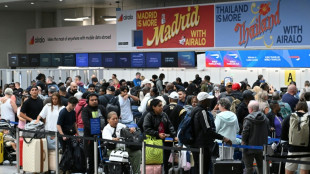 Cyberattack ruled out in UK air traffic glitch as more flights axed

 Ekiden Launches Canton Network’s First Order Book-Based Derivatives Exchange

 Germany's Merz accuses AfD of promoting 'ethnic cleansing'

 Japanese director Kore-eda's manga film charms critics in Venice

 As African space race heats up, Senegal pursues homemade satellites

 UK's little-known Bayeux Tapestry replica steps into spotlight

 Shelton stuns Alcaraz in 3:34 am US Open finish, Sabalenka battles on

 Alcaraz falls to Shelton in epic latest-ever US Open finish

 Tradition Announces Partnership With Affin Moneybrokers to Support Malaysian Market Data

 Protesters urge South Korea to stay out of Iran war

 Africa's informal economy: a burden and lifeline

 Kenyan start-up makes robotic limbs to sign for deaf kids

 Iran, US trade blows as Hormuz impasse deepens

 The round-the-clock monitors protecting Bhutan from glacier risk

 'Hell': Father of surfers killed in Mexico testifies at trial

 Travellers in UK face more chaos after air traffic control glitch

 Crude pushes towards $100 on Mideast flare-up, fanning inflation fears

 Record rain forces Asian Games athletes to evacuate accommodation
 Amusing or addictive? The algorithms powering our social feeds

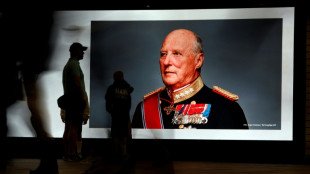 Norway bids farewell to King Harald V, 'grandfather' of the nation

 NFL breaks new ground as 100,000 set to pack MCG in Australia

 EU faces revolt over social media ban for children

 Canada eyes researchers looking to leave 'hostile' US

 Tiafoe escapes Michelsen to reach US Open semi-finals

 InterContinental Hotels Group PLC Announces Transaction in Own Shares - September 09

Do French-speakers face discrimination in Canada, despite its status as an official language along with English?
A string of recent leadership appointments and statements has revived the controversy over the French language's place in Canada, prompting a response from Prime Minister Justin Trudeau.
The latest blow: There are no longer any directors on the corporate board of Montreal-based CN, Canada's largest railway company, who speak French.
The question of whether Canadian corporate leaders should be bilingual received a lot of attention last fall, after the president of Air Canada, Michael Rousseau, said he did not have the time to learn French. He had to publicly apologize for those remarks a few days later.
Under Canadian law, state-owned businesses, such as CN and Air Canada, as well as airports and federal ministries, are required to provide services in both French and English to clients.
Prime Minister Justin Trudeau said this week that he was frustrated by the situation with CN.
"French-speaking Canadians across the country should see themselves reflected in our major national institutions," said the bilingual prime minister, who also asked the responsible government ministers to ensure CN works quickly to rectify the situation.
The recent controversies are a reminder of the French language's precarious position in a North American ocean of English-speakers, as well as previous battles to protect its status as an official language, which has been included in the Canadian constitution since 1982.
But according to some French language proponents in Canada, where the total population of 37 million contains 8 million francophones, the government has failed to meet expectations.
- Less than 20% of Canadians are bilingual -
"There is clearly a hypocrisy on the part of Trudeau," said Stephane Beaulac, a law professor and codirector of the University of Montreal's National Observatory on Linguistic Rights.
He pointed out that while the prime minister is bothered by the CN saga, he chose last year to appoint a non-French speaker as Canada's governor general, who serves as Queen Elizabeth II's official representative in the country.
Mary Simon, originally from the Nunavik area in northern Quebec, is the first Indigenous Canadian to become governor general, but only speaks English and the Inuit language of Inuktitut.
This week, Canada's Commissioner of Official Languages also rebuked the prime minister's office for not having all video streams on their official Facebook page subtitled or dubbed in French.
According to recent opinion polls, more than 90 percent of Canadians strongly support bilingualism, which they consider to be a part of Canadian culture, but less than 20 percent are fluent in both languages.
"Everyone must be able to be served in their preferred language since few Canadians are truly bilingual," says Stephanie Chouinard, a political science professor at the Royal Military College of Canada.
But, she adds, Canadians "have been waiting for the modernization of the Official Languages Act since 2019."
Beaulac, the law professor, notes that "for a long time, to defend French meant you were flagged as pro-separatist."
"Things have changed today, so people are more daring to challenge the domination of English."
Referring to the recent CN appointments, linguistic law professor Frederic Berard explains that "people are angry, shocked, and this anger is justified."
"However, today this kind of situation is relatively rare," especially in Quebec, adds Berard, who chaired Canada's national consultations on the reform of official languages.
But the situation is much more complex for Francophones who do not live in Quebec, he adds, even if there have been advances in recent years.
N.Walker--AT