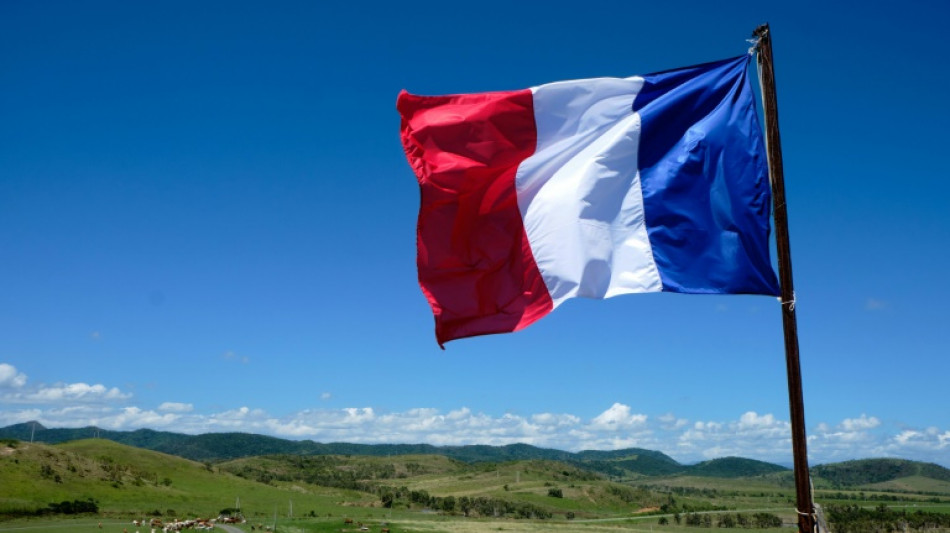
'Silent pain' of Algerians banished by France to the Pacific

 Moutet fined over x-rated Queen's Club rant

 Outrage in Italy after Trump says Meloni 'begged' for photo op

 From birds to fish, how extreme heat causes wildlife to suffer
 Trapped on Everest for days, Nepali survivor recounts escape

 Clark leads by three as US Open second round begins
 Fritz gets revenge on Shelton to reach Halle semis

 Heatwave hits more than half of France's population
 Former England keeper Earps agrees to join London City Lionesses

 Olympic hurdles medallist Bascou suspended for doping

 Pegula sinks Keys to reach Berlin Open semis
 Gaza ceasefire a 'deadly illusion': UNICEF
 S.Africa anti-migrant hate loses team African support at World Cup

 European robotics start-ups go up against Chinese heavyweights

 Japan's men told to clean at home, not just the World Cup

 South Korean leader says told Trump sanctions on North are 'ineffective'
 Stocks rally falters, oil rises as US-Iran talks postponed

 Indonesia to capture last-known wild Bornean rhino for IVF
 USA, Australia eye World Cup knockout rounds, Brazil in action
 Iran to lodge complaint with FIFA over World Cup restrictions

 New Zealand minister defends fishers after two orcas killed in net

 Seoul record leads most Asian markets higher, crude extends losses

 Burnham wins key UK poll, paving way for bid to challenge PM Starmer

 'Pico' Lopes -- Cape Verde defender's journey from Ireland to World Cup
 'Pretty special': captains eye Super Rugby glory in clash of top seeds
 Ivory Coast's Diomande living World Cup dream, dealing with tragedy

On the 60th anniversary of Algeria's independence from France, descendants of the North Africans deported to the Pacific territory of New Caledonia remember the "silent pain" of their ancestors.
Between 1864 and 1897, as French colonial troops advanced through Algeria, 2,100 people were tried by special or military courts and deported.
They were sent in chains around 18,500 kilometres (11,500 miles) to the other side of the world, to a penal colony on the Pacific archipelago of New Caledonia.
The palm-fringed islands east of Australia are one of France's biggest overseas territories.
"The number of dead, whose bodies were thrown overboard, during the crossing, remains unknown," said Taieb Aifa, whose father was on the last convoy of convicts bought to the colony in 1898.
Those who survived the tough journey became known as the "straw hats" -- a nod to the convicts' headgear as they worked in the blazing sun.
Today, their descendants say that so great is the pain, the story has to be "almost prized from them," Aifa told AFP.
Aifa described a five-month journey to the islands, during which convicts were "chained in the holds" of ships.
For many years, even speaking about his ancestors' tale was taboo.
"A code of silence reigned in the families of deportees," said 89-year-old Aifa, now regarded as a pillar of New Caledonia's "Arab community" after serving as mayor of the small town of Bourail for 30 years.
- Colonised 'became coloniser' -
Aifa's father was sentenced to 25 years for fighting against the French army in Setif, in eastern Algeria.
"From the colonised in Algeria, they became colonisers... On land confiscated from the Kanaks", he said, referring to New Caledonia's indigenous inhabitants.
"In New Caledonia, the French state aimed, as in Algeria, to create a settlement," Aifa said.
Christophe Sand, an archaeologist at the IRD Research Centre in Noumea, who is also the descendant of convicts, said that "the deportees were transformed into colonists".
While some French convicts were later able to bring their wives, it was forbidden for the Algerians.
Those sentenced to more than eight years in prison -- the majority -- were not allowed to return to Algeria after their sentence, said Sand.
"This process must have abandoned 3,000 to 5,000 orphans in Algeria", he said.
Maurice Sotirio, the grandson of a convict from Constantine in northeast Algeria, described the heartbreaking trauma of his family's past.
"My grandfather left two children in Algeria whom he never saw again", Sotirio said.
The suffering continued even in freedom.
In New Caledonia, the Algerians were second-class citizens since they often did not speak French, but Arabic or Berber, said Sand.
Their children suffered from the stigma, and only a few families kept hold of their origins.
At the end of the 1960s, the descendants came together to form an association, the "Arabs and friends of the Arabs of New Caledonia".
The islands -- so-called because a British sailor thought they looked like Scotland -- have been French territory since 1853.
Today, they have about 270,000 inhabitants, with the economy's mainstays the production of metals, especially nickel, of which New Caledonia is a major global producer.
Algeria, which Paris regarded as an integral part of France, is this year marking six decades since its 1962 independence following a devastating eight-year war.
- 'Healing process' -
In 2006, Aifa took his first trip to Algeria.
He said the visit was like "bringing back his father who, like other Arabs, had suffered from not being able to return and die in his native country".
Aifa, while proud of his Caledonian heritage, also celebrates his roots in Algeria.
"I am also Algerian, I have a link with Algeria, family, land... I managed to obtain my Algerian papers 20 years ago", he said.
Sand, who also travelled to Algeria with two other descendants, said he felt he was "carrying his ancestor on his shoulders" on the flight.
"When I saw, through the porthole, the port of Algiers, where my great-grandfather and his companions had been thrown into the hold, I felt the urge to scream," he said.
Arriving at his ancestral home in the village of Agraradj in the northern Kabylia region, he bent down to touch the earth.
"I felt that the symbolic weight that I had on my shoulders since the beginning of the journey had disappeared," he said. "I brought his exiled spirit back to the place where he was born".
For Sand, you have to go through "this process of healing, of closing the door" to "build a future" in New Caledonia.
"Healing from the trauma of exile allows the Caledonians that we are today to project ourselves into the future, without remaining prisoners of the past," Sand said.
H.Thompson--AT