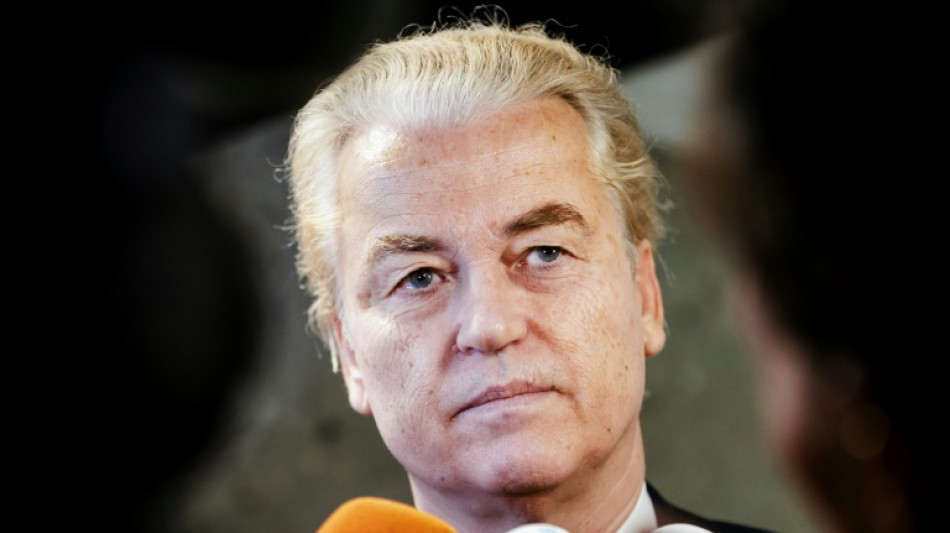
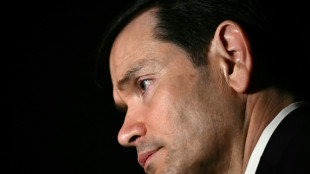
Dutch far-right firebrand Wilders says won't be PM / Photo: Sem van der Wal - ANP/AFP

 Airbus pushes ahead with future single-aisle jet, hydrogen plane

 Stocks rise despite climbing oil prices
 UNAIDS chief calls for 'radical change' in Africa amid aid cuts
 EU cancels subsidy to Venice Biennale over Russia presence
 Heavy rain dampens search for dozens missing in Afghanistan flood

 Argentina represented themselves in 'best possible way' at World Cup: Fernandez
 Philippines, China summon ambassadors over clash in disputed waters
 'White elephant': Colombia's anti-corruption activist turned senator
 Stock markets, oil prices climb
 South Africa's anti-migrant unrest sparks smalltown suspicion, fear
 Tour de France hit by new wave of anti-doping tests
 Afghans search for dozens missing after devastating flood
 Novartis says buoyed by new treatments in second quarter
 Great Barrier Reef at risk of 'collapse', scientists warn
 India's 'Cockroach' movement vows to protest until education minister resigns
 South Korea president urges regulator action on leveraged stock funds
 For Ukraine's drones, names are part of the battle
 Countries move to ban social media for children
 Asia stocks up as chip stocks recover, oil eases
 Desperate Rohingya risk deadly voyages as trafficking surges

 French lawmakers expected to approve social media ban for under-15s
 'All these rashes': chickenpox surges in Gaza camps
 Australia's Cummins, Hazlewood, Lyon back for Bangladesh Test series
 Rubio in Philippines as US condemns 'dangerous' China actions
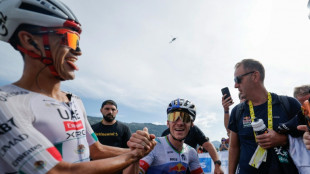 Unnatural physique turns Evenepoel into a Tour de France contender
Dutch far-right leader Geert Wilders said Wednesday that he would not be prime minister despite his stunning election win in November, due to a lack of support across the political spectrum.
"I can only become Prime Minister if ALL parties in the coalition support it. That was not the case," Wilders said on X.
"The love for my country and voters is bigger and more important than my own position."
The announcement came on the eve of an eagerly awaited report on Dutch coalition talks, amid speculation of a breakthrough that could result in a technocratic government.
The man overseeing the negotiations, Kim Putters, has said the bickering parties were ready to take the "next step" after two days of "good and intense" talks at a country estate.
Wilders posted on X that he wanted a "right-wing cabinet... less asylum and immigration. The Dutch come first."
Party leaders have been tight-lipped during the process but public broadcaster NOS reported that the most likely outcome for Thursday's report was an "extra-parliamentary" or technocratic cabinet.
It is unclear exactly what form this could take, but it is expected that the four party leaders will serve as MPs.
Parties would appoint the members of the cabinet but they could be drawn from "ordinary" party members or even from outside politics, according to media reports.
Wilders stunned the Netherlands and Europe with a convincing victory in November elections that put him in pole position to lead coalition negotiations.
Unlike Britain, France or the United States for example, the Netherlands has a very fractured political system that means no party is strong enough to govern on its own.
The far-right leader's Freedom Party (PVV) therefore started talks with the centre-right Liberal VVD party, the BBB farmers' party, and a new party, the New Social Contract (NSC).
The NSC, led by anti-corruption champion Pieter Omtzigt, was the other new factor in the election, gaining 20 seats and making it indispensable in any coalition.
- Nexit referendum? -
But cracks began to show in the talks almost immediately, with sniping on social media and by the NSC in particular raising questions about the PVV's far-right manifesto.
Among other things, the PVV manifesto calls for a ban on mosques, the Koran and Islamic headscarves. It also wants a binding referendum on a "Nexit" -- the Netherlands leaving the European Union.
In February, Omtzigt abruptly quit the coalition talks, plunging the process into chaos with the differences between his party and the PVV "too big" to bridge.
At the time, the Algemeen Dagblad newspaper described the talks as a "slow-motion disaster" with "poison, mutual sniping, gossiping".
A new person, known in the Netherlands as an "informer", was appointed to oversee the talks and this appears to have unblocked the stalemate.
The new informer, Putters, managed to get the four party leaders back to the negotiating table with talks reportedly moving towards a technocratic government.
Time is ticking for the Netherlands to find a prime minister, as the man holding the fort, Mark Rutte, is widely expected to become the new NATO Secretary General.
Since the election, support for the PVV has only increased, surveys suggest, as voters voice frustration at the slow pace of talks.
P.Smith--AT