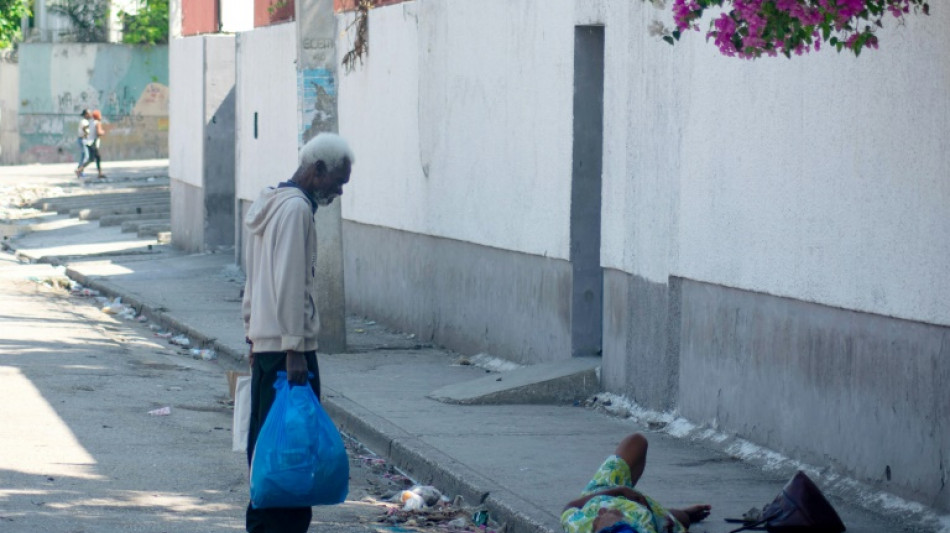
Haiti sees major step but crisis could still worsen / Photo: Clarens SIFFROY - AFP/File

 Airbus pushes ahead with future single-aisle jet, hydrogen plane

 Stocks rise despite climbing oil prices
 UNAIDS chief calls for 'radical change' in Africa amid aid cuts
 EU cancels subsidy to Venice Biennale over Russia presence
 Heavy rain dampens search for dozens missing in Afghanistan flood

 Argentina represented themselves in 'best possible way' at World Cup: Fernandez

 Philippines, China summon ambassadors over clash in disputed waters

 'White elephant': Colombia's anti-corruption activist turned senator
 Stock markets, oil prices climb

 South Africa's anti-migrant unrest sparks smalltown suspicion, fear

 Tour de France hit by new wave of anti-doping tests
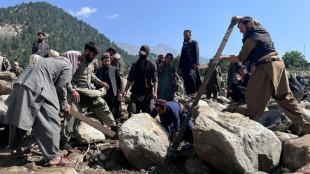 Afghans search for dozens missing after devastating flood
 Novartis says buoyed by new treatments in second quarter

 Great Barrier Reef at risk of 'collapse', scientists warn

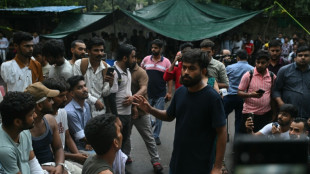 India's 'Cockroach' movement vows to protest until education minister resigns
 South Korea president urges regulator action on leveraged stock funds
 For Ukraine's drones, names are part of the battle
 Countries move to ban social media for children
 Asia stocks up as chip stocks recover, oil eases
 Desperate Rohingya risk deadly voyages as trafficking surges

 French lawmakers expected to approve social media ban for under-15s
 'All these rashes': chickenpox surges in Gaza camps
 Australia's Cummins, Hazlewood, Lyon back for Bangladesh Test series
 Rubio in Philippines as US condemns 'dangerous' China actions
 Unnatural physique turns Evenepoel into a Tour de France contender
A political transition deal in Haiti marks a key step forward for the violence-ravaged country but far more needs to be done, with some experts warning the situation could deteriorate further.
Armed gangs have seized control of much of Haiti, the Western Hemisphere's poorest country, with bandits ransacking infrastructure and fears rising of famine.
- What is the agreement? -
Caribbean leaders and international players, notably US Secretary of State Antony Blinken, thrashed out a deal at talks in Jamaica on Monday in which Prime Minister Ariel Henry will cede power to a new transitional council, which will name an interim leader before holding elections.
Haiti has not held elections since 2016 and Henry has been in power, officially as a transitional figure, since the 2021 assassination of president Jovenel Moise.
The seven voting members of the transitional council will come from parties across Haiti including movements linked to Henry, Moise and former president Jean-Bertrand Aristide, the left-leaning former priest who was Haiti's first democratically elected president.
The council members should be named within 48 hours, State Department spokesman Matthew Miller said Tuesday.
- Will the agreement quell violence?
"Removing Prime Minister Henry and seeking a political solution alone will not automatically solve the acute security crisis in Haiti," said Eddy Acevedo, chief of staff and senior advisor at the Wilson Center in Washington.
He said that Haiti could still plunge into the international community's "worst nightmare" with a gang leader seizing the presidential palace.
He warned that political leaders without legitimacy can cause further instability, with the fledgling national police -- seen by the United States as key to future stability -- potentially laying down weapons if the force does not feel it has solid support.
Kenya has stepped forward to send police as part of an international mission, funded largely by the United States and Canada, to restore order.
Kenya said it was putting the plan on hold with Henry's resignation, but the United States voiced optimism that the mission would go ahead once a new government is in place.
- Is the new council representative? -
Keith Mines, vice president of the Latin America program at the US Institute of Peace and a former US diplomat, said that Haitians had long been seeking a more representative and transparent government.
The transition is "really a huge and unexpected step and, frankly, had it not been for the crisis in security, it probably wouldn't have happened," Mines said.
"I think it opens up a lot of new possibilities, but those are still possibilities that have to be really carefully managed and have to be very decisively supported by the international community, especially the United States," he said.
The weakness of the central government was a key concern for the deployment of the Kenyan-led force, he said.
In addition to the seven members, the council will have two observers.
Mines suggested the establishment of a second council with an advisory role that could bring in other players including minor political parties.
- What role for the gangs? -
The agreement will not give a role to any group under sanctions by the United Nations. Gangs effectively are in control of much of Haiti after years of eroding government authority.
Gedeon Leon, the founder of a Haitian non-governmental group, the Center for Human Rights Analysis and Research, known by its French acronym CARDH, said the transitional council was "not an ideal political situation" but allowed the inclusion of major groups.
"So far we don't see the emergence of new political figures," he said.
"In my view, in the current political situation, the gangs have become a force. We have to be careful that their criminal actions -- rape, massacres and serious human rights abuses -- are not legitimized."
M.White--AT