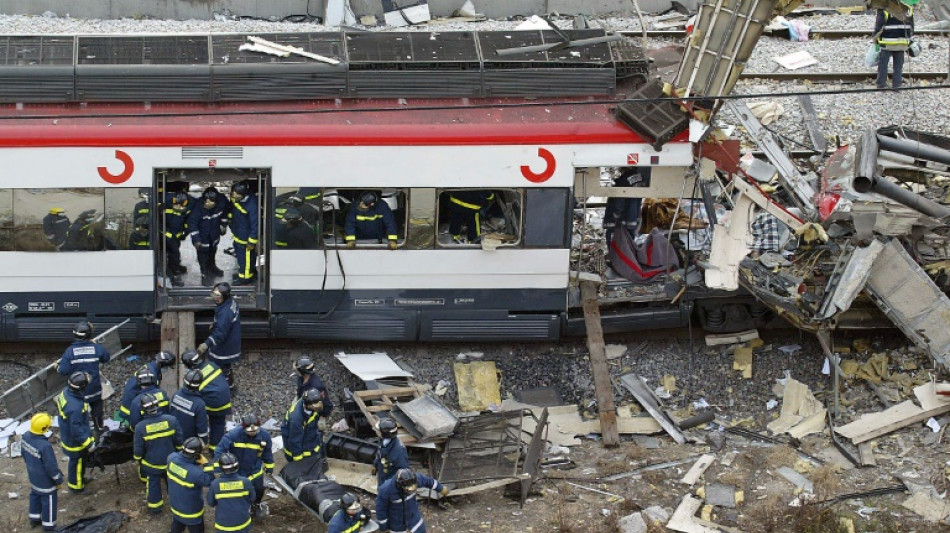
Twenty years on, Spain honours train bombing victims / Photo: Pierre-Philippe MARCOU - AFP/File

 Tour de France hit by new wave of anti-doping tests

 Afghans search for dozens missing after devastating flood
 Novartis says buoyed by new treatments in second quarter

 Great Barrier Reef at risk of 'collapse', scientists warn

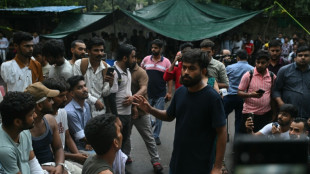 India's 'Cockroach' movement vows to protest until education minister resigns
 South Korea president urges regulator action on leveraged stock funds
 For Ukraine's drones, names are part of the battle
 Countries move to ban social media for children
 Asia stocks up as chip stocks recover, oil eases
 Desperate Rohingya risk deadly voyages as trafficking surges

 French lawmakers expected to approve social media ban for under-15s
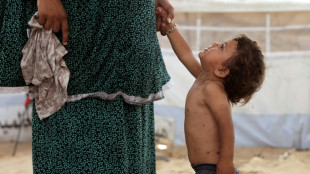 'All these rashes': chickenpox surges in Gaza camps

 Australia's Cummins, Hazlewood, Lyon back for Bangladesh Test series

 Rubio in Philippines as US condemns 'dangerous' China actions
 Unnatural physique turns Evenepoel into a Tour de France contender
 'Sit down!' Australian politician berates dog on live TV
 Emergent Software Secures Growth Investment from Winterbird Partners

 InterContinental Hotels Group PLC Announces Transaction in Own Shares - July 21

 London Stock Exchange to Launch LSE 24

 HM Exploration Confirms Significant Mineralization at Lewis Pilley's Project; Intersects 23 Metres of 1.2% Cu, 1.7% Zn, 10.7 g/t Ag and 0.25 g/t Au

 Silver Range Advances East Goldfield in Nevada

 Reported 20% Surge in U.S. Diesel Futures Highlights Potential Role of Domestic Renewable Fuel Supply

 Trump orders new 50% tariff on many Canadian goods
 US accuses Cuba of sweeping spy campaign, aiding American left

 US stocks drop on latest Middle East fighting, tech earnings caution

Spain and the European Union pay homage Monday to the 192 victims of the March 11, 2004 Madrid train bombings that marked the start of mass Islamist attacks in Europe.
Spain's King Felipe VI and Queen Letizia will preside over the official ceremony at 12:15 pm (1115 GMT) in the Royal Collections Gallery, a museum near the palace.
Organised by Brussels, March 11 has become the official European Day of Remembrance "for the victims of terrorism".
On that date in 2004, the Spanish capital was plunged into chaos as 10 bombs devastated four commuter trains during the early-morning rush hour.
Although Spain had experienced decades of violence at the hands of the Basque separatist group ETA, it had never been hit by an attack of such magnitude, with taxi drivers and the public pitching in to help the emergency services ferry nearly 2,000 wounded to hospital.
Just two-and-a-half years earlier, the United States had been hit by the 9/11 attacks in which Al-Qaeda militants had killed nearly 3,000 people, but when Madrid was hit, Europe didn't immediately think of the jihadist movement founded by Osama bin Laden.
- Disinformation -
Known as 11M -- Spanish shorthand for March 11 -- the attacks on a train at Atocha station and three others headed there, occurred in a highly-charged political context just days before a March 14 general election.
At the time, the ruling right-wing Popular Party (PP) of outgoing premier Jose Maria Aznar was the favourite to defeat the opposition Socialists led by Jose Luis Zapatero.
A year earlier, Aznar's government had decided to join the US-led invasion of Iraq, despite widespread public opposition. And in the following months, Bin Laden had threatened revenge attacks on countries supporting the invasion.
Even so, within hours of the Madrid attacks, Aznar's government publicly blamed ETA, despite mounting evidence to the contrary.
But the ETA hypothesis was soon debunked as investigators traced the perpetrators, largely through three bombs which failed to explode that were found in rucksacks and sports bags.
And Al-Qaeda itself claimed responsibility for the attacks saying it was in response to Spain's involvement in the Iraq war.
Although social media didn't yet exist, doubts over the government's explanation quickly spread across Spain, and during huge demonstrations the following day, protesters expressed hostility towards the authorities who were accused of lying at a time when the word "disinformation" barely existed.
- Only three left in prison -
On March 14, the public voted en masse, handing a resounding victory to the opposition Socialists, with analysts saying the government's disastrous handling of the attacks played a key role.
In early April, seven suspected members of the jihadist cell involved in the carnage blew themselves up as police surrounded an apartment where they had been hiding on the southwestern outskirts of Madrid.
The blast also killed a police officer who is counted in Spain as the 193rd victim of the attacks.
After a three-year investigation, 29 suspects, the vast majority Moroccan, went on trial in early 2007 with the process lasting six months. At the end, 18 were convicted.
Twenty years later, only three are still serving time -- two Moroccans who were each handed nearly 43,000 years, and a Spaniard, who supplied the explosives and was jailed for nearly 35,000 years.
In principle, they will remain behind bars until 2044.
All the others have been released after serving their sentences, the vast majority of them deported or extradited, mainly to Morocco.
P.Hernandez--AT