Civilians trickle out of Kramatorsk after station attack

 Fritz gets revenge on Shelton to reach Halle semis

 Heatwave hits more than half of France's population

 Former England keeper Earps agrees to join London City Lionesses

 Olympic hurdles medallist Bascou suspended for doping

 Pegula sinks Keys to reach Berlin Open semis

 Gaza ceasefire a 'deadly illusion': UNICEF
 S.Africa anti-migrant hate loses team African support at World Cup

 European robotics start-ups go up against Chinese heavyweights

 Japan's men told to clean at home, not just the World Cup

 South Korean leader says told Trump sanctions on North are 'ineffective'

 Stocks rally falters, oil rises as US-Iran talks postponed

 Indonesia to capture last-known wild Bornean rhino for IVF

 USA, Australia eye World Cup knockout rounds, Brazil in action

 Iran to lodge complaint with FIFA over World Cup restrictions

 New Zealand minister defends fishers after two orcas killed in net

 Seoul record leads most Asian markets higher, crude extends losses

 Burnham wins key UK poll, paving way for bid to challenge PM Starmer

 'Pico' Lopes -- Cape Verde defender's journey from Ireland to World Cup
 'Pretty special': captains eye Super Rugby glory in clash of top seeds

 Ivory Coast's Diomande living World Cup dream, dealing with tragedy

 Australia seek 'respect' from US amid World Cup 'layup' row

 Japan doctor-turned-author moots amputations to ease care crunch

 Fossils challenge assumptions on how animals adapted to land
 Canada romp to first World Cup win, Switzerland thump Bosnia

 Venezuela govt, opposition hold US-backed talks on democratic transition

Mini-vans were headed to a church in Kramatorsk in east Ukraine on Saturday morning to collect evacuees after a deadly rocket attack on a train station in the city.
Almost 80 people, most of them elderly, took shelter overnight in the building, not far from the terminal targeted in the strike on Friday.
"There were around 300 to 400 people who rushed here after the strike," Yevgeny, a member of the protestant church, told AFP.
"They were traumatised. Half of them ran to shelter in the cellar, others wanted to leave as soon as possible. Some were evacuated by bus in the afternoon (on Friday). In the end, almost 80 stayed here and I hosted seven at my house," he said.
Evacuees slept on mattresses on the floor in the church and were offered breakfast by volunteers on Saturday morning as they waited for the bus to take them out of the path of a feared Russian offensive in the region.
Moscow denied responsibility for the rocket attack on Friday morning, which killed 52 and injured a further 109 people, according to the latest official count.
Six weeks into President Vladimir Putin's invasion, Moscow has shifted its focus to eastern and southern Ukraine after stiff resistance ended plans to swiftly capture the capital Kyiv.
The stop in Kramatorsk was being used as the main evacuation hub for refugees from the parts of the eastern Donbas region still under Ukrainian control.
- Station closed -
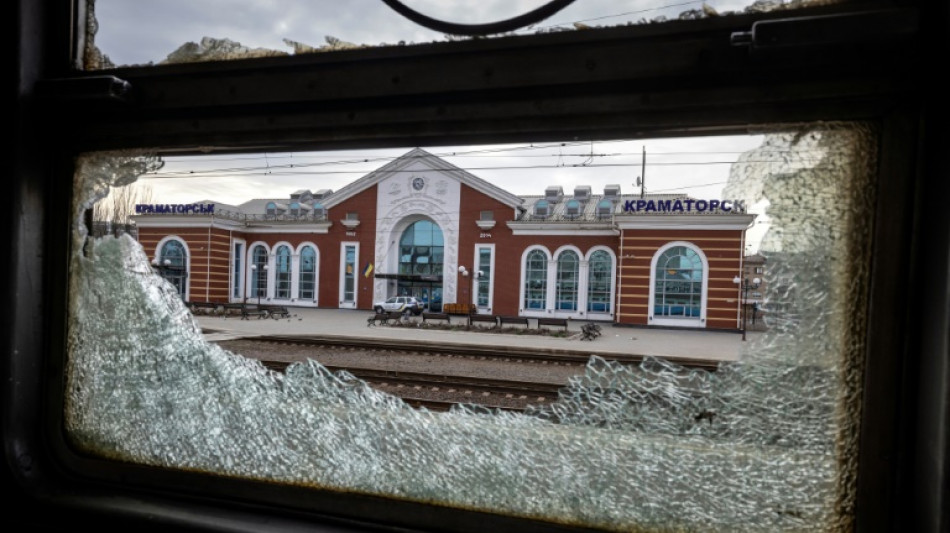
Twenty-four hours after the strike on Saturday morning, the train station was closed and the area cordoned off by police.
Cars charred by the explosion were still sat on the forecourt, while some of the station's blown-out windows had been boarded up.
A sizeable chunk of the rocket's twisted fuselage was still to be found on the grassy roundabout in front of the station.
In Kramatorsk, the night into Saturday and the morning were quiet. Regular heavy artillery explosions could be heard in the distance -- towards the frontline to the northwest -- but none nearby.
The city is now squeezed between the frontlines, to the south and east by the pro-Russian separatist statelets of Donetsk and Lugansk, and to the north by the advance of the Russian army.
The lines of engagement have been relatively stable but daily exchanges between opposing forces have been heated.
The civil-military authorities in Ukrainian-controlled regions of Donetsk and Lugansk, which make up the Donbas, have repeatedly called for civilians to leave the region for fear of a Russian move.
Trains and buses have been laid on for evacuees to leave the area, supported by the work of volunteers.
While the station in Kramatorsk is out of service, four trains are slated to leave from the nearby city of Slavyansk for the west of the country, according to the Ukrainian rail operator.
Other local trains are also set to run, though departure details have yet to be shared for security reasons.
- Two-way street -
Discreetly, evacuations have also continued in the other direction, by road towards the pro-Russian territories.
Convoys of cars, often old Russian-made Ladas with suitcases strapped to the roof, set off every day for the Russian-controlled zone to the north, with the tacit consent of Ukrainian forces manning checkpoints, an AFP journalist understood.
"We are going there because we have relatives there. There is food, it's calm, there are no issues," a 30-year-old man travelling with his family told AFP.
"There are good and bad people on both sides," he said, exchanging Ukrainian currency for Russian rubles at the side of the road.
Once the industrial heartland of the Soviet Union, the former coal-mining region of Donbas, divided by war since 2014, is traditionally more favourable towards Russia.
Nostalgia for the Soviet era comes through in conversation with residents, who regret the closure of the region's big factories, and often reserve criticism for the government in Kyiv.
What is more, many of them, including women and children, do not intend to flee the arrival of Russian forces.
T.Sanchez--AT