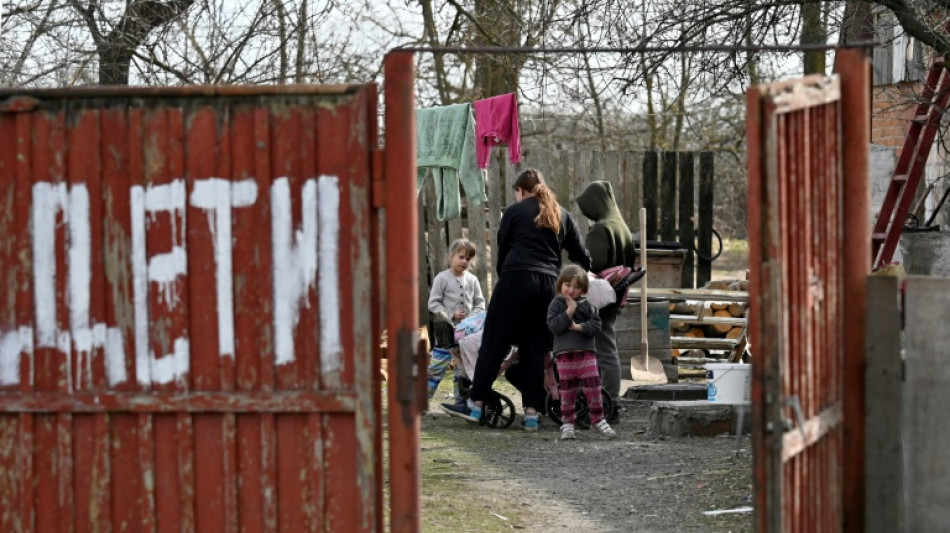
Ukraine villagers say Russian soldiers used them as 'shields'

 From obscurity to smashing sixes: Pakistan's Razaullah rises to stardom

 Bezzecchi takes pole for San Marino MotoGP
 China, Russia, Iran leaders gather in India as BRICS nations seek common ground

 Korda finally beaten as Europe grasp slender Solheim lead

 Zelensky says willing to meet Putin at G20 in Miami: interview

 Quebec Brokerage Qubit Insurance Announces New Data on Coverage Shortfalls as Rebuilding Costs Rise

 Trump asks Smithsonian to install George Washington statues, exhibition

 'A legend': Celine Dion poised for emotional comeback in Paris

 Europe eyes battle over 'pervert' AI glasses

 Philippine Muslim enclave trades bullets for election ballots

 Children in flood-hit Nepal grapple with loss, cling to hope

 Bhutan business bets on hazelnuts for farming future

 First bodies of Philippines ferry fire victims land as toll hits 35

 Gaza film, Malkovich drama vie for Venice top prize

 DR Congo school fire stampede death toll rises to 26: UNICEF

 Best Free Gold IRA Kits in 2026 Rankings Released By Experts

 Top seed Zverev holds off Khachanov to reach US Open final

 James McAvoy brings new film 'Faith' to Toronto fest

 Faultless Duplantis, hungry Ingebrigtsen shine at inaugural Ultimate

 Roblox to launch wallet to pay creators faster and will allow off-platform gaming

 Springboks wary of new-look All Blacks in Baltimore test

 Townsend, Siniakova win US Open doubles for career Grand Slam together

 Verstappen unimpressed with new Madrid street track

 Razaullah heroics deny England quickfire win in 3rd Test against Pakistan

 Masks banned at planned UK protests: police

In the village of Obukhovychi, neighbours say Russian forces dug in around their houses, using them as a "shield" to discourage counter-attacks by Ukrainian armed forces.
On one road in the rural community -- home to 1,500 before the war -- AFP on Thursday saw five cavernous pits dug in spaces between homes and the street, and in gardens up against residential properties.
All were churned by wheel marks or tank tracks and strewn with ration packs, discarded military clothing and Russian and Belarusian cigarette packets.
Locals in the village -- 70 kilometres (44 miles) northwest of Kyiv -- said they were used by a variety of Russian army vehicles from mid-March until their withdrawal at the end of the month.
Homes on the street are also hemmed in by foxholes and semi-permanent camps, crammed up against civilian addresses despite the wide open countryside in all directions.
"They dug the trenches to put the vehicles in and used us as a shield," said 35-year-old Yulia Piankova.
The boundary wall of her property is marked with white paint reading "children" in Russian language. She has five, one of whom is disabled.
"It's bad that they didn't go into the field to fight, but they came to where they knew that many people were," she said.
"It's a central street and they went around and checked who was there. They took us from the cellar, counted us, and then started to dig the next day."
- Crime in conflict -
The use of human shields is forbidden under the Geneva Conventions, the international code of humanitarian conduct during wartime.
A 1977 protocol of the conventions dictates "civilians shall not be used to render certain points or areas immune from military operations, in particular in attempts to shield military objectives from attacks".
Since President Vladimir Putin ordered the invasion of Ukraine on 24 February, there have been numerous allegations of war crimes against his troops, their commanders and Putin himself.
The United Nations has said Russia's widespread and indiscriminate attacks are of "immense concern".
The discovery of bodies wearing civilian clothing in the Kyiv commuter town of Bucha has piled further pressure on Putin.
Some of the dead had their hands tied behind their backs, with Ukraine alleging they were executed.
The Kremlin has denied any role in the deaths and suggested photos of the corpses are "fakes".
However what appears to be strong evidence of atrocities has been mounting by the day as Ukrainian authorities access ground occupied by Russia before soldiers withdrew to regroup for an attack in the east.
- Surrounded by the enemy -
In Obukhovychi one of the trenches is dug up to the foundations of a home where mud has been piled high up against the ground floor windows.
Another house is half-surrounded by an excavation, in the manner of a castle moat.
The villagers said tanks, communication vehicles and armoured troop carriers were parked here.
Piankova said artillery was also stationed in the garden.
"We think they were trying to protect themselves by putting the vehicles in between houses," said 75-year-old Zhenya Babenko. "They knew that our guys wouldn't shell residential housing."
"They were using people as a shield," she said.
Homes in the village bear evidence of artillery strikes. Windows have been blown out, walls are peppered with holes and buildings have been scarred by blasts.
On a road into the settlement there is a convoy of four destroyed trucks and a crippled tank.
By a communal green there is another destroyed lorry near improvised sleeping quarters dug in the earth.
"They were stationed everywhere in the village," said 62-year-old Mykola Vareldzhan.
"They knew there were kids here, because when they came they went around the houses, checked documents."
A.Clark--AT