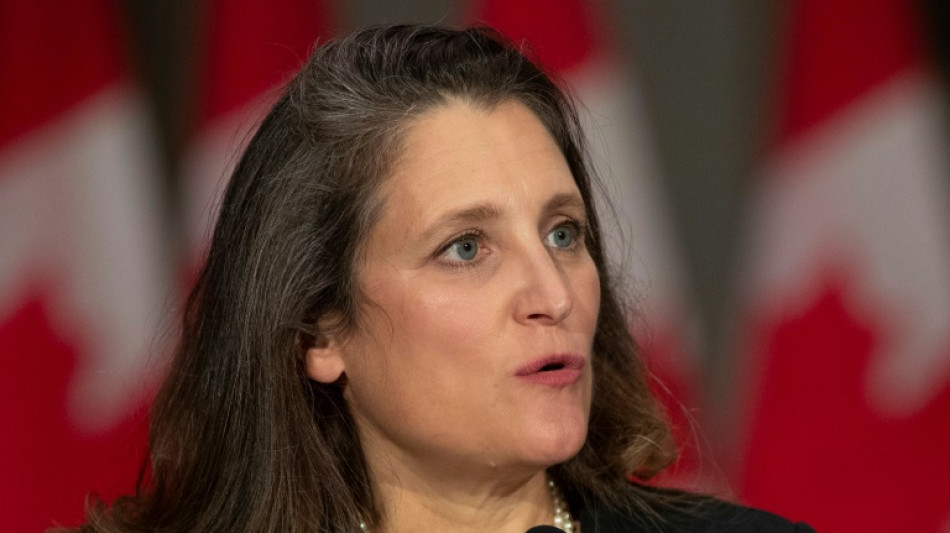
Canada budget amps military spending in response to Ukraine war

 Trump in Ireland for golf tournament, diplomatic pleasantries

 French police suspect train derailment was sabotage

 Trump lands in Ireland for golf tournament, PM talks

 Xi lands in India for BRICS summit overshadowed by war

 From crime to the Arctic: ultramarathoner film debuts in Toronto

 Back to the drawing board for disappointed Tiafoe

 Lady Gaga welcomes first child with fiance: US media

 Shelton tops Tiafoe to book US Open title clash with Zverev

 Shelton powers past Tiafoe to book US Open title clash with Zverev

 Venice Film Festival: A look back on the highlights

 'Widow's Bay' and 'The Pitt' are favorites for Emmys night

 'Everything different' as Zverev returns to US Open final

 Top seed Zverev holds off Khachanov to reach US Open final

 James McAvoy brings new film 'Faith' to Toronto fest

 Faultless Duplantis, hungry Ingebrigtsen shine at inaugural Ultimate

 Roblox to launch wallet to pay creators faster and will allow off-platform gaming

 Springboks wary of new-look All Blacks in Baltimore test

 Townsend, Siniakova win US Open doubles for career Grand Slam together

 Verstappen unimpressed with new Madrid street track

 Razaullah heroics deny England quickfire win in 3rd Test against Pakistan

 Masks banned at planned UK protests: police

 Antonelli on top ahead of Ferraris in Madrid practice

 Dance Fitness Tempe Announces Expansion of Accessible Digital Movement Programs

 Nashville airport to be renamed after Dolly Parton

 Argentina's Dirty War rears its head in Venice film

Canada's finance minister, in response to Russia's invasion of Ukraine, shelled out more money for the military in a budget Thursday that also aims to tackle soaring costs of living and a housing crisis.
But the additional Can$8 billion (US$6.4 billion) earmarked for defense over five years falls far short of a NATO target of spending two percent of GDP.
In a speech to parliament, Finance Minister Chrystia Freeland said: "Putin's invasion of Ukraine has reminded us that our own peaceful democracy -- like all the democracies of the world -- depends ultimately on the defence of hard power."
"We know that freedom does not come for free, and that peace is guaranteed only by our readiness to fight for it," she said. "That is why this budget makes an immediate, additional investment in our armed forces."
According to NATO, Canada currently spends 1.36 percent of GDP on the military, which is down slightly from just a few years ago.
To meet the two percent NATO target, Ottawa would have to set aside tens of billions of dollars more each year, according to parliament's independent fiscal watchdog and other experts.
Freeland suggested Ottawa could still close that NATO gap soon, proposing "a swift defence policy review to equip Canada for a world that has become more dangerous."
Canada, with one of the largest Ukrainian diasporas in the world, also announced an additional Can$1 billion in loans through the International Monetary Fund and Can$500 million in military aid for Ukraine this year.
The budget is the first since Prime Minster Justin Trudeau's Liberals won a third term in elections last September.
With support from a small leftist faction the minority government is expected to pass it in a soon-to-be held vote in the House of Commons.
- Slashing spending -
The budget will see spending slashed by Can$131 billion after the government doled out significant pandemic aid over the past two years that pushed the debt to a record Can$1.16 trillion this year.
At the same time, Freeland said she recognizes that Canadians are struggling with higher costs for almost everything and so the government is rolling out targeted measures to mitigate the impacts of inflation.
Notably, Ottawa aims to double the number of new homes built over the next decade to ease a supply crunch and soaring prices, as well as ban foreign investment in an overheated housing market.
It also earmarked billions of dollars for a new dental care program, coming on the heels of a new national childcare program.
And Ottawa is setting up a fund to attract private foreign investment in Canada's transition away from fossil fuels, raising taxes on banks and insurance companies, and supporting domestic exploration for critical minerals used to make electric vehicle batteries and semi-conductors.
After what Freeland described as having "teetered on the brink" in 2020 when the pandemic hit, the Canadian economy has rebounded strongly.
It has recovered 122 percent of the jobs lost in those early months, and the unemployment rate -- at 5.5 percent -- is now just shy of a pre-pandemic low, while economic growth is "1.2 percent above where it was before the pandemic," she noted.
Private sector economists surveyed by Ottawa forecast slightly slower growth of 3.9 percent in 2022 and 3.1 percent next year.
"After wave after wave and lockdown after lockdown, our economy has not just recovered, it is booming," Freeland said.
But getting through the last two years came at a "significant cost" and now the government must reduce spending as it reaches for an eventual balanced budget, she said.
"We are absolutely determined that our debt-to-GDP ratio must continue to decline," the minister said.
"Our pandemic deficits are and must continue to be reduced. The extraordinary debts we incurred to keep Canadians safe and solvent must be paid down."
The budget deficit is expected to fall from Can$113.8 billion in 2021-2022 to Can$52.8 billion in 2022-2023.
The debt-to-GDP ratio, meanwhile, is forecast to fall from 46.5 percent in 2021-2022 to 45.1 percent in 2022-2023.
T.Perez--AT
