Children of Chernigiv leave clues of Russian siege

 Mas on brink of Vuelta triumph as Landa claims stage 20

 No Kerr clash as Ingebrigtsen pulls out of Ultimate 1,500m
 Anthropic boss calls for slowing pace of AI development

 BRICS nations call for 'maximum restraint' in Middle East war

 England v Pakistan Test series: Three talking points

 Marquez snatches San Marino MotoGP sprint ahead of Bezzecchi
 Philippine ferry fire death toll climbs to 76 as identification process begins
 BRICS nations urge 'maximum restraint' in Middle East war

 Zelensky open to meeting Putin at G20 in Miami

 England survive scare to seal 3-0 sweep against Pakistan

 Trump says Irish unification would be 'fantastic'

 Bodies of Philippines ferry fire victims brought ashore as toll hits 35

 Flick warns Barca stars to keep focus after perfect start

 Trump in Ireland for golf tournament, diplomatic pleasantries

 French police suspect train derailment was sabotage

 Trump lands in Ireland for golf tournament, PM talks

 Xi lands in India for BRICS summit overshadowed by war

 From crime to the Arctic: ultramarathoner film debuts in Toronto

 Back to the drawing board for disappointed Tiafoe

 Lady Gaga welcomes first child with fiance: US media

 Shelton tops Tiafoe to book US Open title clash with Zverev

 Shelton powers past Tiafoe to book US Open title clash with Zverev

 Venice Film Festival: A look back on the highlights

 'Widow's Bay' and 'The Pitt' are favorites for Emmys night

 'Everything different' as Zverev returns to US Open final

In the dank basement of a children's hospital in Chernigiv there are cave paintings on the wall -- tiny handprints, a smeared rainbow, a fluttering Ukrainian flag.
After Russian bombs began to fall on February 24 the underage patients came here to wait out the fury being visited on the city above.
They daubed the walls to pass the hours and days. Some wrote their names inside the silhouette of a cluster of balloons: Myroslava, Vasylyna, Glasha, Ulya.
"I did not count them, but there were quite a lot," said 30 year-old Natalia, a member of Ukraine's territorial defence forces, barely visible in the stifling gloom.
Before Russia launched the war she was an interior designer. But this is a dwelling no reasonable person would choose, least of all for children.
The entrance to the stairwell has been smashed through a wall. There is head-splitting pipework hidden in the dim. The odour of damp hangs thick in the air.
"We are very grateful that the children were taken out before we had no electricity, no water and no heat," she said.
"Not all, but most of the children were taken out before all these benefits of civilisation disappeared."
"They got a chance to survive."
- A city encircled -
Chernigiv -- just 50 kilometres (31 miles) from the border with Belarus -- was swiftly encircled in the early days of the invasion ordered by Russian President Vladimir Putin.
Moscow's forces did not take the city but it was pounded with artillery and air strikes for more than a month before troops withdrew in recent days, regrouping for an offensive in eastern Ukraine.
Signs of the siege they waged to take this foothold towards the capital Kyiv are everywhere.
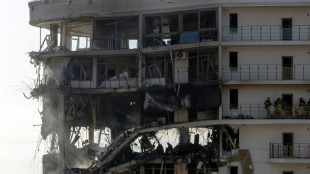
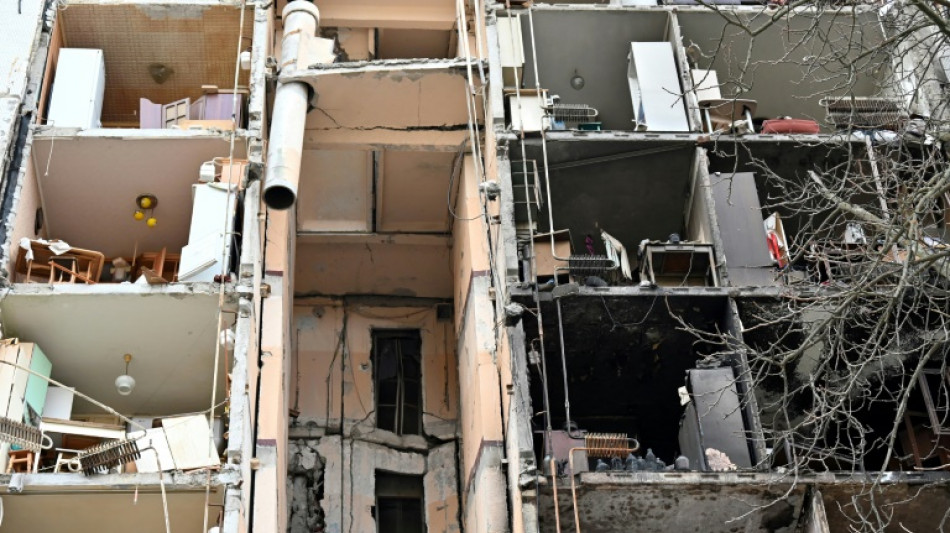
Apartment blocks have been gored by blasts. A hotel has a semicircle missing from its top half, as though the sky has taken a bite from above. The football stadium has been pummelled into its pitch.
The children's hospital has also been marked by the deluge. On the upper floor there is a puckered, charred wound from an incoming strike. The windows are flecked with holes.
Now it is being used to store aid supplies. The children -- cancer patients among them -- are no longer here. They have been transported south.
But there are clues of the traumas they endured. On a ledge outside, a plastic bag of Lego is paired with another collection of trinkets -- shrapnel garnered from the hospital grounds.
"Cluster bombs were flying, we have traces of these bombs," said 51-year-old Olena Makoviy. "The injured were brought to the children's hospital, both adults and children."
"It was very scary here from the first days of the war," she said. "They brought guys, handsome, young, but no longer alive."
- Neighbours bury neighbours -
City officials estimate around 350 civilians have been killed in Chernigiv.
Municipal council secretary Oleksandr Lomako said the city witnessed "war crimes" under "artillery, heavy weapons and bombs".
Civilians died waiting in line for water and bread, and in early March an air strike on a 12-storey residential building claimed 45 to 50 lives, he said.
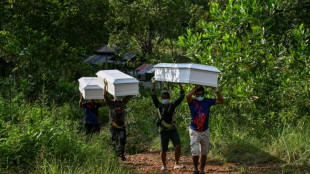
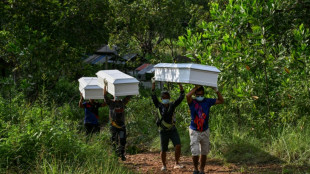
All of these bodies have been buried in a mass grave by fellow citizens, in a cleared patch of forest land.
Galyna Troyanovska, 66, has come to look for the son of a friend buried among the forest of grave markers staked in the mud.
Like the children of Chernigiv, she has been living underground.
"We did not go out of the basements," she said. "There was no water, no light, no gas, the walls were trembling."
"We try not to cry, we have already cried before," she adds. "We hold back, we need to live on."
A.O.Scott--AT