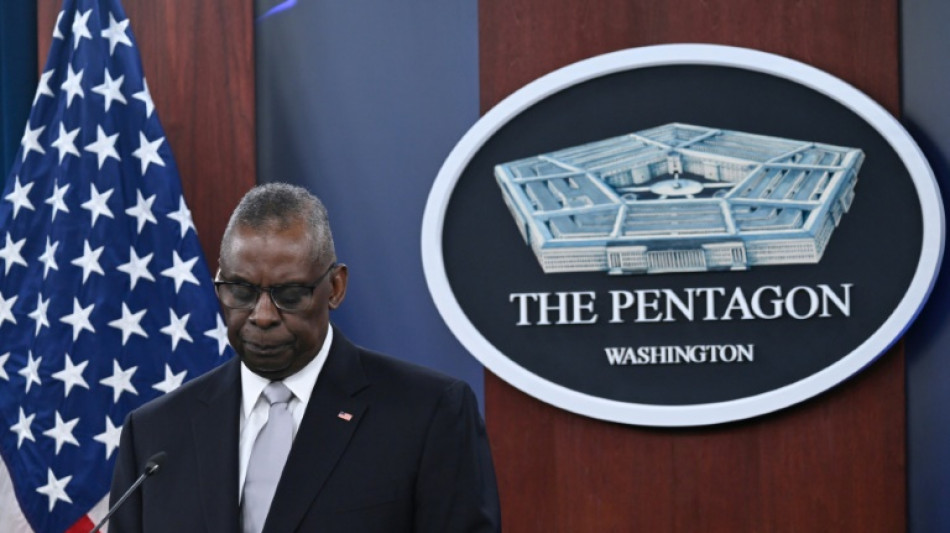
Hospitalized Pentagon chief hands duties to deputy / Photo: ANDREW CABALLERO-REYNOLDS - AFP

 None shall pass: Spain's defence ready to thwart Messi in World Cup final

 China's Kimi K3 rattles US AI industry

 Herbert takes Open lead, equals Burns' round of 62

 'Great innings ends': Cricket mourns West Indies great Sobers

 Fickle winds whip up huge Spanish wildfire

 US links Taco Bell lettuce to diarrhea-causing parasite outbreak

 Strong quake hits southern Mexico, tsunami alert lifted

 Deschamps set for bittersweet ending to France reign as Zidane waits

 German lawmaker faces criticism for US surrogacy to have a child

 Southern Mexico hit by 7.3 quake, triggering tsunami alert

 Germany defender Gosens signs with Schalke

 Nigerian court dismisses suit challenging Shell's divestment
 Ex-president Sall arrives back in Senegal for meeting with successor
 Brazil toughens rules on gambling ads as bets explode

 Swiss rider Schmid cramps up but wins Tour de France stage 13

 'Overpriced Dubai skyscraper': Slovaks outraged by ministry's $61-mn HQ
 Cubes and lubes: Europe's 'Speedcubers' twist for glory
 NFL boss teases Japan among 10 new nations for regular-season games

 Messi eyes glorious farewell as Spain, Argentina clash in World Cup final

 China landslide kills 8, at least 34 missing: officials
 France blocks access to Polymarket

 Warholm eyes win in London stadium that kickstarted his career
 Herbert takes British Open lead, equals major history with 62 alongside Burns

 Verstappen back on top in opening practice at Belgian Grand Prix
 MEXC Adds Five Ondo Tokenized Stocks Spanning Semiconductors to Power Infrastructure

US Secretary of Defense Lloyd Austin, who is fighting prostate cancer, transferred his duties to his deputy hours after he was taken to hospital for "an emergent bladder issue," a spokesman said Sunday.
Deputy Secretary of Defense Kathleen Hicks "assumed the functions and duties" just before 5:00 pm (2200 GMT), Pentagon spokesman Pat Ryder said in a statement, adding that Austin was still receiving treatment and that the White House and Congress had been informed.
The announcement came weeks after it emerged that Austin, 70, had kept previous hospital stays secret and had not immediately informed US President Joe Biden of his cancer diagnosis, sparking criticism as the United States faces crises in the Middle East and Ukraine.
Austin effectively vanished from the public eye for treatment for prostate cancer in December and again in January after suffering complications from the procedure.
This time, the public was alerted around two hours after he was sent to the hospital on Sunday afternoon.
Austin "was transported by his security detail to Walter Reed National Military Medical Center," Ryder said in an earlier statement.
"The Deputy Secretary of Defense and the Chairman of the Joint Chiefs of Staff have been notified. Additionally, White House and Congressional notifications have occurred."
Initially Ryder noted that the defense chief brought along classified communications systems and would be retaining "the functions and duties of his office."
The announcement that Hicks would instead be taking over came just a few hours later, however.
After coming under heavy political fire for keeping the previous hospital stays secret, Austin apologized earlier this month.
"I should have told the president about my cancer diagnosis," he told journalists on February 1.
At the time, he said he was still in recovery, suffering from leg pain and using a golf cart for transportation inside the Pentagon.
The undisclosed absences -- as well as this current hospital stay -- come at a time when the United States faces a spiraling crisis in the Middle East, with American forces in Iraq and Syria facing near-daily attacks from Iran-backed militants in retaliation for Washington's steadfast support of Israel.
The top US defense official is also a key figure in attempts by the Biden administration to maintain support for Ukraine's fight against Russian invasion, as Republican members of Congress refuse to authorize new funding for military aid to Kyiv.
Various Republican lawmakers previously called for Austin to be sacked, but Biden, while lamenting the Pentagon chief's lapse in judgment, has said he remains confident in his defense secretary.
Austin -- a commanding presence at well over six feet tall -- is an intensely private person who eschews the spotlight, which he said played into his decision to keep the cancer diagnosis secret.
But he admitted that "taking this kind of job means losing some of the privacy that most of us expect. The American people have a right to know if their leaders are facing health challenges that might affect their ability to perform their duties, even temporarily."
W.Stewart--AT