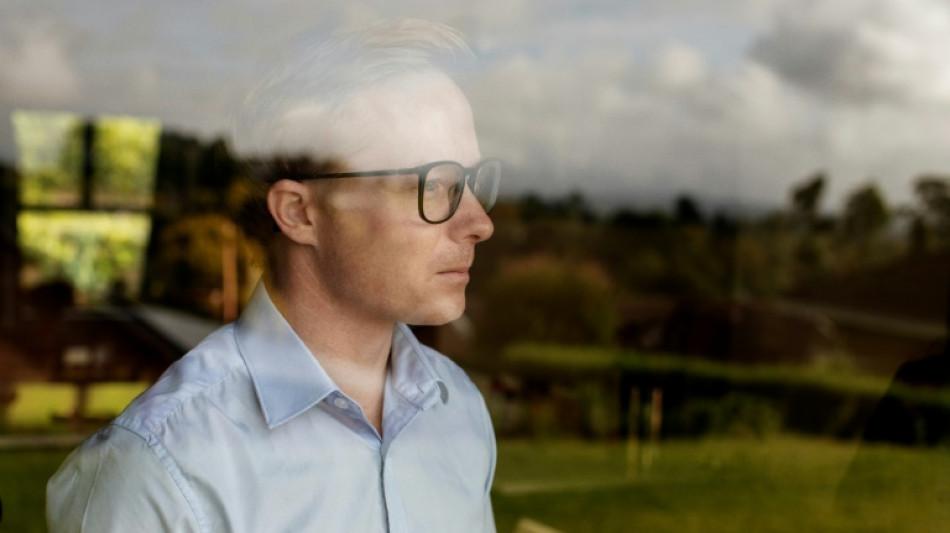
The election pitch of South Africa's white Zulu / Photo: GIANLUIGI GUERCIA - AFP

 Antonelli fastest for Mercedes in second practice in Belgium
 US links Taco Bell lettuce to multistate parasite outbreak
 Garry Sobers, towering West Indies cricket all-rounder, dies at 89
 France, Germany plan 'roadmap' to tackle China trade imbalances
 Tech share selloff rolls on, oil prices climb on Mideast clashes

 Swiss rider Schmid wins Tour de France stage 13
 Neymar returns to Santos with questions hanging over his future

 Wildfire smoke engulfs millions in US ahead of World Cup final
 Russia fines anti-war politician as he suffers medical episode
 Herbert equals major record round of 62 to take British Open lead
 New Labour leader Burnham vows to renew hope as next UK PM

 Kerr targets world mile record, Hodgkinson happy to 'run free'
 'Concerns' after Amnesty labels J.K. Rowling women's centre 'anti-rights'

 Horror film 'Obsession' is exploding cinema profit records

 EU reforms carbon market under pressure from industry

 Russia fines anti-war politician in chaotic court hearing
 Georgia capital to demolish unfinished landmark amid political feud
 Argentina await FIFA decision over displaying World Cup Falklands banner
 Volvo Cars sees declining sales in 'challenging' environment
 India launches first hydrogen-powered train in clean energy push
 MEXC May–June Report: 750M+ USDT Futures Insurance Fund & 100% Asset Reserves

 Petula Clark, 93, hopes real singers will survive the AI tide
 Japan outlaws flag desecration despite critics
 From coal pits to wind turbines, Polish miners rise to the occasion
 Opposition to data centres grows in cramped urban Japan

Chris Pappas doesn't look like a typical politician in South Africa's key electoral battleground, the populous province of KwaZulu-Natal.
Thirty years after democracy was won, South Africa's leadership is still dominated by black veterans of the anti-apartheid struggle.
Pappas, however, is a young-looking 32, born more than a year-and-a-half after Nelson Mandela was released from prison -- and white.
Nevertheless, he has risen above the identity politics of KwaZulu-Natal to become mayor of the uMngeni Municipality and a candidate to perhaps run the entire province.
His pitch to the overwhelmingly black and Zulu electorate is simple: he promises efficient government after what he sees as wasted opportunities of years under the ruling ANC.
Elsewhere in South Africa his party, the liberal opposition Democratic Alliance (DA), suffers from its image as a home for voters from the country's white minority.
But in uMngeni this Zulu-speaking mayor is on good terms with many black voters and keen to show them that he can run their local government with their immediate needs in mind.
When he came to office in the 120,000-person district in 2021, one of his first decisions was to hire a public buildings manager.
"Maintenance didn't exist, it was a foreign concept. It was all about building and building, new and shiny, and cutting ribbons," he told AFP.
- Blazer and slacks -
Before, he said, when the council needed to change a light-bulb it issued a contract. Now the facility supervisor can fix it, saving, he argued, 100,000 rand (5,000 euros) a year.
In his sharp blue blazer and khaki slacks, blonde short-back-and-sides neatly combed, he stood out on a visit to overall-clad motor mechanics in the black township of Mpophomeni.
But he was a welcome visitor. He was keen to chat with every employee and to provide a helping hand to 55-year-old Sozabile Gumbi to invest in new tools and equipment.
He has criticised the clientelist approach of the ANC, but here he was picking a local small business to support, in a bid to build ties and create jobs.
"That's how employment is created," he told AFP.
"That's our approach, we are applying the theory of massive small change. Solving big problems with lots of small solutions. People notice them when they add up."
He listened to each employee carefully, shook their hands and cheerfully acted as a translator for non Zulu-speaking visitors.
Further along, he showed AFP how the township has been installing solar power, in a country where three decades of ANC rule has left much of the economy prey to daily power cuts.
Street lamps now light the street at night, increasing a sense of safety, and homes have individual panels that can light a single bulb and charge a mobile phone.
Everyone had a request. Middle class citizens want the potholes fixed to protect their cars, poorer people want their grandmother's crumbling mud-brick home shored up.
But will Pappas' white skin, and DA allegiance, hurt him when he stands in the broader election to become premier of the whole province?
"There's the propaganda that our opponents spread: The DA is going to bring back apartheid, the DA is going to take away people’s grants, whatever it might be," he admitted.
"But here we are in government and apartheid hasn't come back. We haven't taken away people's grants. We haven't stolen people's houses."
Pappas' bilingualism, in a country where most whites speak the Afrikaans or English descended from Dutch and British colonial settlers, seems to help him.
In the street he is accosted by laughing young Zulu men demanding selfies. As he resumed his tour they called after the young mayor: ""We're voting out the old people"."
"Chris Pappas is white in every sense of the word. But he's also relatable to the black community. He can transcend those racial barriers," deputy mayor Sandile Mnikathi says.
"It's refreshing, he's young and coming with different ideas ... The nuance that comes with tradition and culture, he understands it and lives it," added the 28-year-old.
Race is still a big issue in South Africa, and the ruling ANC is facing a DA challenge from its right and a radical left challenge from black parties like the EFF.
This year's general election may mark the first time that Mandela's party of liberation loses its absolute majority as voters question its record in government.
- 'Same blood' -
Politicians like Pappas, if they can bridge the old divides, could yet profit.
Thembi Mchunu, a 60-year-old pensioner, said she had been disappointed by ANC rule after a hopeful start. Now, she's backing a white mayor he calls by his first name.
"Chris came and he is attending to everyone," she told AFP. "He speaks Zulu like he is a black person. He goes to all the schools. He even goes to churches, attends funerals."
Unemployed 38-year-old Siyabonga Zundi agrees. "We have the same blood. Chris has the same blood as I've got," he insisted, dismissing the race question.
Pappas clearly prefers street-level municipal management to big political rallies. "I like figuring out how to use power to get things done," he told AFP.
But if he is going to run a bigger area like KwaZulu-Natal, the former student in town planning will need to translate local success to the provincial stage.
"People are often scared of the word 'power' but really its opposite is 'powerlessness'," he said. "So if you don’t have power you can’t do anything. How to use that power is important."
H.Romero--AT