Israeli wineries near Lebanon fear ruined crop as war looms / Photo: jalaa marey - AFP

 Marquez wins in Malaysia to stand on brink of MotoGP world title

 Binance says resuming withdrawals after major hack

 Divided Bulgaria votes in tense presidential runoff

 Trump says US looking 'closely' at report Nvidia CEO target of China spy plot

 Maxey scores 38 to lead Sixers 'fighters' to another comeback win
 Valkyries defeat Dream to capture first WNBA crown

 'Seen and heard': Uruguay neighborhood places hopes in pope

 Spewing US election falsehoods, AI chatbots face scrutiny

 EU's new levy on parcels kicks in

 Ocon denies reports of altercation after being dumped by Haas

 Hamilton says love of racing keeps him young

 'Disgraceful' Australia face reckoning after South Africa humbling

 Sovereignty wins Breeders' Cup Classic, Benvenuto Cellini triumphs in Turf for O'Brien

 Hamilton takes record 105th pole and first for Ferrari, as Antonelli lurks

 German rioters loot shops as 'Gen Z' demos turn ugly

 Barca hammer Alaves to retain Liga top spot

 UK king to address Commonwealth with 'unflinching honesty' amid slavery focus

 US judge dismisses Trump lawsuit against Wall Steet Journal over Epstein letter

 Polish president holds crisis talks in court standoff
 NFL to review new allegations against Packers' Jacobs: reports

 Le Havre owners sack coach after PSG thrashing

 De Minaur upsets Zverev and will face Alacaraz in Vienna final

 German police, protesters clash after 'Gen Z' demos
 Fresh frustration for Maresca as Man City lose to Brighton
 Norris fastest ahead of Antonelli in final Mexico practice

Black clouds loom over grapevines in northern Israel on hills that stretch to the Lebanese border, where months of violence have raised fears of a wider war.
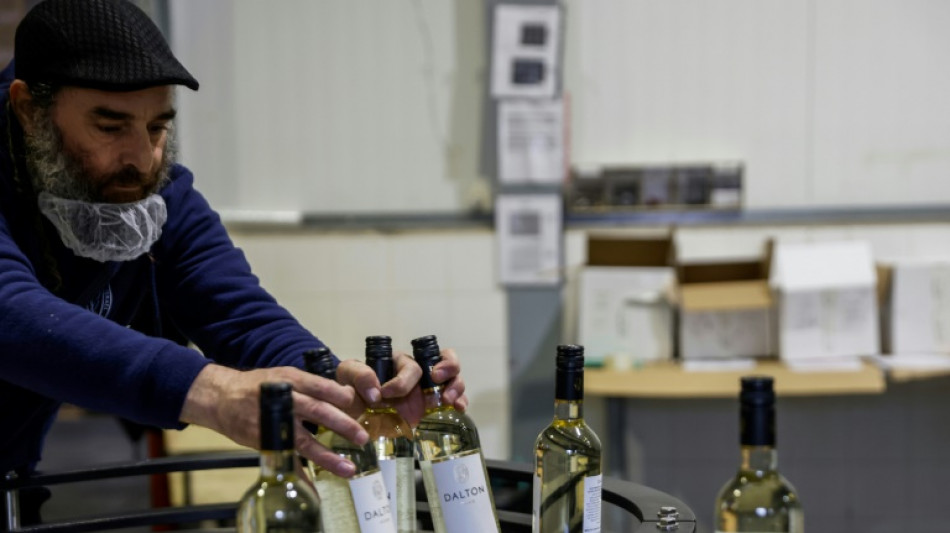
The tense border area -- where the Israeli army has traded deadly fire with the Hezbollah militant group for months -- can be seen from atop the Dalton Winery's fermentation vats.
Alex Haruni, the vineyard's owner, worries that if a full-scale war were to break out, it could also ruin the coming vintage.
"That's quite a lot of wine," he said.
The vines must be pruned before spring, and nature won't wait for peace.
"We have until March to get this done," Haruni said. "If not, the year is gone."
Israel has been at war in Gaza since the Palestinian militant group Hamas launched its October 7 attack, and has also traded fire with Lebanon's Iran-backed Hezbollah movement, a Hamas ally.
Almost four months of conflict have heaped new challenges on Israel's wine industry, including labour shortages and falling demand in the war-weary nation, a year after extreme heat caused a poor harvest.
Along the UN-patrolled border with Lebanon, where vineyards and orchards crowd the mountain slopes, the situation is particularly precarious ahead of the growing season, experts say.
Hezbollah has fired rockets and missiles almost daily since the Gaza war began, killing nine Israeli soldiers and six civilians, according to Israeli officials.
Israel's frequent retaliatory strikes have killed more than 200 people in southern Lebanon, most of them Hezbollah fighters, according to an AFP tally.
There are fears of worse to come. Israel and Hezbollah last fought a major war in 2006.
At the time, rockets rained down on Israel's north during the summer, but a ceasefire was struck in time for growers to harvest their grapes.
Defence Minister Yoav Gallant said on Sunday he had directed Israel's air force to "point the noses of the planes north and prepare for any harm that may come".
- 'Manpower crisis' -
Rami Na'aman, owner of a winery in Ramot Naftali, an Israeli village near the Lebanese border, said the fighting had forced him and thousands of others from their homes.
He can only reach his establishment twice a week, provided the military hasn't closed the roads.
The head of the Bank of Israel, Amir Yaron, warned last month that the war's "adverse economic impact... is substantial", especially on the construction and tourism industries.
Migal, an Israeli research institute, in November published a survey of 389 farmers, more than three quarters of whom projected an "average 35 percent drop in production and income".
The farming sector faces "the greatest manpower crisis since the state's founding" in 1948, the agriculture ministry said recently.
Thousands of foreign workers have fled Israel since the start of the war, and many agriculture labourers have been called up to the army as reservists.
The government has barred entry to tens of thousands of Palestinian labourers from the occupied West Bank and the besieged Gaza Strip.
Like other sectors, the wine industry has been hit by these problems.
Eyal Miles cultivates vines and cherries on the slopes around Kerem Ben Zimra, a farming hamlet home to four wineries just six kilometres (less than four miles) from Lebanon.
Miles, too, is worried about whether the pruning can be done by spring.
The field-hands he typically hires to help on his seven hectares (17 acres) of land, he said, are "afraid to work here due to the proximity to the border".
- Falling consumption -
At Dalton Winery, a Hezbollah projectile damaged vines in one plot near the frontier, forcing the business to issue field workers with helmets and flak jackets.
Around 10 percent of its vines are in closed military zones and inaccessible.
Visitor centres, usually a key source of revenue for northern wineries of all sizes, now lie empty with tourists steering clear of the region.
On top of these problems, the war has "clearly caused a decline in wine consumption" across Israel, said Haim Gan, a wine industry expert and founder of The Grape Man, a wine tasting emporium.
He blamed the call-up of more than 300,000 reservists, the postponement of weddings and other celebrations, and the generally "lifeless, unpleasant atmosphere" in the country.
At Dalton Winery, the slate of difficulties means that Haruni is considering laying off staff.
Miles, meanwhile, said a sharp drop in visits to his business has meant that "since October 7, the winery is closed", while online sales barely pick up the slack.
He remained optimistic, however, that despite the threat of a war in the north, "we will overcome this".
By the end of March, he predicted, "it will all be pruned and it will be ready for the coming harvest".
N.Mitchell--AT