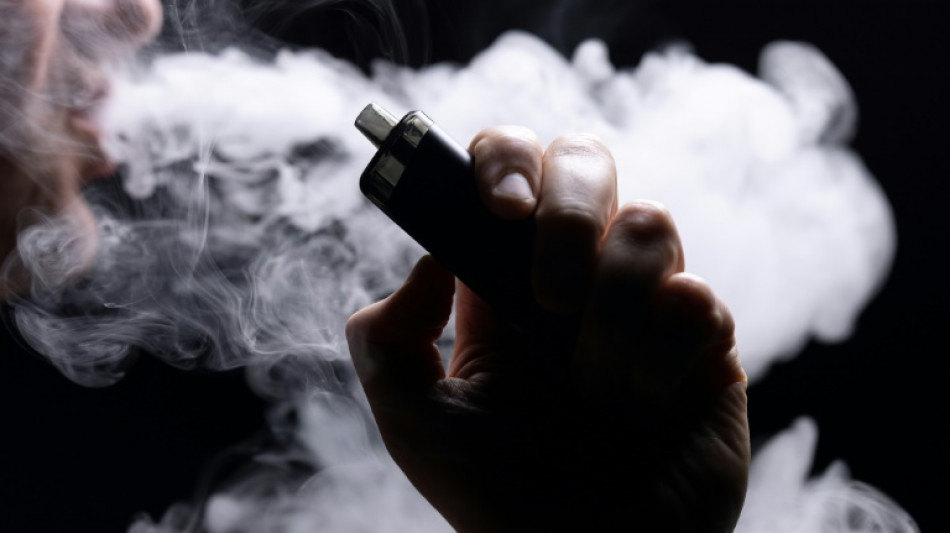
The fight over vaping: Lobbyists, campaigners clash before summit / Photo: JOEL SAGET - AFP/File

 US stocks gain after reassuring inflation data, tech giants advance

 EU accepts X's plan to fix digital content violations

 Toronto air ranked among world's worst as wildfire smoke billows south

 Argentina and England set for World Cup semi-final showdown

 Argentina protects landmark Obelisk as World Cup madness mounts

 Tour stage winner Waerenskjold inspired by Manx Missile Cavendish

 Canada central bank holds key rate steady, says economy improving

 Trump tells immigration agents to resume traffic stops despite killings

 Hong Kong police raid independent bookstore run by former journalists

 Castres' ex-All Black Papali'i ruled out for six months

 British Open chiefs have no plan to change schedule if England reach World Cup final

 Orban's ex-FM quits Hungary parliament for China's BYD

 Up to 45% of dementia risk can be prevented, delayed: WHO

 Tech stocks lead gains, oil prices rise

 Bangkok bar fire toll rises to 33 as PM vows venue overhaul

 Power restored across Cuba after third outage in two weeks

 France in 'very worrying' drought: minister

 Attempted burglary at Yamal's home after World Cup triumph: police, media

 European stocks drop as oil prices rise

 Broad says England need extra ODI seamer after India defeat

 Myanmar leader to visit Thailand next month: Thai FM to AFP

 Belgian great Meunier signs for Premier League side Sunderland

 Kenya denies Rastafarians the right to smoke weed

 Generative AI's power sparks fears of dumbing humans down

 'Like my lover': Chinese users bid farewell to AI companions

Does vaping offer an opportunity for smokers to kick their deadly tobacco habit, or pose a vast new health threat to the world's young people?
This long-smouldering question has again come to the forefront in the run-up to a tobacco summit being held by the World Health Organization next week.
It will likely be the scene of a familiar fight pitting proponents of e-cigarettes -- including some lobbyists for the tobacco industry -- against anti-smoking campaigners.
Vaping and other recent smoking innovations are expected to be high on the agenda as country representatives gather in Panama City on Monday, tasked with revising a WHO treaty on tobacco control.
E-cigarette devices do not contain tobacco. Instead, they are loaded with a liquid usually containing nicotine that is inhaled as vapour.
The process does not involve tar or carbon monoxide, the main drivers of the countless cancers and heart diseases linked to tobacco, suggesting that vaping should be less harmful than smoking.
However, the WHO has declined to acknowledge that vaping is any less dangerous than cigarettes.
This position, shared by many anti-smoking campaigners, is based on the precaution principle.
Because there is very little research on vaping dating back more than a decade, it is impossible to rule out that it could pose an unknown, long-term threat to people's health.
This lack of clarity has led to very different national policies. More than 30 countries have banned vaping, but it is largely unregulated in others.
- Big Tobacco influence -
Outraged pro-vaping groups say these bans deprive smokers of a crucial way to quit tobacco, which is confirmed to be a massive threat to public health.
This pro-movement is partly led by the traditional tobacco industry, which was initially slow to join the vaping revolution, but has now heavily invested in e-cigarettes and new tobacco products.
In October, the Guardian revealed that a senior vice-president at tobacco giant Philip Morris International told staff to fight back against the WHO's "prohibitionist attack on smoke-free products".
Philip Morris International told AFP that it is "committed to presenting to governments and the media the value of innovation for reducing smoking rates more rapidly".
Tobacco Tactics, a group linked to the UK's University of Bath, documented a large number of interactions between the tobacco industry and British legislators between 2021 and 2023, according to researcher Tom Gatehouse.
The "vast majority" of these interactions were about "vaping and newer products and the regulation of them," he told AFP.
Gatehouse accused Big Tobacco of trying to regain influence by falsely posing as fighters against cigarettes, which are still the industry's biggest source of income.
He admitted that "it's a very complex scenario," because some pro-vaping lobbying is conducted by other e-cigarettes producers, whose interests sometimes diverge from the tobacco industry.
And other independent groups "really do believe that vaping is a solution to smoking," said Amelie Eschenbrenner, spokeswoman for France's National Committee Against Smoking.
She said that one way to spot of the influence of the tobacco industry is that it has deliberately sown confusion about the difference between e-cigarettes and heated tobacco products, which use tobacco and are considered probably more harmful than vaping.
But even sincere defenders have a habit of speaking about vaping in ways not backed by scientific evidence, Eschenbrenner said.
This was particularly the case when opposing measures aiming to stem teenage vaping, such as prohibitions on youth-focused flavours or recent bans on disposable e-cigarettes in the UK and France, she added.
- What does the research say? -
A Cochrane review -- considered the gold standard for analysing the available knowledge -- found there was strong evidence that e-cigarettes are more effective for quitting smoking than nicotine patches.
But another question lingers: Do the young people who have taken up vaping in huge numbers eventually move on to cigarettes?
Jamie Hartmann-Boyce, who has led several Cochrane reviews on vaping, told AFP that "there is clear evidence that young people who vape are more likely to go on to smoke".
But it is not clear that this is driving more young people to smoke who would not have anyway, she added. If that were the case, youth smoking would be rising overall -- instead it is declining in most countries.
Many medical researchers have called for vaping to remain legal as a tool for quitting smoking, while doing everything possible to stop young people from taking up either habit.
"If people switch completely from smoking to vaping they substantially reduce their risk of premature death and disability," Nicholas Hopkinson, professor of respiratory medicine at Imperial College London, told AFP.
"But people who do this should be encouraged to quit vaping as well in the long run."
W.Moreno--AT