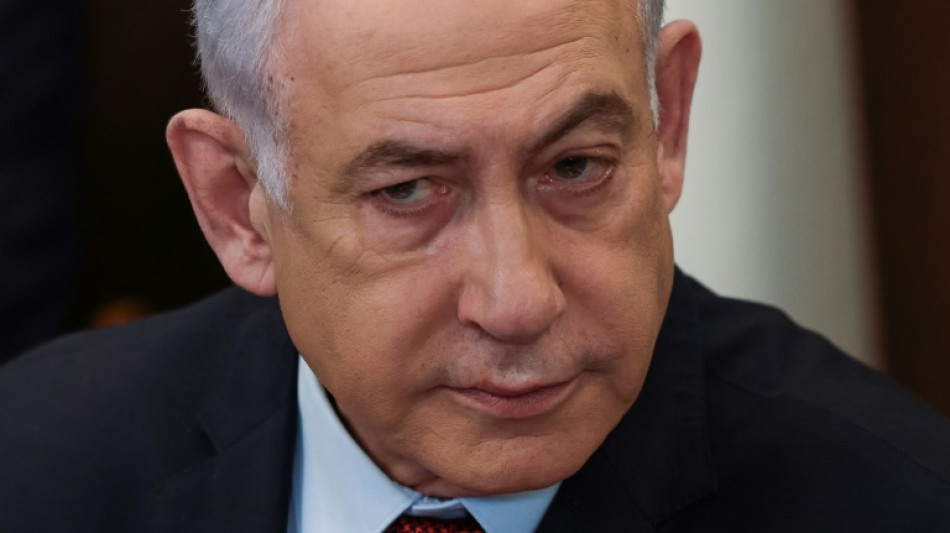
Netanyahu's political tightrope on Hamas hostage deal / Photo: RONEN ZVULUN - POOL/AFP

 US stocks gain after reassuring inflation data, tech giants advance

 EU accepts X's plan to fix digital content violations

 Toronto air ranked among world's worst as wildfire smoke billows south

 Argentina and England set for World Cup semi-final showdown

 Argentina protects landmark Obelisk as World Cup madness mounts

 Tour stage winner Waerenskjold inspired by Manx Missile Cavendish

 Canada central bank holds key rate steady, says economy improving

 Trump tells immigration agents to resume traffic stops despite killings

 Hong Kong police raid independent bookstore run by former journalists

 Castres' ex-All Black Papali'i ruled out for six months

 British Open chiefs have no plan to change schedule if England reach World Cup final

 Orban's ex-FM quits Hungary parliament for China's BYD

 Up to 45% of dementia risk can be prevented, delayed: WHO

 Tech stocks lead gains, oil prices rise

 Bangkok bar fire toll rises to 33 as PM vows venue overhaul
 Power restored across Cuba after third outage in two weeks
 France in 'very worrying' drought: minister

 Attempted burglary at Yamal's home after World Cup triumph: police, media

 European stocks drop as oil prices rise

 Broad says England need extra ODI seamer after India defeat

 Myanmar leader to visit Thailand next month: Thai FM to AFP

 Belgian great Meunier signs for Premier League side Sunderland

 Kenya denies Rastafarians the right to smoke weed

 Generative AI's power sparks fears of dumbing humans down

 'Like my lover': Chinese users bid farewell to AI companions

Israeli Prime Minister Benjamin Netanyahu is engaged in intense political manoeuvring as pressure grows at home and abroad to release hostages held in Gaza and bring fighting to a halt.
A proposal to free the hostages in exchange for a pause in Israel's offensive in the Palestinian territory is being studied by Hamas leaders after it was thrashed out by Israel, Qatar, Egypt and the United States.
US Secretary of State Antony Blinken is expected in Israel soon for talks with Netanyahu on the proposal.
But far-right members of Israel's ruling coalition have said they would bring down Netanyahu's government if the proposal is agreed, with National Security Minister Itamar Ben-Gvir warning parliament on Wednesday: "A dangerous deal means the dissolution of the government."
As public outrage steadily grows over the hostages, Netanyahu is working to keep his extreme-right allies on side despite their threats to walk, experts told AFP.
"I think that because of the amount of pressure on the government from the Israeli public... the government will agree to some kind of prisoner exchange," said Israela Oron of the Ben-Gurion University of the Negev, referring to a previous deal that saw Israeli hostages released in exchange for Palestinian prisoners.
"Netanyahu is trying to prepare his coalition for this hostage deal."
Opposition leader Yair Lapid presented an alternative option to the premier on Wednesday, saying his party would back a freeze in fighting if it meant hostages were released.
"I'm not ready for the hostages not to be released for political reasons, so we'll do whatever it takes, if we have to enter the government... we'll enter the government," Lapid told Israeli broadcaster Channel 12, offering to join Netanyahu's coalition to save its parliamentary majority.
- Doubts over coalition threat -
But the last-minute scrapping of a Lapid-Netanyahu meeting scheduled for Thursday cast doubts on whether the political overtures between the two forces would amount to anything, experts said.
Suggestions that Ben-Gvir and other extreme-right leaders would follow through on their threats to bring down the government were dismissed by experts.
"I don't see the extreme-right ripping apart a government which is their dream government -- this is the high point of their careers thus far, unlikely to be repeated again," said Reuven Hazan, a professor of political science at the Hebrew University of Jerusalem.
While November's pause to the fighting lasted a week, the latest accord aims to pave the way for an initial six-week halt.
A Hamas source told AFP the three-stage plan would start with this halt which would see more aid deliveries into the Gaza Strip.
Only "women, children and sick men over 60" held by Gaza militants would be freed during that stage in exchange for Palestinian prisoners in Israel, the source said, requesting anonymity because of the sensitivity of the talks.
There would also be "negotiations around the withdrawal of Israeli forces", with possible additional phases involving more hostage-prisoner exchanges, said the source, adding that rebuilding the territory was also among issues addressed by the deal.
Netanyahu is facing a delicate balancing act between recognising the urgency of securing the release of hostages and not being seen as giving in to Hamas demands, experts said.
- 'Not at any price' -
On Wednesday, he said his government was working "to reach an agreement to free our hostages, but not at any price".
"We won't take soldiers out of Gaza, we won't end the war and we won't free thousands of terrorists," Netanyahu said.
The war in Gaza was triggered by Hamas's October 7 attack on Israel, which resulted in the deaths of around 1,160 people, mostly civilians, according to an AFP tally based on official figures.
Militants also seized about 250 hostages. Israel says 132 remain in Gaza, including at least 27 people believed to have been killed.
Following the deadliest attack in Israel's history, its military launched a withering air, land and sea offensive that has killed at least 27,019 people in Gaza, most of them women and children, according to the health ministry in the Hamas-run territory.
Experts said that Netanyahu and his extreme right coalition members are likely to stay the course throughout the war, even if another hostage deal is agreed.
"I don't see Netanyahu all of a sudden jettisoning those who are willing to support him on the issues that are important to him," said Hazan of the Hebrew University of Jerusalem.
"If I had a dollar for every time the extreme right said they would leave the government, I would be on vacation on a sunny beach somewhere."
M.O.Allen--AT