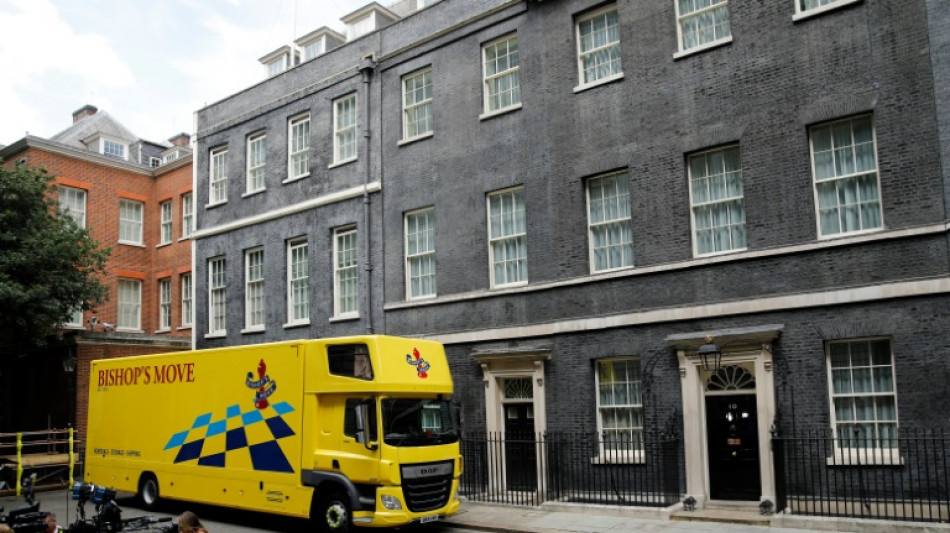
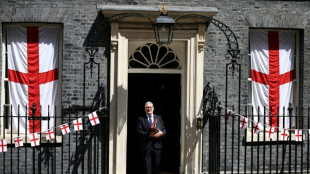
On course for power, UK's Labour prepares for a quick change / Photo: Tolga AKMEN - AFP

 US stocks gain after reassuring inflation data, tech giants advance
 EU accepts X's plan to fix digital content violations

 Toronto air ranked among world's worst as wildfire smoke billows south
 Argentina and England set for World Cup semi-final showdown

 Argentina protects landmark Obelisk as World Cup madness mounts
 Tour stage winner Waerenskjold inspired by Manx Missile Cavendish
 Canada central bank holds key rate steady, says economy improving
 Trump tells immigration agents to resume traffic stops despite killings
 Hong Kong police raid independent bookstore run by former journalists

 Castres' ex-All Black Papali'i ruled out for six months

 British Open chiefs have no plan to change schedule if England reach World Cup final

 Orban's ex-FM quits Hungary parliament for China's BYD

 Up to 45% of dementia risk can be prevented, delayed: WHO
 Tech stocks lead gains, oil prices rise

 Bangkok bar fire toll rises to 33 as PM vows venue overhaul

 Power restored across Cuba after third outage in two weeks
 France in 'very worrying' drought: minister
 Attempted burglary at Yamal's home after World Cup triumph: police, media
 European stocks drop as oil prices rise
 Broad says England need extra ODI seamer after India defeat

 Myanmar leader to visit Thailand next month: Thai FM to AFP

 Belgian great Meunier signs for Premier League side Sunderland
 Kenya denies Rastafarians the right to smoke weed

 Generative AI's power sparks fears of dumbing humans down

 'Like my lover': Chinese users bid farewell to AI companions
If the main opposition Labour party wins the next UK general election as opinion polls indicate, then a familiar sight will appear outside the prime minister's official residence the next day: removal vans.
The overnight transition, unique in major Western democracies, contrasts with the roughly two months' preparation for an incoming US administration and around 10 days for a new French president.
But if Labour defeats the governing Conservatives by a majority at this year's nationwide vote, its leader Keir Starmer will replace Rishi Sunak inside 10 Downing Street within hours.
The UK's politically neutral 500,000-strong civil service, satirised in the hit 1980s British sitcom "Yes Minister", will immediately find itself working for new government ministers with new priorities.
Key to the quick changeover are so-called "access talks" between the opposition party and senior civil servants, which occur in the run-up to an election.
Tory leader Sunak recently gave Labour permission to commence these discussions with mandarins in Whitehall -- the catch-all term for the civil service -- and they are due to start imminently.
"They're important because they're the only opportunity before the election for opposition politicians to privately share their thinking and their ideas with the civil service government machine," former civil servant Alex Thomas told AFP.
They are also a chance for civil servants to inform future ministers and their advisers about any operational issues they may encounter at the department they might soon lead.
"It's an opportunity for people to build a working relationship," added Thomas, who was involved in access talks before the 2017 election when he worked in the office of the cabinet secretary, the head of the civil service.
- Secrecy -
The talks are confidential and almost always happen away from government offices to avoid any chance of ministers running into their opposite number sneaking a chat with their permanent secretary -- the most senior civil servant in a department.
Permanent secretaries are expected to stick to providing factual information only.
They are not to provide policy advice or inform the opposition of imminent government announcements, and must not report back to the government what they have been told.
Often, the opposition chooses to keep quiet any major policy plans that they have yet to announce publicly, just to be sure of no leaks.
Jill Rutter received a surprise when she worked at the Treasury in 1997, as Tony Blair's New Labour party swept into power after 18 years of Conservative rule.
"We had our first big meeting. (Then new Chancellor) Gordon Brown came into the office, and he said, 'I'm going make the Bank of England independent.' And we all went, 'What?!'" recalled the former civil servant.
Access talks began at least 16 months before the 1997 and 2010 elections, the last time there was a change of majority government, according to the Institute for Government (IfG) think tank.
Labour will have around nine or 10 months of discussions if Sunak calls the election for the autumn.
If he goes early in the spring, then they could have as little as four months.
- Stability -
Despite being in opposition for 14 years, Labour's top team has ministerial experience in Yvette Cooper and Ed Miliband, while Starmer himself was a senior civil servant in his former role as director of public prosecutions for England and Wales.
"They are probably more experienced at the top level than they were in 1997," Rutter told AFP.
"The interesting thing is, can they actually sort of translate that into action when they get into government?"
The myth of the civil servant, popularised by fictional mandarin Sir Humphrey Appleby in "Yes Minister", is that of conniving bureaucrat seeking to thwart the minister's objectives.
"In reality, most of the time the minister wins and that is the way it should be because the minister is democratically elected," said Thomas, now at the IfG.
Rutter noted that civil servants had experienced "almost non-stop change" in recent years, with five Conservative prime ministers since the 2016 Brexit vote and endless ministerial reshuffles.
Some lawmakers have also taken to blaming the civil service, with several permanent secretaries moved on.
Many bureaucrats will be looking for stability from a new administration, Rutter said.
"I think the civil service will want reduced churn, hopefully more clarity of direction, and a government that's not tearing itself to ribbons all the time," she said.
Th.Gonzalez--AT