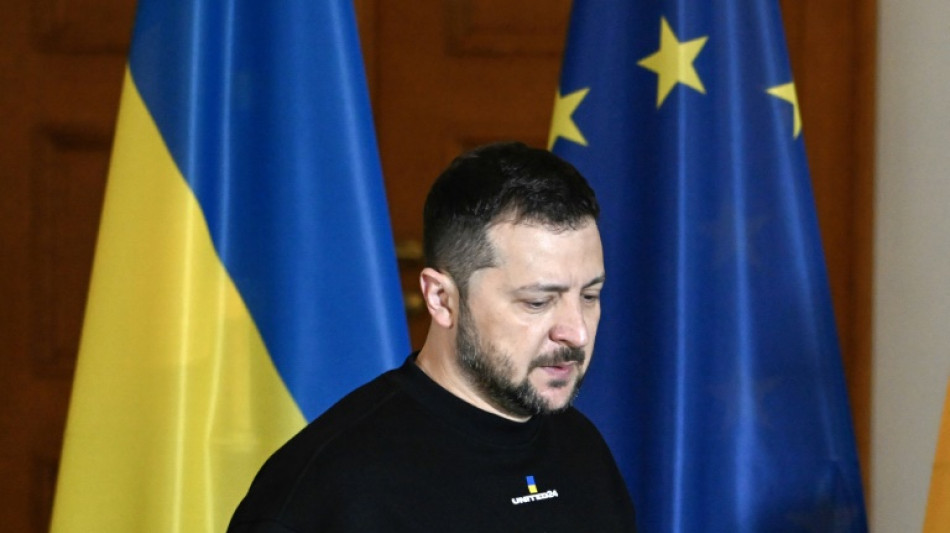
EU moves to tap profits from Russian assets for Ukraine / Photo: Tobias SCHWARZ - AFP

 Ahead of World Cup semi-final, Argentine VP calls English 'pirates'
 Tech stocks wobble, oil prices slip back
 Court rules England World Cup winner died from brain injury linked to heading

 Waerenskjold wins fastest ever Tour de France stage
 Crowds cross Gibraltar-Spain frontier as border controls vanish

 Women's rights charity ends Stade Francais deal after McLean arrival
 McIlroy says fast-running British Open fairways a 'double-edged sword'

 Cricket World Cup revamp could see extra India-Pakistan clash
 German leader not opposed to Chinese taking over car plants

 Trump tells immigration agents to keep traffic stops despite killings
 Starmer bids UK MPs 'goodbye', vows to support Burnham
 Sri Lanka expands anti-dengue drive as deaths mount
 Germany's BASF lifts forecasts but Mideast war casts shadow
 Germany World Cup exit reveals structural failures, says Leverkusen boss

 Local 'hero': Bellingham's hometown buzzing ahead of semi-final clash
 UN says Sudan resources fuel civil war

 Meta employees allege discriminatory AI-driven layoffs

 India's Sindhu targets medal at home world championships

 UN warns of cracks in global immunisation system

 Bangkok bar fire toll rises to 32 as PM vows venue overhaul

 Badminton underdogs enjoy 'amazing' 16 minutes of fame in Japan
 US expands sanctions targeting Iran oil, cryptocurrency sectors

 'We don't have time': Montenegro's bird haven fading

 Dutch tech giant ASML posts gain in second-quarter profits
 US renews blockade, trades strikes with Iran over Hormuz strait

The EU has reached an agreement on a first step towards tapping profits from frozen Russian assets to help pay for rebuilding war-ravaged Ukraine, officials said.
EU ambassadors agreed on a plan to set aside the profits from the assets in order for them to eventually be used to help pay for Ukraine's reconstruction, the Belgian presidency of the European Union said on X, formerly Twitter, late Monday.
The agreement moves forward a long and legally fraught debate about how to use Russian state assets that were blocked by Western institutions immediately in the wake of Moscow's all-out invasion of Ukraine nearly two years ago.
The EU has frozen some 200 billion euros ($220 billion) of Russian central bank assets, with about 90 percent of those funds held by the international deposit organisation Euroclear, based in Belgium.
Simply confiscating all that money and giving it to Ukraine's reconstruction efforts is not seen as an option, as that could rattle international markets and undermine the euro.
Some countries, notably Belgium, had proposed a windfall tax on the frozen funds that could generate some three billion euros a year for Kyiv.
The European Commission made a cautious proposal that was put to all 27 EU member countries under which deposit holders like Euroclear would first have to separate interest or profits earned on the frozen assets and ring-fence them.
A second proposal was to be put forward later on how the ring-fenced profits could then be shifted into a fund that would go to Kyiv.
Lithuania's ambassador to the EU, Arnoldas Pranckevicius, called the overnight preliminary agreement a "very important and long awaited decision".
But, he said on X, it was "only the beginning of the road," adding: "Now looking forward to the 2nd step proposal from the European Commission on the use of profits for reconstruction of Ukraine and the start of discussion on confiscating assets themselves."
- G7 issue -
The issue goes beyond the EU. The bloc acted in concert with the G7 group of wealthy nations to freeze the Russian assets.
The United States wants a collective G7 decision on how to tap the Russian money.
Diplomats say Washington is increasingly in favour of outright confiscation of all frozen Russian funds, but that the Europeans have pushed back on that.
The movement on the frozen funds issue comes at an otherwise difficult time for Ukraine as continued Western support runs into political headwinds in both Washington and Brussels.
In the United States, opposition Republicans are blocking further US funds and weapons for Ukraine in manoeuvring over domestic issues, notably migration.
And in the European Union, Hungary -- whose leader Viktor Orban is close to Russian President Vladimir Putin -- has blocked a 50-billion-euro EU financial lifeline for Kyiv.
A summit in Brussels on Thursday will again tackle that issue with hopes of persuading Hungary to drop its veto.
The estimated total cost of rebuilding Ukraine is at least $411 billion (380 billion euros), according to a joint assessment put out in March last year by the World Bank, the European Commission and the United Nations.
R.Chavez--AT