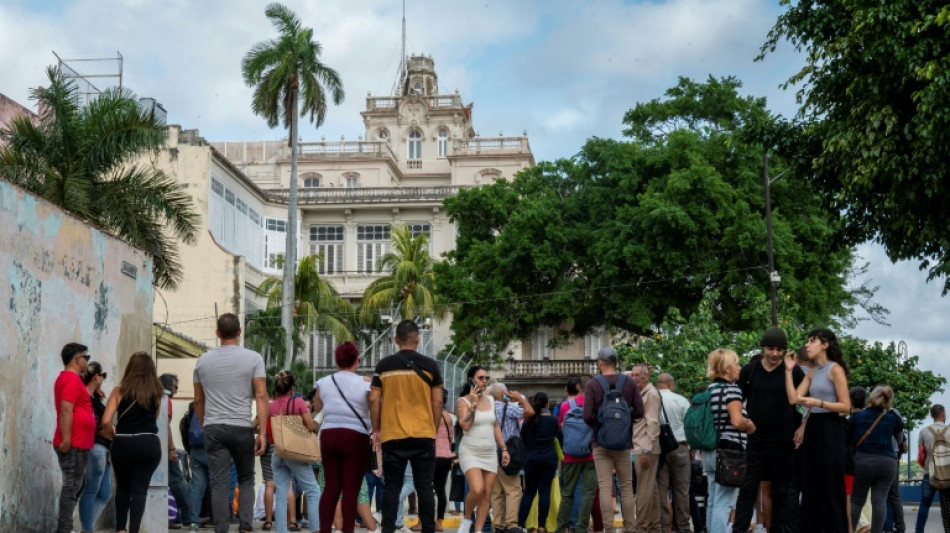
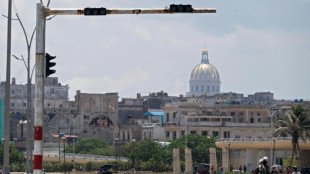
'There was nothing': Ailing economy fueling record exodus of Cubans / Photo: Yamil LAGE - AFP

 Ahead of World Cup semi-final, Argentine VP calls English 'pirates'

 Tech stocks wobble, oil prices slip back

 Court rules England World Cup winner died from brain injury linked to heading

 Waerenskjold wins fastest ever Tour de France stage

 Crowds cross Gibraltar-Spain frontier as border controls vanish

 Women's rights charity ends Stade Francais deal after McLean arrival

 McIlroy says fast-running British Open fairways a 'double-edged sword'

 Cricket World Cup revamp could see extra India-Pakistan clash

 German leader not opposed to Chinese taking over car plants

 Trump tells immigration agents to keep traffic stops despite killings
 Starmer bids UK MPs 'goodbye', vows to support Burnham

 Sri Lanka expands anti-dengue drive as deaths mount

 Germany's BASF lifts forecasts but Mideast war casts shadow

 Germany World Cup exit reveals structural failures, says Leverkusen boss

 Local 'hero': Bellingham's hometown buzzing ahead of semi-final clash

 UN says Sudan resources fuel civil war

 Meta employees allege discriminatory AI-driven layoffs

 India's Sindhu targets medal at home world championships

 UN warns of cracks in global immunisation system

 Bangkok bar fire toll rises to 32 as PM vows venue overhaul

 Badminton underdogs enjoy 'amazing' 16 minutes of fame in Japan
 US expands sanctions targeting Iran oil, cryptocurrency sectors

 'We don't have time': Montenegro's bird haven fading

 Dutch tech giant ASML posts gain in second-quarter profits

 US renews blockade, trades strikes with Iran over Hormuz strait

Even as her home country of Cuba crumbled around her, Elsa resisted joining the growing US-bound exodus until she felt she had no options left.
But the 30-year-old finally packed her bags last year, and after a long and dangerous journey made it to Miami in November.
She's among the nearly five percent of the island's population that has fled to the United States in the past two years, the biggest wave of emigration since Fidel Castro's revolution.
"It was very difficult to meet even one's basic needs. There was nothing," Elsa told AFP of her reasons for leaving, asking her last name not be shared.
"The (electricity) blackouts became unbearable and then there was (the price of) food."
The communist island is in the grips of its worst economic crisis in decades, with sky-high inflation and shortages of fuel, medicine and basic foodstuffs -- and US sanctions -- aggravating an already dire situation.
Like thousands before her, Elsa flew to Managua, Nicaragua, and from there made her way 3,000-odd kilometers (about 1,900 miles) to the US border.
On Saturday, the US Customs and Border Protection agency said it had registered more than 153,000 irregular entries from Cuba in 2023.
Another 67,000 entered legally under a humanitarian parole program, introduced a year ago by President Joe Biden's administration in a bid to slow illegal migration.
Together with the 313,506 who left in 2022, this mass movement represents "the largest number of Cuban migrants recorded in two years since the beginning of the post-revolutionary Cuban exodus in 1959," said Jorge Duany, director of the Cuban Research Institute at Florida International University.
These 533,000 Cubans represent almost five percent of the island's 2022 population of 11.1 million.
- 'A substantial loss' -
Other historic migration waves included the so-called Mariel boatlift in which about 130,000 left Cuba as refugees in the 1980s, and the 35,000-odd who fled in a "raft exodus" in 1994.
"Many young people with high educational and occupational levels" left in the last two years, creating "a substantial loss of human resources" for Cuba, said Duany.
The country already has one of the oldest populations in the region.
The latest mass exit started in November 2021, when Cuban ally Nicaragua lifted its visa requirement for Cubans.
Last year, there was a surge in chartered flights to the Central American country, a waypoint for those making their way to the United States -- an increase so noticeable that Washington sanctioned the carriers involved.
- 'There's everything here' -
Not all Cuban migrants head for the United States, however. Latin American countries and Europe are also popular destinations, though there is no official global figure.
Some 36,574 paperless Cuban migrants sought refuge in Mexico in 2022 and 2023, while at least 22,000 entered Uruguay and hundreds arrived in Chile in the same period, according to official figures from these three countries.
Radibel Pena, a 28-year-old carpenter, flew last April from Havana to Georgetown, Guyana, which does not require a visa from Cubans.
He then crossed the jungles of Brazil and made it to Bolivia, from where he entered Chile illegally on May 1.
"There's everything here. One can work with dignity and live well," he told AFP in Valparaiso, where he lives with his girlfriend and works in construction.
In Europe, Spain is a favorite Cuban destination, especially since the passage in 2022 of a so-called "Grandchildren's Law" that allows Spanish descendants to obtain nationality.
Marco Antonio Napoles Alvarez, a 24-year-old waiter from the Cuban province of Holguin, hopes to make a new life in Madrid with his sister.
"We plan to settle down there to see if we do well," he told AFP as he left the Spanish embassy in Havana with a big smile -- and a Spanish passport in hand.
Ch.Campbell--AT