
Breivik provokes as he seeks parole, a decade after Norway attacks

 Man allegedly behind 'targeted' attack on Australian lawmaker appears in court
 Musk backs SpaceX-Tesla merger as rocket firm turns profit

 Zelensky, US hail 'productive' talks to end Trump feud
 'Unbelievable' Foden back in the groove with treble in Man City rout
 Pistons rally to beat Celtics in NBA 2026-27 season opener

 PSG late show downs Barca in Champions League, Liverpool fight back
 Liverpool strike back to beat Villarreal in seven-goal thriller
 Dow boosted as markets rotate from tech shares
 Zelensky hails resumption of US advance warning of strikes on Ukraine
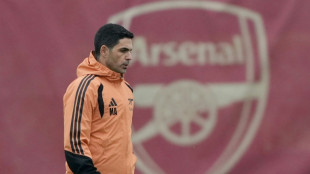
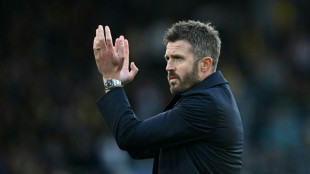 Carrick says only wins can ease doubts over Man Utd future

 Top NBA Draft pick Dybantsa to miss opener with ankle sprain
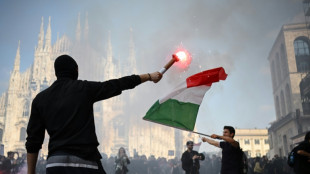 Italy sends troops, toughens security laws after Milan clashes
 Alberta separatists vow to fight on, risking turmoil for Canada
 Two men re-arrested for suspected spying for Iran in airbase scare: UK police

 Guatemalan man gets 30 years for truck smuggling deaths of 53 migrants

 'Clayface' gets under the skin of the superhero genre
 Zelensky, US envoys hold Oslo talks as Ukraine claims US missile holdup
 All-rounder Minhas stars as Pakistan crush England in tri-series
 Bavuma hits 179, Rabada strikes as South Africa dominate
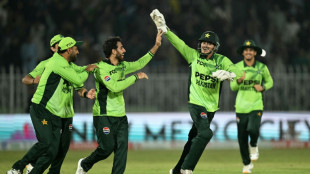 Allrounder Minhas stars as Pakistan crush England in tri-series
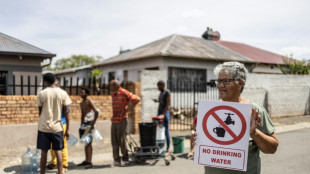
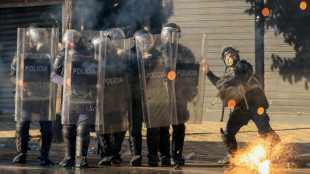 Albania PM blames 'hybrid war' for week of unrest
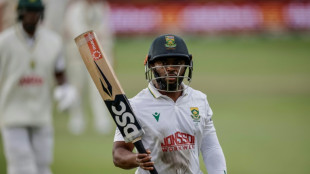 Bavuma hits 179 to lead South African fightback
 Solid GM results overshadowed by latest jump in commodity costs
 Houthi attacks undermine Saudi Arabia's economic ambitions

 French PM vows 'massive' police deployment for new demonstrations
Right-wing extremist Anders Behring Breivik made Nazi salutes and lauded white power on Tuesday as he asked for parole just 10 years after carrying out Norway's deadliest peacetime attack, using his court appearance to spread his ideology.
The 42-year-old told the three judges he had distanced himself from violence and insisted he could not be held responsible for the July 2011 attacks that left 77 people dead because he had been "brainwashed" by the neo-Nazi movement Blood and Honour.
Wearing a black suit, white shirt and gold tie, Breivik had earlier made a Nazi salute to greet the judges of the district court in the southern region of Telemark, convened for security reasons in the gymnasium of the Skien prison where he is incarcerated.
His remarks failed to convince experts, survivors and the families of the victims, who had feared he would take advantage of the three-day hearing, broadcast live by several media with a slight delay, as a platform for his radical views.
On July 22, 2011, Breivik killed eight people when he set off a truck bomb near government offices in Oslo, then gunned down 69 others, most of them teenagers, at a summer camp for the Labour party youth wing on the island of Utoya.
He said he killed them because they embraced multiculturalism.
He was sentenced in 2012 to 21 years in prison, to be extended indefinitely as long as he is considered a threat to society.
Under Norwegian law at the time, he had to serve at least 10 years before he was eligible to apply for conditional release.
The families' fears were confirmed off the bat on Tuesday: appearing with a shaved head, he entered the room carrying a sign written in English reading "Stop your genocide against our white nations."
During a long address, he told the court he was merely a "foot soldier" for the Blood and Honour movement that he said was responsible for the attacks, acknowledging only that he had allowed himself to be radicalised.
Giving his "word" that he had now distanced himself from violence and terror, he said he wanted to continue his National Socialist struggle in a non-violent fashion.
But he said he was ready to renounce any political activities if the court asked him to do so.
- 'Keep up the illusion' -
"It is very clear that he assumes responsibility for what he did even if he's trying to distance himself", commented Tore Bjorgo, director of the Centre for Research on Extremism (C-REX) at the University of Oslo.
"He said what he had to say to keep up the illusion for a conditional release but he revealed his true self earlier when he justified the crimes", he told AFP.
When prosecutor Hulda Karlsdottir read out the long list of victims and how they died, Breivik interrupted her, saying that "72 percent of them had leading positions in the Labour Party".
In his attempt to exonerate himself -- at times so bizarre it elicited laughs from those seated in the room -- Breivik dissected his own radicalisation process.
In a long and rambling ideological speech rarely interrupted by the judge, Breivik referred often to a "cultural war" and "white power".
Survivors and families of the victims were upset by the publicity Breivik received.
"It's not because it's 'scandalous' or 'painful' that I think Breivik shouldn't be broadcast", Elin L'Estrange, who survived the attacks, wrote on Twitter.
"It's because he's a symbol for the extreme-right who has already inspired several other mass killings".
- 'Don't want him released' -
Breivik's attacks were Norway's deadliest since World War II, and his request is widely expected to be rejected.
But the hearing is seen as yet another test of Norway's rule of law, where Breivik has a right to be treated like any other citizen before the courts.
In 2016, Breivik -- who has three cells at his disposal in prison, with a television and DVD player, a games console and a typewriter -- got the Norwegian state convicted of "inhumane" and "degrading" treatment because of his isolation from other inmates.
The verdict was overturned on appeal.
This is not the first time Breivik has claimed to renounce violence.
He has previously made similar remarks in court and in his letters, to AFP among others, even comparing himself to Nelson Mandela.
His 2011 massacre has inspired other attacks, including that in Christchurch, New Zealand in 2019.
Prior to Tuesday's hearing, a support group for the families said it wanted to "encourage as little focus as possible on the terrorist and his message."
Meanwhile, Breivik's father Jens Breivik told Germany's tabloid Bild he thought the parole hearing was "absurd".
"Anders will never get out. Probably not during the next 20 years. I don't want him released".
W.Moreno--AT