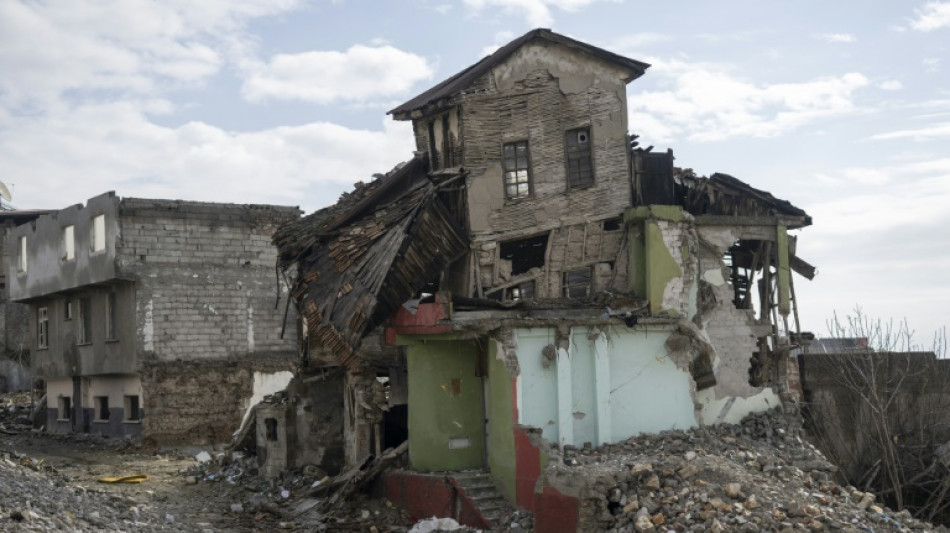
Fear, uncertainty and grief year after Turkey's quake / Photo: YASIN AKGUL - AFP

 McIlroy says fast-running British Open fairways a 'double-edged sword'

 Cricket World Cup revamp could see extra India-Pakistan clash
 German leader not opposed to Chinese taking over car plants
 Trump tells immigration agents to keep traffic stops despite killings
 Starmer bids UK MPs 'goodbye', vows to support Burnham
 Sri Lanka expands anti-dengue drive as deaths mount

 Germany's BASF lifts forecasts but Mideast war casts shadow

 Germany World Cup exit reveals structural failures, says Leverkusen boss

 Local 'hero': Bellingham's hometown buzzing ahead of semi-final clash
 UN says Sudan resources fuel civil war

 Meta employees allege discriminatory AI-driven layoffs

 India's Sindhu targets medal at home world championships

 UN warns of cracks in global immunisation system
 Bangkok bar fire toll rises to 32 as PM vows venue overhaul
 Badminton underdogs enjoy 'amazing' 16 minutes of fame in Japan
 US expands sanctions targeting Iran oil, cryptocurrency sectors

 'We don't have time': Montenegro's bird haven fading
 Dutch tech giant ASML posts gain in second-quarter profits
 US renews blockade, trades strikes with Iran over Hormuz strait

 Australian PM says to enact laws to govern AI

 China's economic growth hits slowest pace in more than three years
 Seoul leads Asian stocks higher as US inflation eases rate fears

 Duped or spun with juju: how sex trade trafficks Nigerian women

 France fireworks fizzle as Spain advance to World Cup final
 Gibraltar and Spain end border checks

Over 65 nightmarish seconds of the pre-dawn hours of February 6, 2023, the ground swallowed swathes of entire cities across Turkey's southeast, resulting in more than 50,000 deaths.
The initial 7.8-magnitude earthquake shook the ground as far away as Egypt.
Bridges collapsed, roads and airport tarmacs cracked, and millions of lives across 11 Turkish provinces were upturned by the time the rest of the country woke up, stunned.
A year later, hundreds of thousands remain displaced, many of them living in container cities, while the rest of the quake-prone country waits in fear for the next big shake.
"I had 3,700 registered voters. Only 1,300 are left," said Ali Karatosun, a mukhtar (village chief) in Kahramanmaras province, not far from the epicentre of Turkey's worst disaster of modern times.
More than 850,000 buildings crumbled in the initial quake and the thousands of aftershocks that followed, including a 7.5-magnitude one that afternoon.
In the Syrian border province of Hatay, where the ancient city of Antioch -- now called Antakya -- formed the cradle of Muslim and Christian civilisations, just 250,000 of the original 1.7 million inhabitants remain.
"Our Hatay is gone. Completely gone," said Mevlude Aydin, 41, who lost her daughter, husband and a dozen relatives.
- 'No money. No jobs' -
The disaster put enormous political pressure on President Recep Tayyip Erdogan, who faced re-election later that year.
Responding to criticism that rescuers were too slow to react, leaving many initial survivors trapped under rubble in the freezing cold, the veteran leader promised to build 650,000 housing units within a year.
Eleven months later, the construction of 307,000 housing units has been launched, of which 46,000 have been delivered, according to environment and urbanisation ministry data.
In the meantime, families that chose to stay in the disaster zone and were unable to find accommodation have been housed in metal container homes the size of small studios.
The containers have access to free running water and power, offering safety and warmth. But families have few surviving possessions and their immediate prospects are unclear.
The Hatay region lost the same number of buildings in seconds as it usually takes a decade to build, an Economic Policy Research Foundation of Turkey (TEPAV) report found.
In Adiyaman province, at the opposite end of the quake zone, 40 percent of the buildings collapsed.
"The earthquake will create a financing need of approximately $150 billion over a five-year period," the economic policy institute said in a comprehensive report.
"The cost of reconstruction and rehabilitation will have a significant and long-term negative impact on the Turkish economy."
The affected region was already under intense economic strain, being home to half of the 3.7 million refugees who fled civil war in neighbouring Syria.
"No money. No jobs. We are far from returning to normal," said Kadir Yenicel, a 70-year-old in Kahramanmaras, echoing the worries of many across the disaster zone.
"People don't know what to do."
- 'Band-aid solutions' -
The instant collapse of so many buildings in one of the world's most earthquake-prone regions points to the greed of unscrupulous property developers and corruption among bureaucrats who signed off on unsafe building projects, experts say.
In two of the more egregious examples, nearly all 22 buildings in one high-rise complex collapsed in Kahramanmaras, claiming 1,400 lives, and hundreds more died when their luxurious Renaissance residence crumbled in Antakya.
The handful of wilful negligence cases opened so far have avoided prosecuting officials, focusing on contracts instead.
Meanwhile, Turkey is no better prepared for another earthquake than it was one year ago, experts say.
"There is still much to be done," said Mihat Kadioglu, a disaster management professor at Istanbul Technical University.
"Measures should go beyond mere band-aid solutions, and require a real and more fundamental reform."
While it caused temporary panic, particularly in quake-prone cities such as Istanbul, the disaster "did not lead to a change in behaviour among the public or officials", Kadioglu said.
And even if safety standards are better enforced, buildings could still fall if erected without proper soil studies or on dangerous terrain such as riverbeds, as was the case in Kahramanmaras, he said.
Dilfuroz Sahin, who heads the town planning chamber in southeastern Diyarbakir, struck a more optimistic tone, saying officials were updating their seismic maps and conducting "stricter, more numerous inspections".
Zihni Tekin, an engineering consultant, strongly disagreed, expressing disappointment that Erdogan overcame the quake to secure re-election last May.
Turkey's problems cannot be solved by "completely corrupt and ignorant people", he said, referring to Erdogan's Islamic-rooted AKP party.
H.Gonzales--AT