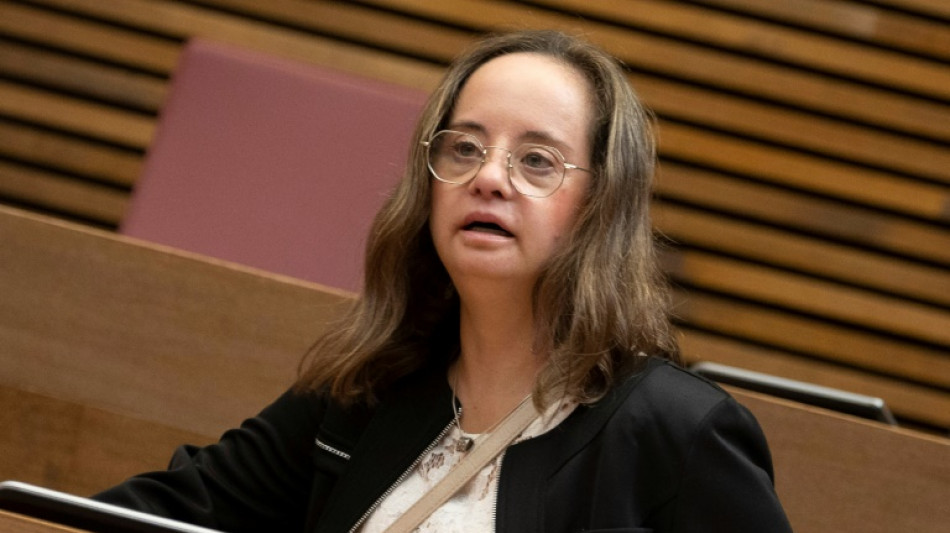
Pioneering MP hails disability reform in Spain / Photo: JOSE JORDAN - AFP

 McIlroy says fast-running British Open fairways a 'double-edged sword'

 Cricket World Cup revamp could see extra India-Pakistan clash

 German leader not opposed to Chinese taking over car plants
 Trump tells immigration agents to keep traffic stops despite killings

 Starmer bids UK MPs 'goodbye', vows to support Burnham
 Sri Lanka expands anti-dengue drive as deaths mount

 Germany's BASF lifts forecasts but Mideast war casts shadow

 Germany World Cup exit reveals structural failures, says Leverkusen boss

 Local 'hero': Bellingham's hometown buzzing ahead of semi-final clash

 UN says Sudan resources fuel civil war

 Meta employees allege discriminatory AI-driven layoffs

 India's Sindhu targets medal at home world championships

 UN warns of cracks in global immunisation system

 Bangkok bar fire toll rises to 32 as PM vows venue overhaul

 Badminton underdogs enjoy 'amazing' 16 minutes of fame in Japan

 US expands sanctions targeting Iran oil, cryptocurrency sectors

 'We don't have time': Montenegro's bird haven fading

 Dutch tech giant ASML posts gain in second-quarter profits

 US renews blockade, trades strikes with Iran over Hormuz strait

 Australian PM says to enact laws to govern AI

 China's economic growth hits slowest pace in more than three years

 Seoul leads Asian stocks higher as US inflation eases rate fears

 Duped or spun with juju: how sex trade trafficks Nigerian women

 France fireworks fizzle as Spain advance to World Cup final

 Gibraltar and Spain end border checks

Addressing Valencia's regional parliament, Mar Galceran's confidence is striking: she is Spain's first lawmaker with Down syndrome and one of just a few elected across Europe.
She is fighting to change Spanish society's approach to people with disabilities, the formal description of which was amended in the Constitution on Thursday.
Galceran, 46, was voted into Valencia's regional parliament in September, the first person with Down syndrome to be elected in Spain at regional or national level.
Elected as an MP for the right-wing opposition Popular Party (PP), she wants "to change the way society views people with disabilities".
And she has welcomed the rare move to revise Spain's Constitution to replace the word "handicapped" ("disminuido") with "people with disabilities" which was approved by the Senate upper house on Thursday.
Using the term "disminuido" or its colloquial equivalent "minusvalido" ("less valid") has long been "offensive and insulting to the collective of people with disabilities", she told AFP.
"Because we are not 'diminished' nor are we 'less valid'. We are not worth less than other people."
The reform, which also expands their rights, is only the third-ever change to Spain's Constitution since it was approved in 1978, and the first of a social nature.
"Words matter," she said, explaining the importance of "seeing the people and not the disability they have".
- A 'necessary' reform if late -
A member of the PP since she was 18, she spent many years as a civil servant, and always took a stand against the discrimination she faced over her genetic condition.
She spent four years as head of Asindown, a foundation in the Valencia region which helps the families of children with Down syndrome.
An avid runner who loves dancing and once worked in childcare, Galceran says her teenage years were marked by "rejection".
Growing up, she had "acquaintances but never friends, because they saw me as different and didn't really count me as a friend".
Her network of real support always came from her family, who "have always supported me in my decisions".
Since being sworn in, Galceran has been active in the parliamentary committee on people with disabilities, which she believes needs a "cross-party" approach within the healthcare sector, within families, within work and education.
"And there's still a lot left to be done."
For her, the constitutional reform was one of the top priorities.
While it remains largely symbolic, Galceran sees it as a "fair" and "necessary" step -- even if it should have happened earlier.
- 'With different abilities' -
Until now, the wording of article 49 of the Constitution has said that Spain's public authorities are responsible for policies involving the "treatment, rehabilitation and integration of the physically, sensory and mentally handicapped".
The new version says "persons with disabilities are entitled to rights" that must be exercised in "freedom and genuine equality, without discrimination", and stresses the importance of attention to "the specific needs of women and girls with disabilities".
A large majority of Spanish Senators approved the reform in its final reading on Thursday. Only the three from far-right party Vox voted against, arguing they did not want to vote in unison with the ruling left.
Socialist Prime Minister Pedro Sanchez said the measure settled "a moral debt owed to more than four million Spaniards" with one degree or another of disability.
"There is still a long way to go to achieve full inclusion, to embrace the diversity that defines us and to make visible what for so long was painfully ignored," he added during a debate in the lower house of parliament last week, acknowledging the reform was "late".
"The first thing we must do is ask their forgiveness" for using "such an offensive term for so many years," he added.
For Galceran, the debate over language needs to go even further: one day she hopes that even the term "disabled" will be changed to refer to "people with different capacities".
ctpe/vab/hmw/ds/giv
D.Lopez--AT