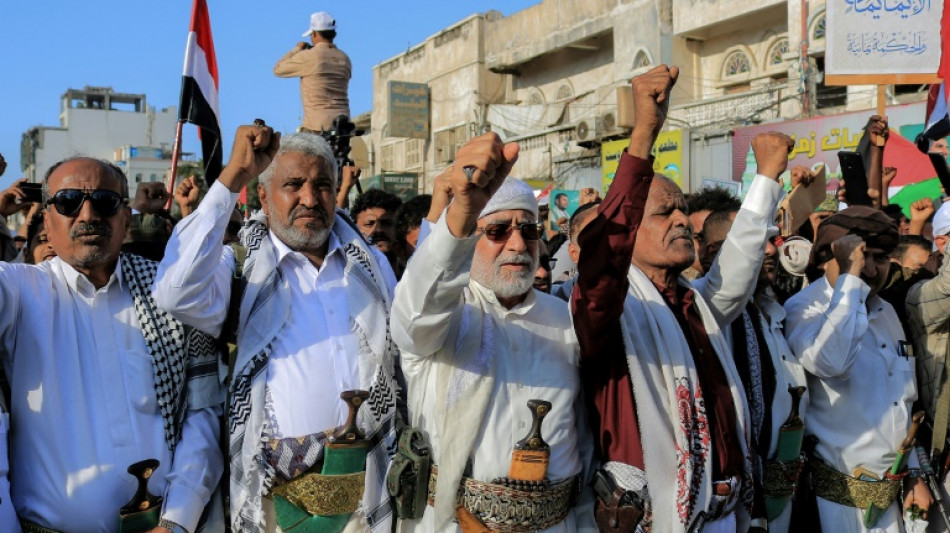
Biden, the reluctant escalationist, seeks calm after Yemen strikes / Photo: - - AFP

 Australian swimmer O'Callaghan reveals she has spinal fractures

 Argentina and England collide with World Cup final spot at stake

 AI ignites 'ignored sector' for Japan chipmaker Kioxia

 Writers union sues to block US Paramount deal

 UK announces social media curfew for older teens

 Italy court to rule in deadly bridge collapse case

 Tuchel unfazed by history ahead of England v Argentina World Cup semi

 Scaloni says fatigue not a concern for Argentina in World Cup semi-final

 2026 Gold IRA Company Reviews: Independent Rankings of the Top Gold IRA Providers Released

 'Immense disappointment': Mbappe rues end of World Cup dream

 Viva! Delirium in Madrid as Spain reach World Cup final

 NFL Texans co-founder McNair dead at 89

 Spain deliver World Cup masterclass against France to reach final

 Brook upbeat about England ODI form amid Test captaincy uncertainty

 Record-smashing heat wave surges from West to eastern US, Canada

 Wildfires that ravaged historic forest outside Paris contained

 NY state pauses new large data center projects in US first

 England v Argentina: World Cup battles

 Argentina v England in the World Cup: much more than just a game

 Green groups sue to block Trump rule gutting species habitat protections

 Man Utd sign Aston Villa midfielder Tielemans

 Pogacar inspired by Djokovic after Tour de France jeers

 Balogun admits red card furore affected US World Cup team

 Pogacar inspired by Djokovic amid Tour de France jeers

 'Gus' the T. rex fetches record $50.1 mn at US auction

President Joe Biden took office vowing to negotiate an end to a bloody war in Yemen and to remove US troops from harm's way.
He enters his reelection year by launching strikes on the country instead, but his administration hopes calm can return.
Experts say the Biden administration and Yemen's Huthi insurgents, as well as the group's backers in Iran, have tacitly entered a delicate and dangerous understanding -- they both feel the need to use force, while presuming the other side does not want to escalate.
Secretary of State Antony Blinken, on four tours of the Middle East since Hamas militants attacked Israel on October 7, unleashing massive retaliation on Gaza, has put a priority on containing the conflict.
US officials privately believe that Lebanon's Hezbollah, also backed by Iran's clerical state, has heard the message.
The Huthis, by contrast, have defied US warnings by persistently firing on international ships in avowed solidarity with the Palestinians, disrupting global commerce in the Red Sea and forcing lengthy detours around Africa.
Blinken on his latest tour briefed regional partners on Friday's US and British strikes against the Huthis -- which took place as he was on his plane back to Washington -- and made clear that the United States saw the strikes as defensive, and not a new salvo in a regional war.
"I don't think the conflict is escalating. There are lots of danger points; we're trying to deal with each of them," Blinken told reporters Thursday in Cairo, his last stop.
Biden, in a statement announcing the strikes, notably did not mention Iran -- despite earlier accusations by the United States that Tehran provided the capacity for the Huthi attacks. The omission likely signals that the regional power is not in direct US crosshairs.
The Biden administration also insisted it was retaliating, not escalating, after strikes on Iranian-linked Shiite militias in Iraq, following more than 100 attacks on US forces there and in neighboring Syria since the outbreak of the Israel-Hamas war.
- Huthis feel 'bulletproof' -
After extensive US and UN diplomacy, a truce has held since April 2022 in Yemen between the Huthis and the Saudi-backed, internationally recognized government, ending a decade of civil war that caused one of the world's worst humanitarian crises.
Michael Knights, a fellow at the Washington Institute for Near East Policy who has studied the Huthis, said that the insurgents were keenly aware that the United States did not want to destroy the uneasy peace in Yemen, the Arabian peninsula's poorest country.
The Huthis have a "very high pain tolerance" after years of fighting, and the strikes on their missile capacity are unlikely to change their hold on power in Yemen, Knights said.
"The Huthis kind of understand that they're bulletproof at the moment," he said.
"They have a lot of license to do what they're going to do and thumb their nose at the world's largest power, and they are kind of high on this moment -- they are intoxicated by it."
He expected the Huthis to phase down the confrontation in tandem with the Gaza war, although Israel has vowed no let-up in its campaign to eradicate Hamas.
"What the US is trying to do is make the Huthis back down before the Gaza conflict ends, and that is probably impossible," he said.
- Wider war not 'inevitable' -
Sarhang Hamasaeed, director of Middle East programs at the US Institute of Peace, said the Huthis saw the confrontation as a "manageable" way to boost their profile in the region.
"But it is very possible the loss of life on any side could push one side to escalate more, and that could continue the chain reaction and a more regional confrontation," Hamasaeed said.
"I think the key actors do not want it, but that does not mean it's inevitable," he said.
Jon Alterman, senior vice president at the Center for Strategic and International Studies, wrote in an analysis that Iran likely was "delighted" by the Huthi attacks on international ships, from which Tehran can "enjoy the benefits without paying the costs."
But he said it was a mistake to believe that Iran was directing the attacks and, despite the risks and economic damage, Alterman doubted the Huthi attacks in themselves would bring a wider Middle East war.
"Neither side is looking to have an all-out war, and they are badly mismatched," he said.
E.Hall--AT