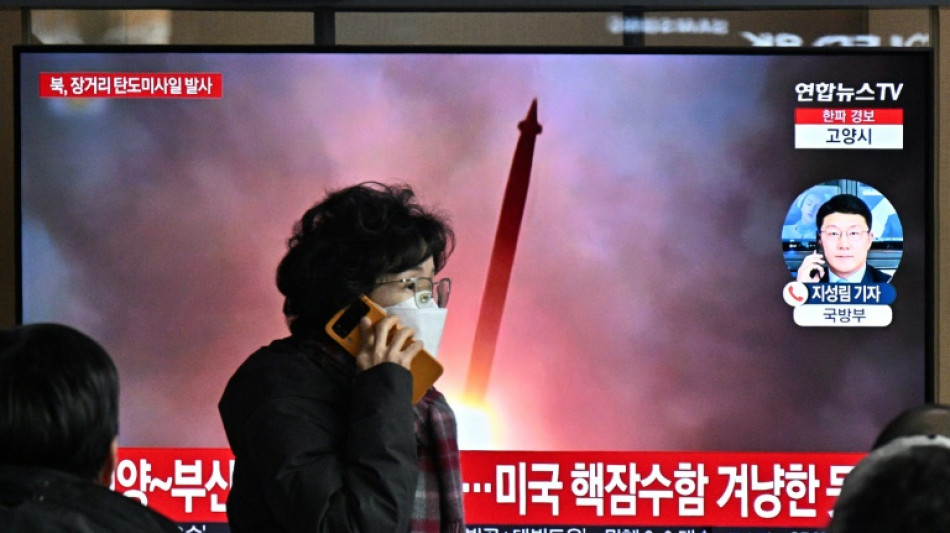
North Korea test-fires most advanced ICBM with US in range / Photo: Anthony WALLACE - AFP

 Mercedes-Benz cuts 2026 profit outlook on tough China market

 Reparations calls follow Charles on tough Caribbean trip

 Jammu and Kashmir ministers resign before planned council expansion

 Germany, EU, stable investment stops despite upheaval: Merz

 China brands drop Mbappe for 'offending national sentiments'

 India orders evacuations as Cyclone Arnab looms

 Dutch broadcaster pulls out of Eurovision over Israel 'sensitivities'

 Critical coal inventories affect nearly half of India’s domestic power plants

 FCNR(B) deposit drive puts sharper margin pressure on private banks

 Noel Tata requests records of September 17 Tata Sons board meeting

 Reparations calls to dog King Charles's tough Caribbean trip

 Global rates and foreign outflows remain key risks for Indian markets

 Neha Nagar says ₹3 crore can fund retirement with disciplined planning

 Vikas Satija says steady SIP flows shielded Indian equities from deeper losses

 Brewers rout Rays to reach brink of World Series sweep

 Mbappe dropped by Chinese brands for 'offending national sentiments'

 Kuwait exhibition presents Ukraine’s Islamic heritage and cultural ties

 Tech firms track Wall St rally on mixed day for Asian markets
 Jay-Z to perform at Super Bowl LXI halftime show: NFL

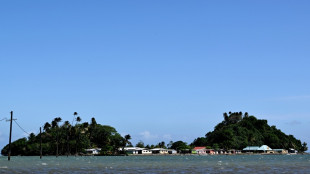 Climate-threatened Fijian utopia rejects calls to relocate

 Israel to give verdict on Netanyahu in pivotal election

 $1m bounties, dawn arrests: Trump presses voter fraud campaign

 Gasping for air: Borneo residents struggle as island burns

 Doha exhibition charts a millennium of Chinese maritime ceramics trade

 New Zealand ex-PM Ardern to teach leadership in Sydney

North Korea on Monday test-fired its most advanced intercontinental ballistic missile that has the potential to reach the United States, extending a record-breaking number of weapons tests this year and triggering further international condemnation.
South Korea said the North fired an ICBM that used solid fuel, which makes missiles easier to transport and faster to fire than liquid-fuelled versions.
Monday's launch was the third time the North had tested a solid-fuel ICBM, after launches in April and July, which analysts said signalled consistent efforts to improve the technology.
North Korea had said the previous two were "Hwasong-18" missiles but did not immediately comment on Monday's launch.
The United States, South Korea and Japan all quickly condemned the missile test, stating it was in breach of United Nations Security Council resolutions and would make the Korean peninsula less secure.
South Korean President Yoon Suk Yeol ordered an "immediate and overwhelming" countermeasure, and called for a joint response with the United States and Japan.
Japan's defence ministry said the ICBM had a potential range of more than 15,000 kilometres, which would cover all of the United States. It followed a short-range missile launch on Sunday night.
"(The launches are) not only a clear violation of UN Security Council resolutions but also a threat to peace and stability of the region and we strongly condemn," Japanese Prime Minister Fumio Kishida said.
The United Nations Security Council has adopted many resolutions calling on North Korea to halt its nuclear and ballistic missile programmes since it first conducted a nuclear test in 2006.
Following the test-fire, Stephane Dujarric, spokesman for the UN secretary-general, called on the North "to fully comply with its international obligations, including under relevant Security Council resolutions."
However China, a close ally of North Korea, offered no direct response to the latest launches and instead released a statement highlighting the deep trust between the two nations.
"In the face of the turbulent international situation, China and the DPRK have always firmly supported and trusted each other," Foreign Minister Wang Yi said after meeting an official from Pyongyang, using the official acronym for North Korea.
South Korea's military initially said it had detected the launch of a long-range ballistic missile from the Pyongyang area on Monday morning that flew 1,000 kilometres (620 miles) before splashing down in the East Sea, also known as the Sea of Japan.
The South reported the missile flew up rather than across, a method Pyongyang has previously said it employs in some weapons tests to avoid flying over neighbouring countries.
- 'Irreversible' nuclear power -
North Korea last year declared itself an "irreversible" nuclear power and has repeatedly said it will never give up its nuclear programme, which the regime views as essential for its survival.
Park Won-gon, a professor of North Korean Studies at Ewha University in Seoul, said the latest ICBM was likely the Hwasong-18, adding that it would be a huge asset for North Korea, if and when it becomes operational.
"The Hwasong-18 uses solid fuel, so there will be no preparation time, and it can be fired immediately from a mobile launcher, and it can be seen as a weapon system with a practical ability to strike the US mainland," Park told AFP.
However, the North has yet to perfect those capabilities, according to Go Myong-hyun, a researcher at the Asian Institute for Policy Studies.
"Regarding ICBMs, there are still many technical aspects that need to be supplemented, including securing the re-entry technology and multiple warhead technology," Go told AFP.
- Nuclear threats -
The back-to-back launches followed yet another bout of angry rhetoric between the US-South Korea alliance and the North.
The United States and South Korea on Friday held their second session of the Nuclear Consultative Group in Washington, where they discussed nuclear deterrence in the event of conflict with the North.
On Saturday they warned that any nuclear attack from Pyongyang on the United States and South Korea would result in the end of the North Korean regime.
A spokesperson for North Korea's defence ministry on Sunday slammed the allies' plans to expand the annual joint military exercise next year to include a nuclear operation drill.
"This is an open declaration on nuclear confrontation to make the use of nuclear weapons against the DPRK a fait accompli," said a statement carried by the KCNA news agency.
The North's launch of a military spy satellite last month, which it claimed was providing images of US and South Korean military sites, further damaged ties.
That event fractured a military agreement between the Koreas established to de-escalate tensions on the peninsula, with both sides then ramping up security along the Demilitarized Zone (DMZ) separating them.
A.Taylor--AT