
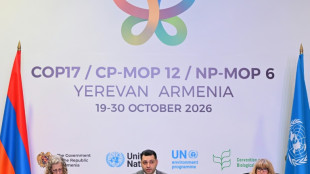
At UN climate talks, no consensus on what consensus is / Photo: Giuseppe CACACE - AFP

 US-brokered truce begins in Ukraine city occupied by Russia

 Qatar launches Fashion and Crafts Council to connect talent with global markets
 Jordan strikes militant groups in Syria after church attack

 FIA chief praises Middle East motorsport volunteers and officials

 Australia warns of 'unprecedented' AI threat

 Qatar Amir arrives in Moscow for eighth GECF summit

 Kane beats Yamal and Mbappe to taste Ballon d'Or glory
 Ballon d'Or crowns Putellas's return to top of women's game

 Godts stars as PSG beat Lyon to go top of Ligue 1

 NBA inks deal with Kalshi and Polymarket, citing safeguards
 US rapper Macklemore launches 'Free Palestine Tour' after Ed Sheeran fallout

 Venezuela leader criticizes Machado over dramatic return from exile

 Brazil markets battered after Lula win, AI in focus elsewhere
 Lula savors Brazil win as Bolsonaro rejects result, markets tumble

 Canadian youths ask court to impose binding climate protections

 Walter Koenig, who played original Chekov on 'Star Trek,' dies at 90

 Netanyahu, rivals trade attacks over Iran as clock counts down to Israel vote
 Townsend urges Scotland to use Nations Championship as World Cup springboard

 Microsoft offers voluntary exit packages to 60,000 staff

 S.Africa ambassador calls for talks with US over 'tense' ties

 'Smells of freedom': Serbians hopeful after landmark election

 South Africa select 'enforcer' Coetzee for Australia decider
 Botanists comb Gabon's rich rainforests with nature on the line

 New levy on non-EU parcels kicks in Sunday
 Stocks climb ahead of tech earnings, central bank calls

The world's climate negotiators meeting in Dubai have spent sleepless nights in an elusive quest for consensus, but there is no consensus on what consensus means.
The United Arab Emirates, citing the need in the UN process for consensus, in a draft agreement for the COP28 summit stopped short of backing historic calls for a "phase-out" of fossil fuels.
Saudi Arabia, the world's largest oil exporter, has led objections to strong action against fossil fuels, the main culprit behind the planet's climate crisis.
But COP, as the annual Conference of the Parties meetings are called, takes no votes and there is no requirement of unanimity.
"It's a matter of interpretation," said Alden Meyer, a veteran watcher of climate negotiations at the E3G climate think tank.
He recalled that Saudi Arabia and Kuwait objected during the original United Nations vote in 1992 that established the UN Framework Convention on Climate Change (UNFCCC) but the session president, from France, simply brought the gavel down.
Ever since, Saudi Arabia has blocked a proposed rule that would allow decisions by a two-thirds majority if there is no consensus.
In 2012 in Doha, host Qatar ignored a request by Russia to take to the floor with concerns related to the landmark Kyoto Protocol, prompting Moscow angrily to hold up work in talks the following year, Meyer said.
A UNFCCC official said that any objections needed to be "explicit" for there to be no consensus.
- Ignoring dissent -
One of the most successful summits took place in Paris in 2015 with an agreement for countries to seek to limit warming to within 1.5 degrees (2.7 Fahrenheit) from pre-industrial levels.
But the delegate from Nicaragua initially refused to sign on, leading to an extraordinary pressure campaign on the small, single country that reportedly involved intervention by Pope Francis.
Laurent Fabius, then France's foreign minister and COP21 president, said: "I can no long recall whether it was me myself or via the pope, but we inquired to know if he was really representative" of Nicaragua's government position.
"The reply was no and that gave us more freedom," Fabius said.
Objections from Latin American leftists were more successful in the outcome of one of the most anticipated COPs, the 2009 summit in Copenhagen.
In a scene that stunned the sleep-deprived room, the Venezuelan representative, Claudia Salerno, raised her hand with a stigmata-like bloody palm, saying she was speaking on behalf of countries ignored by a deal brokered by US president Barack Obama with other major powers including China.
Denmark's prime minister, Lars Lokke Rasmussen, was ready to give up and declare the summit a failure, until the United States and Britain quickly asked for a break and Rasmussen came back to declare the agreement "noted" rather than approved or rejected.
In a parallel COP process, biodiversity talks in Montreal last year reached a major agreement on protecting species when the Chinese president of the meeting ignored objections by the Democratic Republic of Congo, which sought greater assistance from wealthy countries.
In Dubai, it remains to be seen if the Emirati president would brush aside the interests of Saudi Arabia, his country's larger neighbour and fellow oil producer.
Fellow Arab oil producers Kuwait, Iraq and Bahrain have also raised objections to phasing out fossil fuels.
"It comes down to the judgment of the presidency," Meyer said. "Ultimately it's more of a political question."
G.P.Martin--AT