Ukraine sees drones as crucial to battlefield success / Photo: Anatolii STEPANOV - AFP

 Machado ready to meet Venezuela leader after shock return

 Lula celebrates election win as Brazil markets tumble

 France's Macron accuses social media of sowing discord ahead of election
 Anthropic unveils IPO filing showing soaring sales and AI risks

 US singer Chris Brown avoids jail over London nightclub brawl

 US singer Chris Brown avoids jail over UK nightclub brawl
 Man Utd crisis deepens as Carrick faces axe
 Serbian student movement eyes power after resounding snap poll victory
 Eala breezes past world number 411 in Tokyo opener

 Swedish Centre Party leader says government coalition talks failed
 Barca's big-game defeats pose familiar questions
 Russia says open to mini Ukraine ceasefires, but no let up in war
 Bangladesh measles crisis 'warning sign' of other outbreaks: report
 'Historic victory': World leaders celebrate Lula's re-election
 Stock markets mixed ahead of tech earnings, central bank decisions

 Mother renews anti-bullying appeal a decade after son’s death
 'Historic victory': Leftist leaders in the Americas celebrate Lula's re-election

 African players in Europe: Jackson brace ends City's perfect record

 Argentine police arrest stepfather after pregnant 10-year-old reaches hospital
 Mother dies after rescuing sons from riptide in the Bahamas
 James Blunt reportedly sought extra underwear during Celebrity Traitors filming

 Trump says Canada trade deal coming 'soon'

 Police urge home-security checks as darker evenings return

 Kane primed to pip Yamal, Mbappe to Ballon d'Or glory
 UK households advised to prepare for three days without essential services

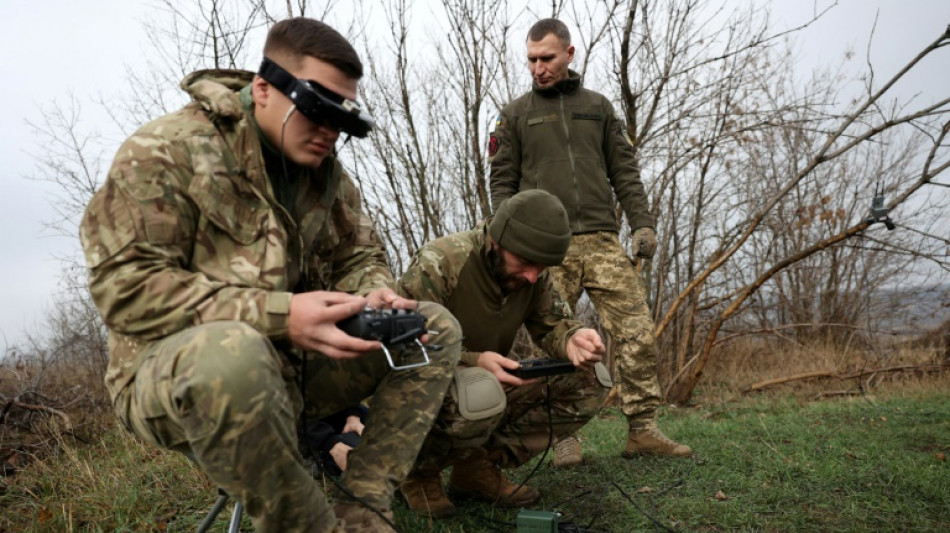
Sat in a soggy field and strapped into a virtual reality headset, Ukrainian soldier Igor was piloting a military drone test flight using a small control panel in his hands.
The unmanned devices have become a crucial piece of military tech for both Kyiv and Moscow in the war, used extensively to scope out enemy positions, drop explosives and crash into targets.
"Compared to the beginning (of the war), we've made significant progress," 24-year-old Igor, who declined to give his full name for security reasons, told AFP near the frontline city of Bakhmut.
Next to him his colleagues had set up two small masts, signal boosters to increase the drone's range -- and its threat.
"The efficiency of FPV (First Person View) drones has gotten much better. We can fly further and make better use of the ammo carried," he said.
His four-propeller device is equipped with a front-facing camera that allows him to see real-time images as if he were personally aboard the craft.
It can either drop its payload -- typically grenades -- and be flown back for another attack, or set to self-detonate.
Drones are also used extensively for reconnaissance, to spot enemy movements or positions. Another drone can then be sent to attack the target, or the intelligence can by used for artillery and tank fire or advances by infantry units.
Troops on the frontlines have become increasing dependent on -- and fearful of -- their potential.
"Drones are the eyes of our troops," Mykhailo Fedorov, Ukraine's minister of digital transformation, told AFP.
- 120,000 drones a month -
The prevalence of drone warfare has triggered an arms race between Moscow and Kyiv.
Last year, Ukraine's government launched the "Army of Drones" project through its UNITED24 fundraising platform to buy devices, train operators and repair equipment.
Fedorov said the program now had 200 drone manufacturers signed up.
"Last year, only seven (types of) Ukrainian drone could be used on the frontline. Now there are 50 different models made in Ukraine, and the number continues to grow," he said.
FPV drones "cost a couple of hundred dollars but are capable of destroying equipment worth millions when handled by a skilled operator," he added.
Ukrainian officials say they need between 100,000 and 120,000 drones a month.
Fedorov singled out Ukraine's naval drones in the Black Sea as "performing excellent work by destroying the Russian fleet and ensuring maritime safety".
The army uses eight-propeller drones to carry anti-tank mines packed with almost six kilograms (13 pounds) of explosives.
The Russians have allegedly dubbed them "Baba Yaga" after a witch from Slavic folklore who cooked and ate children.
- Artificial intelligence -
In the basement of a house-turned-workshop near Bakhmut, a team led by a 27-year-old commander with the call sign "Banderas" was refitting civilian drones made from Chinese parts for the war effort.
They rejig the devices "so they function with our equipment, antennas and receivers," and install more powerful batteries to increase their range to 18 kilometres (11 miles), he told AFP.
The cellar is also stocked with ammunition for RPG-7 grenade launchers -- a one-kilogram warhead capable of penetrating 500 millimetres (20 inches) of armour -- which is then loaded under the drone before an attack.
Banderas said they lose around a third of the drones, sometimes to enemy fire but usually "because of (Russian) electronic counter-measures" that cut the signal to the drones, causing them to fall from the sky.
Ukraine has also established an "Army of Electronic Warfare" to better defend itself against Russian devices, such as the Lancet tactical attack drones used against artillery.
Kyiv is now planning to use artificial intelligence to better target Russian positions and defend against attacks.
The defence ministry recently approved a system made by Ukrainian firm Saker Scout that uses AI-based algorithms and "advanced optics". It "independently recognises and records the coordinates of enemy equipment (even when camouflaged) and immediately sends the information to the command post," the ministry said in September.
"This eliminates the risk of 'human error', as the eye of the operator is not always able to pick up on every nuance," it added.
To officials like Fedorov, it is impossible to overstate the importance of drones to the situation on the battlefield.
"This war will be won thanks to drones," he said. "Ukraine is doing everything possible -- and impossible -- to succeed."
O.Gutierrez--AT