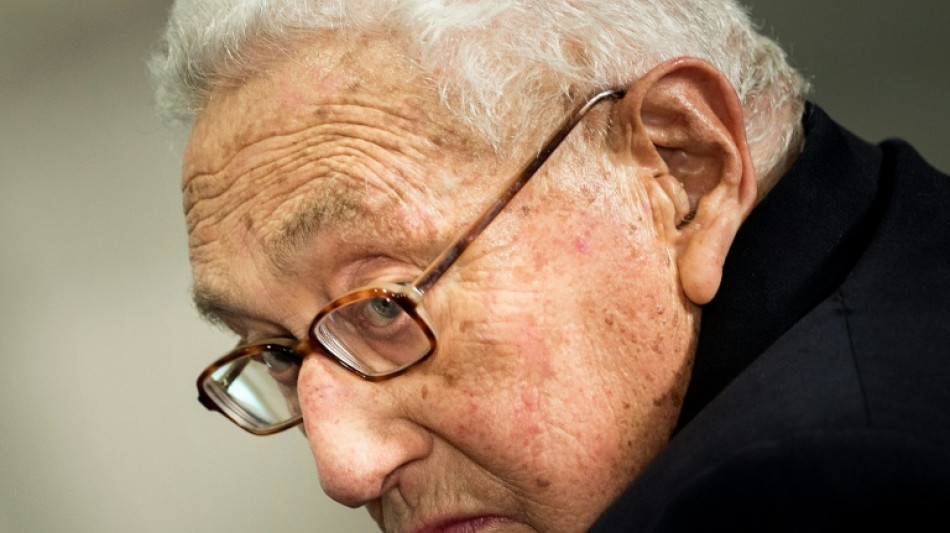
'My blood boils': Kissinger's bitter legacy in Southeast Asia / Photo: Brendan Smialowski - AFP

 Families claim bodies as Bangkok fire toll rises to 30
 Egg-free school meals scramble politics in India
 US strikes Iran for third day, will reimpose blockade
 Italy's Cannone gets four-match ban for red card against All Blacks
 Co-star says Sam Neill battled pneumonia before death

 Armenian apricots become geopolitical battleground with Russia
 Jay-Z pays tribute to NY hometown crowd and his 30-year legacy
 Birthday boy Yamal stands by 'no fear' comment ahead of France clash
 Guardian Metal Resources PLC Announces Non-Core Portfolio Exploration Results
 Trump slashes two Utah protected areas by more than 90%
 Spain 'favourites' says Deschamps ahead of World Cup semi-final showdown
 Norway receive heroes' welcome in Oslo after World Cup exit
 Pickford backs England to keep cool in tense Argentina World Cup semi
 Oil prices surge on US-Iran attacks; tech shares fall
 Thomas Tuchel: England's World Cup mastermind
 Mbappe paradox stirs club v country debate as France face Spain
 Trump reimposes Iran naval blockade, threatens Hormuz fees

 US vows campaign to end ICC 'threat' to Americans

 Yemen govt says hit Sanaa airport, Houthis attack Saudi Arabia

 US judge voids 'improper' Trump tax deal
 US appeals court revives private cases alleging Tylenol link to autism

 Spieth adamant he has more golf majors left in him
 'VAR-gentina?': conspiracy theories swirl ahead of World Cup semi-finals
 Counter-terror police take over investigation into UK politician's killing

 McCullum sorry for England defeats after 'romantic' finish with Stokes
As global tributes to late US diplomat Henry Kissinger poured in, his death stirred fury across Southeast Asia.
Homage has been paid to Kissinger's realpolitik and intellectual heft as secretary of state to US presidents Richard Nixon and Gerald Ford.
But in Southeast Asia, millions have remembered when the United States bombed swathes of Laos and Cambodia during the Vietnam War, an onslaught ordered by Kissinger and Nixon.
"Every single time I hear Kissinger's name, my blood boils," Sera Koulabdara, who fled Laos with her family at age six, told AFP.
The bombing was a failed attempt to disrupt rebel movements and strengthen Washington's hand as it pulled out of Vietnam.
Koulabdara said her father remembered the bombing.
"He described it as a roaring rain, but instead of water, it was flames."
Laos became the world's most-bombed country per capita from 1964 to 1973 as the United States dropped more than two million tonnes of ordnance, equal to a plane load of bombs every eight minutes.
Since then, unexploded ordnance (UXO) in the impoverished country has killed or wounded at least 20,000 Laotians.
"The life-threatening problem that exists in Laos is a direct result of the US's barbaric decisions and one of the main architects, Kissinger," said Koulabdara, who heads advocacy group Legacies of War.
Demining work continues.
"Laos is still the country most polluted by cluster munitions in the world," said Reinier Carabain of Handicap International –- Humanity & Inclusion, an organisation that has destroyed nearly 47,000 pieces of UXO since 2006.
"Every day, civilians in a quarter of the villages in Laos run the risk of being killed or injured by explosive remnants".
- 'I am hopeless' -
In neighbouring Cambodia, the bombing campaign helped fuel the rise of the Khmer Rouge regime, which killed about two million Cambodians between 1975 and 1979 in acts later ruled as genocide by the kingdom's UN-backed court.
Former leader Hun Sen had long called for Kissinger to be charged with war crimes.
UXO still litter the countryside, killing an estimated 20,000 Cambodians in the past four decades.
Heng Ratana, director general of the Cambodian Mine Action Centre, told AFP the decision to bomb "our beautiful country and peaceful people by destroying everything" was Kissinger's true legacy.
"I am hopeless," said 60-year-old Cambodian Sam En, who was blinded and lost the use of both arms after he tried to remove a cluster bomb at his Kratie province home in 2014.
Sam En, who relies on his daughter for care, said he felt differently about Kissinger after his death.
"Before I felt angry. But now he has died, so as a Buddhist follower, I forgive him."
- 'Suffering' -
In Vietnam, where some see Kissinger's rapprochement with China as paving Beijing's rise to dominance in the region, he leaves a complex legacy.
Kissinger was awarded the Nobel Peace Prize for negotiations to end the Vietnam War, even though the conflict did not immediately finish and his North Vietnamese counterpart, Le Duc Tho, declined to accept the prize.
Pham Ngac, an interpreter for North Vietnam during the Paris Peace Accords negotiation, called Kissinger an "outstanding" diplomat.
"He was the most... persuasive diplomat, to the benefit of the US," the 88-year-old former diplomat told AFP.
Neither the Vietnamese nor Cambodian governments responded to AFP requests for comment on Kissinger's death.
"He was the one that helped cause a lot of suffering for Vietnamese people," Tran Quy Tuyen, a soldier in Hanoi's air defence division between 1965 and 1973, told AFP.
"I guess many Vietnamese would say that he should have died years ago," the 78-year-old said.
T.Wright--AT