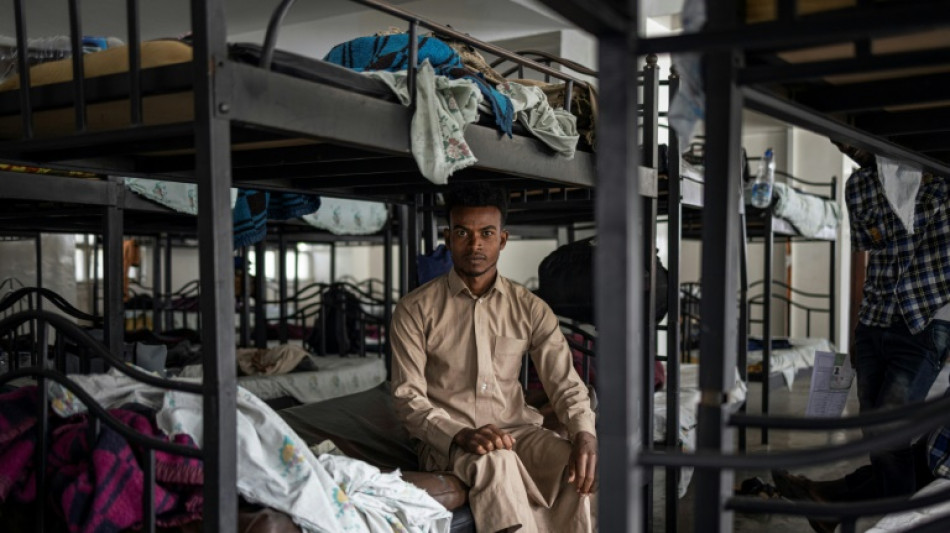
Traumatic journeys of Ethiopians seeking a better life / Photo: Michele Spatari - AFP

 Falcons hand 49ers first defeat of NFL season, Vikings remain unbeaten

 Lula, Bolsonaro in virtual tie halfway through Brazil vote count

 Antonelli looks to seal title 'in style' after US Grand Prix win

 Real Madrid century 'just a detail' for Mbappe after Clasico win

 Mbappe double helps Real Madrid stun Barca in La Liga Clasico

 Antonelli wins US Grand but title triumph has to wait another week
 Manchester United slump deepens as Liverpool climb with Brighton win
 Reus sends Bordeaux second in Top 14 with victory at La Rochelle

 Serbia's student movement ousts longtime leader in parliament poll

 Kuwait minister urges focus on investment quality and development impact

 Descendants of British slave-owning families support reparations campaign
 Aleksandar Vucic: Serbia's veteran ruler felled by student-led movement

 Obama attacks Trump record while campaigning in Ohio and Michigan

 Brazil voting extended in tight race between Lula, Bolsonaro

 'Marine has to win': Le Pen supporters fear for France's future

 QNB expands cross-border funding for AI and digital infrastructure

 France's Le Pen launches presidential bid vowing to restore 'rule of law'

 Qatar Charity delivers Braille Qurans to blind readers in Kosovo and Albania

 Houthis say attacked Riyadh airport hours after flights resume

 Monaco hold Lille as Rennes go top of Ligue 1

 Thousands gather in Prague to protest licence fee plans

 Pease spins to floor gold as US tops gymnastics medal table

 Marchant back in England training squad ahead of Nations Championship fixtures
 French skater Siao Him Fa soars to victory in season-opener at home

 Embattled Albanian PM vows fines for violent protesters

Starvation, torture, robbery -- young Ethiopian migrant "returnees" recount the horrors they endured on their fruitless journeys in search of a better life in the Gulf.
"I was imprisoned and beaten for money. I have a scar on my back which has lasted five months," said 23-year-old Abu Gizaw Assefaw, now back home nursing his shattered dreams of a job in oil-rich Saudi Arabia.
Abu Gizaw is among hundreds of thousands of people, mainly Ethiopians, who each year embark on a treacherous journey through the Horn of Africa, crossing scorching desert, rough seas and active war zones in search of economic opportunity.
Many do not make it.
The "Eastern Route" is described by the International Organization for Migration as "one of the most dangerous and complex human migratory routes in Africa and the world".
The migrants AFP spoke to said they left because they had no livelihood in Ethiopia, Africa's second most populous nation that is riven by armed conflict, climate disasters and economic crisis.
- 'Didn't eat for days' -
Abu Gizaw told how he took a bus with 10 friends from Addis Ababa to the Afar region of northern Ethiopia, then trekked through the desert for days to reach the sea.
"You can imagine how difficult it was. The sun was blistering. We didn't eat for days. I lost many of my friends to starvation," said Abu Gizaw.
He was one of dozens of Ethiopian migrant "returnees" being processed at an IOM transit centre in Addis Ababa who now face an uncertain future back home.
In Djibouti, he and his friends ran into human traffickers, and ended up paying 30,000 birr ($540) each for the crossing to Yemen, only to be caught again by smugglers demanding even more money.
"In Yemen, if you don't pay them, they take people from the group and kill them. Our families sold everything that they had including land and sent us the money. If not, they kill."
He finally reached Saudi Arabia, but said he was captured and dumped in the desert, eventually finding his way back by boat to Djibouti and then Ethiopia.
- 'Vultures preyed on the dead' -
Although the majority of those taking the Eastern Route are men, the number of women doubled to 106,700 in 2022, the IOM said.
Eighteen-year-old Neyima Mohammed said she was desperate to go to Saudi Arabia to make money after the failure of her small business selling groceries.
But she faced horror after horror on the journey and eventually gave up.
They were passed from one trafficker to another after they started out from her hometown of Silte in southern Ethiopia, and encountered many thieves who beat the men and stole their money.
"There was starvation, thirst," she said. "Many of our friends died on the road and also a boat sank and many drowned in the sea."
After they reached Yemen, she and her friends were involved in a road accident that killed and injured a number of people, she said, signalling the end of their journey.
"We laid them on the road because there was no cemetery. Vultures preyed on their dead bodies."
Back in Addis, she said: "I am happy that I came back alive to my country. I want to forget what happened to me and want to continue my life."
- 'Came back empty-handed' -
Shamsadin Awol, 20, said if he had known what trials and tribulations awaited him on the route to Saudi Arabia, he would never have left his home in eastern Ethiopia.
Smugglers took him to Hargeisa, the capital of the breakaway Somali region of Somaliland, then to Yemen and Saudi Arabia.
"You must pay to continue the journey, you can't even travel for five minutes if you don't pay," he said.
"I received 275,000 birr (almost $5,000) throughout my journey but spent it in vain. I used up everything and came back empty-handed."
His relief was palpable on his return to Ethiopia, saying he had suffered from mental health issues while away.
"When we entered and breathed the air of Oromia we gave praise to the Lord. Coming back home alive was so great," he said, vowing to never travel with traffickers again.
"I want to send this message to my brothers and sisters: It is better to live in your own country with poverty than to lead a luxurious life in another nation."
K.Hill--AT