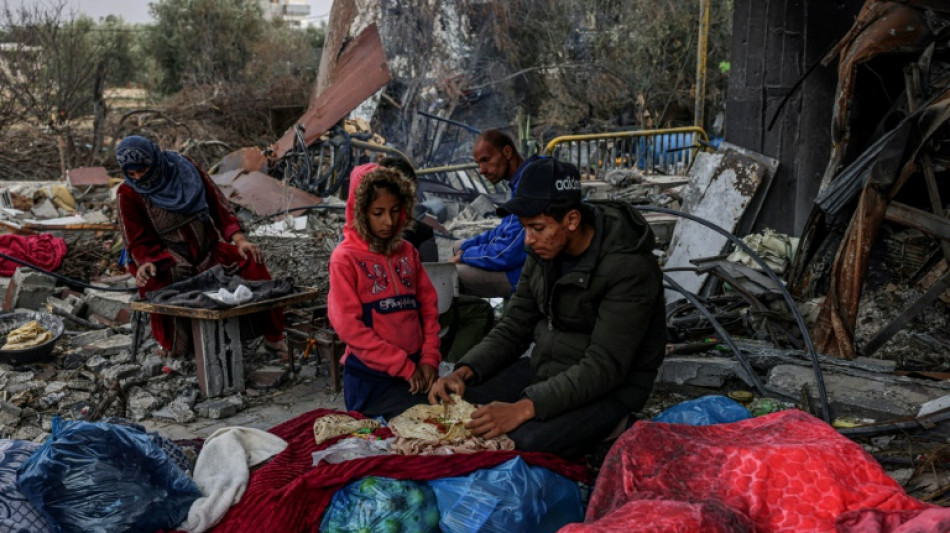
Gaza families return to homes in ruins / Photo: SAID KHATIB - AFP

 Messi meets England at last with World Cup final place on the line

 Oil extends gains after latest US strikes, tech suffers more losses

 Young Australian men falling victim to online sexual extortion: regulator

 New era for Gibraltar as border controls with Spain set to end

 England face might of Messi's Argentina in World Cup semi-final

 Spain to go on 'front foot' against France in World Cup semi: De la Fuente

 US strikes Iran for third night as Trump says deal still 'possible'

 Trump vows to hit Iran 'hard,' impose Hormuz transit fees

 France and Spain prepare to duel at World Cup

 Five Britons among foreign Spanish wildfire victims

 Ukraine allies pledge more air defence, pressure Russia

 'Until the end': The tireless, traumatic search for Venezuela quake victims

 Trump expected to shrink protected lands in Utah: reports

 Twelve US states sue to block Paramount's Warner Bros. takeover

 New boss Alonso calls for Chelsea 'hunger', wants Fernandez to stay

 Knight excited for future after England career ends in India defeat

 From bombmaking to motorcycle tweaks: how Nigerian jihadists use AI

 Edwards vows to 'upskill' England women for Ashes after India defeat

 Hungary MPs pass constitutional tweak to oust Orban-allied president

 Ukraine allies meet in Paris to boost air defence, pressure Russia

 Fitzpatrick blames betting for golf fans' bad behaviour

 Trump declares Iran blockade back, says US will charge Hormuz fees

 Uganda opposition leader treason trial starts without lawyers

 Iraola vows to remain true to himself at Liverpool

 Volkswagen confirms weighing up to 50,000 more job cuts

Tea and cheese sandwiches are on the breakfast menu for Taghrid al-Najjar's children. It should be an everyday moment, but their home in the Gaza Strip is now mostly rubble.
The walls have collapsed, with furniture and appliances buried under concrete.
Until the war, the 46-year-old mother had never left her farming village along the border with Israel in the southeast of the Strip.
Since Friday a truce has paused the fighting between Israel and Hamas, allowing them to return to a neighbourhood in ruins.
"It is only here that I feel good," she said.
Najjar fled when Israeli bombardments started as it went to war with Hamas in retaliation for the October 7 attacks that left 1,200 dead, mostly civilians, according to the Israeli authorities.
For weeks she lived with nine members of her family in a Khan Yunis school converted into a makeshift camp for displaced people.
The Hamas-led government says nearly 15,000 people, also mostly civilians, have been killed in the Gaza war, and Najjar said dozens of people in her wider extended family have died.
As soon as the truce went into effect on Friday -- it has now been extended for an additional two days -- she began making her way home to Abasan on foot.
"I discovered that my house had been completely destroyed -- 27 years of my life to build it and everything is gone!" she said.
"For two days I couldn't eat, then I told myself that I had to continue living," she added, looking at her children.
"My house is destroyed but my children are alive, so we will rebuild. We have already done it once, we can do it again," she told AFP.
Each night the family squeezes through a window to sleep in the only room where the walls have not entirely crumpled.
- Children 'traumatised' -
Once there is a permanent ceasefire, Najjar said, they will pitch a tent, but only for "long enough to rebuild the house".
Her 64-year-old neighbour Jamil Abu Azra's main concern was his four young grandchildren.
"They can sleep anywhere, the problem is that they are afraid and they are traumatised," he said.
"Even us adults are afraid, but we pretend in front of the little ones."
Across the street, Bassem Abu Taaima contemplated the destroyed building where his family and his four brothers' families had lived.
"We are all farmers or taxi drivers. We really have nothing to do with the resistance," he said of Palestinian armed groups, "so we don't understand why all this is happening to us."
Wearing a jacket given to him by a neighbour, and shorts despite the biting cold, he said he will wait for the war to end before setting up a tent and starting to clear and rebuild.
He has scoured the debris for warm clothes, although everything he has found has been burned or torn.
- School destroyed -
Nearby, Naim Taaimat, 46, was building a shelter for his family from wood, some fabric and a few nails.
"This is where I will live with my wife, our seven children and my mother after the war," he said.
More tents will be needed as his brothers -- each has seven children -- "have also lost their homes", he added.
The brothers "shed blood" to build the houses where the families' possession are now buried under rubble.
Taaimat's first priority was to find his daughter Nivine's trousseau, as she had been due to get married next week. He used a hammer to try to break up the concrete blocks before rummaging around with his bare hands.
"Now she's lost her house and her fiance also lost his house. So I have to find something so that she can still be a little happy."
Twelve-year-old Abdessamad interrupted, running in shouting: "We found an electric lamp and we have logs for the fire!"
Sitting with his friends on a dirt floor near the United Nations school where used to study, now partly wrecked by Israeli bombing, he laughed, sang and joked.
"The war really scared us and it was horrible, but there is good news," said his friend Nabil, eight.
Laughing, and hoping his parents couldn't overhear him, he explained: "The school's destroyed and we won't be able to go back for a while."
A.Anderson--AT