Azov Regiment takes centre stage in Ukraine propaganda war

 England No 8 Pollock could move abroad or switch sports amid contract stand-off
 Canada makes pitch as safe place to invest in 'uncertain world'
 In-form Malen fires Roma to Serie A summit
 IOC visits Lyon amid leadership turmoil for 2030 Winter Olympics
 New York seizes 12 celeb deep-fake porn sites
 Jesse Eisenberg channels emotional intensity into 'The Debut'
 Alarm over AI grows as divided US Congress struggles to act
 PopDEX Surpasses $61M TVL and $2B Trading Volume in Closed Beta

 Oasis announce new 2027 world tour
 Women athletes condemn 'sexualised' Sydney Sweeney commercial

 UN calls for 'urgent action' to rein in AI in face of 'unprecedented risks'
 Russia intensifies attacks seeking to intimidate Ukraine, Europe
 Richarlison not in Spurs League Cup squad: De Zerbi
 French defence group Thales calls on governments to regulate AI
 Three talking points from the Spanish Grand Prix
 Saudi football body vows action against Jota chants, Ronaldo urges life ban
 North Korea win 10-0 in Asian Games football mismatch
 Nigerian oil refinery Dangote launches IPO
 Houthis target Saudi base as Iran denies involvement in Yemen war

 Sweden faces political uncertainty after election thriller
 How a Chapman Student Revived the Forgotten History of San Francisco's Lavender Panthers

 Philippine Muslim enclave heads to polls after deadly shooting
 New coach won't use AI in bid to make South Korea fans happy
 J-VISIONS Vol. 4 Now Online: Read English Articles on Japanese Corporate IR
 In DR Congo streets, ex-hoods get tough on litter -- and locals
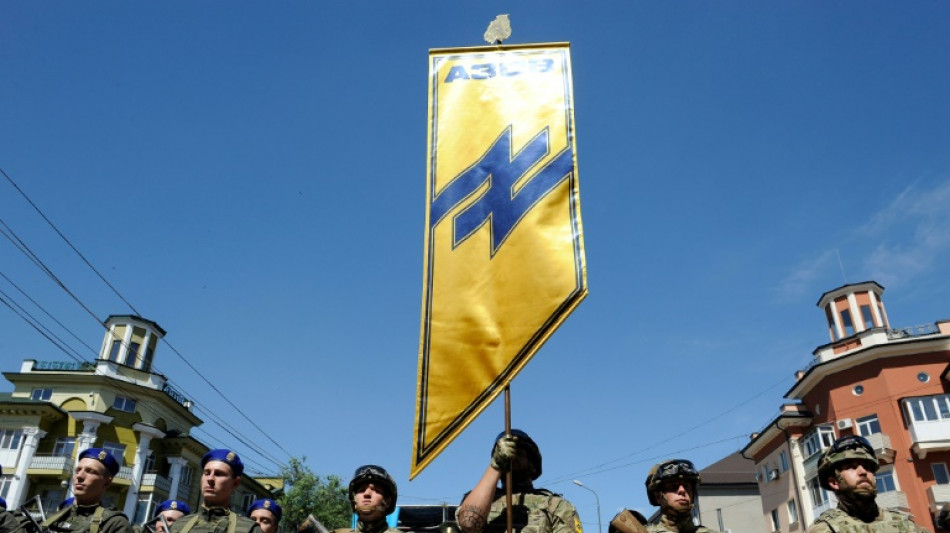
Some call them war heroes, others neo-Nazis: Ukraine's Azov Regiment is at the heart of the propaganda war between Kyiv and Moscow, as Russia claims to seek the "denazification" of Ukraine.
The Azov Special Operations Detachment, previously known as the "Azov Battalion" but now called the "Azov Regiment", is often targeted in pro-Russian social media posts, including by Russian embassies in Paris, London and elsewhere.
The regiment is currently entrenched in the southern port city of Mariupol that has been the scene of some of the war's heaviest fighting.
Russian Foreign Minister Sergei Lavrov used their presence to justify the bombing of a maternity ward there, saying the Azov regiment "and other radicals" were hiding in the building.
The regiment, created in 2014 by far-right activists, was first deployed against pro-Russian separatists in eastern Ukraine.
It has since been integrated into the National Guard, under interior ministry command.
Its founders included Andriy Biletsky, a former member of the Patriot of Ukraine paramilitary organisation.
As first mostly volunteers, the battalion's members wore insignia, such as the so-called "Wolfsangel" (wolf's hook), that were reminiscent of symbols used by SS units in Nazi Germany.
- 'De-ideologised' -
"In 2014 this battalion had indeed a far-right background, these were far-right racists that founded the battalion," said Andreas Umland at the Stockholm Centre for Eastern European Studies.
But it had since become "de-ideologised" and a regular fighting unit, he told AFP.
Its recruits now join not because of ideology but because "it has the reputation of being a particularly tough fighting unit," Umland said.
The Azov battalion, named after the Sea of Azov to Ukraine's south, became famous for winning back Mariupol from Russian-backed separatists in 2014.
Eight years later, it is again fighting for the city that Russian President Vladimir Putin hopes will give him his first major victory in the Ukraine campaign.
Beating the Azov Regiment could also help him justify the "denazification" claims prominent in Russian propaganda, which also labels Ukrainian leader Volodymyr Zelensky, who is Jewish, as leading a "gang of drug addicts and neo-Nazis".
Such attacks try to build on Russia's collective World War II memory of what it calls the Great Patriotic War, and thus whip up nationalist support for the invasion, experts say.
- 'Absolute evil' -
"The terms 'nazism' and 'fascism' evoke, in the Russian context, absolute evil that you cannot bargain with," said Sergei Fediunin, a political scientist at France's National Institute for Oriental Languages and Civilisations.
"The only option is to fight and destroy it."
Russian propaganda also targets the Ukrainian nationalists who fought Soviet Russia after 1945 and their leader, Stepan Bandera, who collaborated with Nazi Germany.
The Azov Regiment, meanwhile, has joined the propaganda war, publishing victory statements on the Telegram messaging service that are often accompanied by videos of burning Russian tanks, and calling the Russians "the real fascists".
The Azov now function like other regiments "but with better PR," said Vyacheslav Likhachev, a research analyst at the ZMINA Centre for Human Rights in Kyiv.
Their stellar reputation attracts plenty of potential recruits, "so they can choose the better ones", he told AFP.
The unit, numbering 2,000 to 3,000 troops, has kept the same wolf-hook insignia, but Umland said in Ukraine there was little confusion about its links to the past.
"It doesn't have the connotation of being a sort of fascist symbol anymore," he said.
Overall, ultra-nationalist political forces have been on the decline in Ukraine since 2014, said Anna Colin Lebedev at France's Paris Nanterre University.
"One of the reasons is that soft nationalism has now become mainstream since the Russian attack," she said on Twitter.
Azov's former commanders, including Biletsky, entered politics after 2014 but their far-right platform never attracted more than two percent of voters.
But since Russia's invasion some of them have taken up arms again, with the Azov Regiment or other units.
Biletsky, meanwhile, has returned to Mariupol from where he runs an active Telegram account.
P.Hernandez--AT