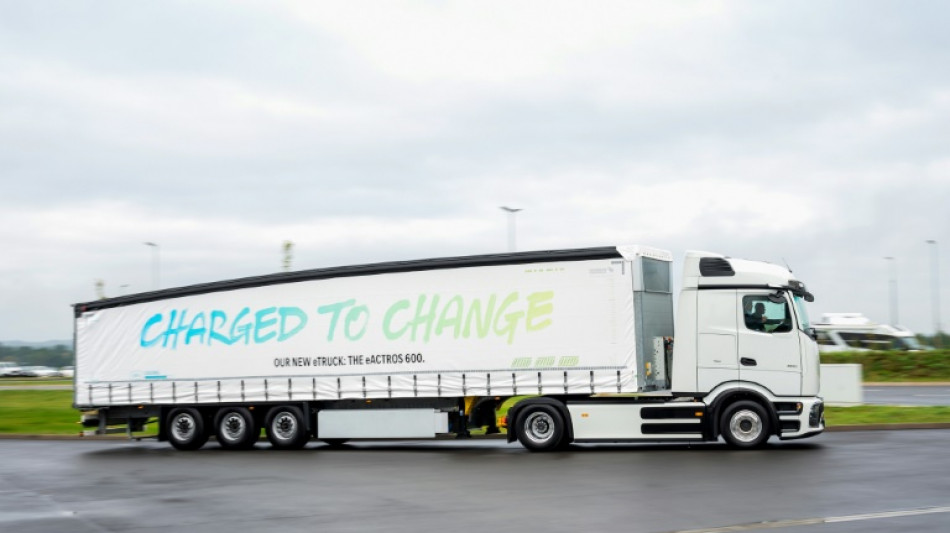
Electric heavy lorries poised to overtake hydrogen trucks / Photo: Daniel Bockwoldt - AFP

 Seen and heard at France protests

 White says Fiji can have 'massive' World Cup after beating Japan

 England thrash France 82-0 to keep Rugby League World Cup hopes alive

 Security high as France braces for new protests

 White makes winning start as Fiji edge Eddie Jones's Japan

 Lula, Bolsonaro strike calmer tone in final Brazil election debate

 'How is it possible?': Students protest Indonesian haze

 Israel launches major West Bank operation after soldiers killed

 Typhoon Champi knocks out power to thousands in Taiwan

 As Israeli election nears, campaign turns ugly

 Oscar hopeful 'La Bola Negra' offers lessons about communicating, directors say

 Trapped: Soaring fuel costs hurt Maine lobster industry before midterms

 Marc Marquez beats brother Alex to Australian MotoGP pole
 5 Ways to Prepare Financially for Parenthood

 Rubio urges Cubans to work with CIA, but warns: be discreet

 Leclerc tops times for Ferrari in practice for US Grand Prix

 Lula, Bolsonaro lock horns in final debate before Brazil vote

 Poulter and Hatton leave LIV Golf

 Blakely vaults out of the shadow of Biles for all-around world title

 Oil tops $116 with stocks mixed on earnings, AI

 Trump orders lawsuit to block Alaska Senate result if Republicans lose

 Ebola patient in Nigeria is Swiss, had not visited DR Congo: Bern

 Messi receives top Spanish award from heir to throne

 Macron condemns 'racist terrorist attack' after deadly shooting near Paris
 Shiffrin sidesteps slalom in 'exploration' season

Hydrogen-powered heavy lorries were once seen as the future of emissions-free road transport but they could soon be relegated to niche markets in Europe, overtaken by electric trucks.
On the outskirts of Trondheim in western Norway, food wholesaler Asko has since 2020 been testing four hydrogen fuel cell trucks supplied by Swedish truckmaker Scania.
The experience has been mixed so far.
Integration problems, defective parts and a forced stoppage after the explosion of a charging station near Oslo have meant the vehicles have been available for use only 30 to 40 percent of the time.
"They're not on the road as much as we would have liked. That's the least we can say," admits Asko project head Roger Saether.
"But we're convinced that it will all work out in the end."
When they're running, the trucks, which have a range of up to 500 kilometres (310 miles), supply supermarkets spread across a vast region.
For closer deliveries, the group uses battery-run vehicles, which today have a shorter range.
That distribution of roles -- hydrogen lorries for heavy loads over long distances, electric ones for lighter loads on short distances -- has long been accepted as standard among industry experts due to the advantages and disadvantages of each technology.
But things are changing.
"Now what we're seeing is that contrary to a few years ago, electric trucks and buses are actually playing an increasingly big role and we also see a very important role for them to play in the decarbonisation (process)," said Fedor Unterlohner, freight manager at NGO Transport and Environment.
- Electric Avenue -
Heavy duty vehicles account for six percent of the European Union's greenhouse gas emissions.
Brussels has called for the industry to reduce its emissions by 45 percent compared to 2019 levels by 2030, and by 90 percent by 2040.
According to a study conducted last year by German authorities, truckmakers expect 63 percent of new lorries sold in Europe in 2030 to be "zero emission" vehicles.
Electric trucks are expected to make up the lion's share, with 85 percent.
That's because previous concerns about electric trucks have been eliminated as, unlike hydrogen, the technology for electric trucks has benefitted from advances made in the electric car industry.
Range?
Most heavy trucks in Europe drive fewer than 800 kilometres a day, a distance that could soon be within reach of electric batteries -- especially given drivers' strictly regulated breaks, during which they can recharge their vehicles.
Payload limited by the batteries' weight?
The amount of energy batteries can store continues to improve, to the point where the weight difference compared to a diesel truck is expected to become insignificant.
Infrastructure?
So-called megawatt charging stations are currently being developed and should soon be able to provide 10 times more power than the fastest charging stations currently available.
- Economies of scale -
When it comes to cost -- a crucial factor, given the narrow margins in the transport sector -- electric trucks hold the advantage.
Purchase prices benefit from economies of scale generated by the rapid development of electric car batteries.
Operating costs are also modest, with e-trucks requiring little maintenance and electricity normally much less expensive than green hydrogen.
However, in some cases hydrogen lorries could be the wiser choice.
"For example, if you are driving with two drivers in Europe -- which allows drivers to skip regulated breaks.
"Or when you are in very peripheral regions. Or on islands where you don't have any connection to the grid," said Unterlohner.
"Or if you're transporting an 80-tonne wind turbine through Germany, where you have to block the roads in the night and you have to work all night. Then it may make sense," he said.
But even Scania, which has supplied the four hydrogen trucks to Asko, has chosen to focus on electric heavy trucks "due to their cost advantage in total operation economy and fuel efficiency".
"For some geographies and operations ... we see that the hydrogen-fuelled vehicles might be a viable technology," Scania senior official Peter Forsberg said.
"Therefore we have initiated some activities in order to learn how the hydrogen eco system might play out."
O.Brown--AT