Fleeing Russian invasion, Ukrainian woman reaches Gaza

 Television's A-listers glitter on Emmys red carpet

 US Supreme Court blocks Trump mail-in ballot restrictions

 Dodgers clinch playoff berth in bid for third straight World Series
 Doomers and boosters: who's who in the AI wars

 GAC presents autonomous trucks and MONTX concepts at Hannover show

 EU extends Russia sanction deadline

 Thai wildlife investigators track traffickers through social media

 Trump rejects AI slowdown concerns as UN urges coordinated controls

 US judge postpones new visa rules for foreign students, journalists

 Higher wages draw migrant workers to Kashmir despite attacks

 Oil supply concerns and AI warnings weigh on global markets

 'I am the hoax buster': Trump rejects AI danger warnings

 Macklemore dropped from Ed Sheeran tour after 'free Palestine' speech

 Trump's son confirms Russian businessman paid for post-wedding festivities

 Betis beat winless Villarreal to go third

 Etihad capacity rises as war disruption weighs on annual earnings

 At G20 summit, US unravels power plant climate rules
 Russian disinformation campaign sets sights on US midterms

 England No 8 Pollock could move abroad or switch sports amid contract stand-off

 Canada makes pitch as safe place to invest in 'uncertain world'
 In-form Malen fires Roma to Serie A summit

 IOC visits Lyon amid leadership turmoil for 2030 Winter Olympics

 New York seizes 12 celeb deep-fake porn sites

 Jesse Eisenberg channels emotional intensity into 'The Debut'

 Alarm over AI grows as divided US Congress struggles to act

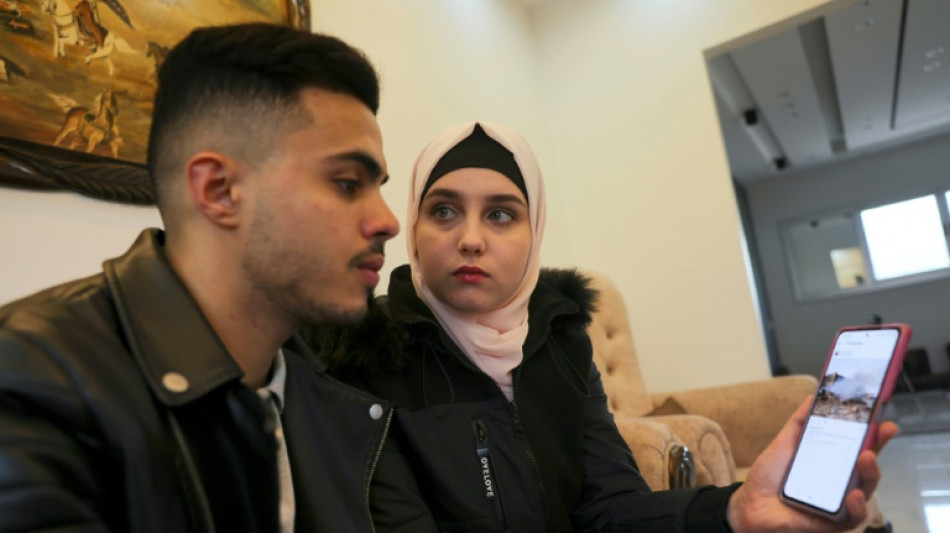
After Russia invaded Ukraine, Viktoria Saidam knew she needed to find a "safer place" than Kyiv and ultimately chose her husband's homeland -- a Palestinian territory not typically associated with security: Gaza.
Saidam, 21, was born Viktoria Breij in Vinnytsia, a town some 200 kilometres (125 miles) southwest of Ukraine's capital.
While studying pharmacy in Kyiv, she met Ibrahim Saidam, a medical student from Bureij, a refugee camp in the Gaza Strip, the Israeli-blockaded Mediterranean enclave home to 2.3 million Palestinians.
Since they married two years ago, Viktoria Saidam had been keen to get to Gaza to meet her in-laws, but the Russian assault launched on February 24 accelerated that long-anticipated family gathering, she told AFP.
"We understood that there was no way to know what tomorrow would bring. The number of dead and dying was rising every day," said the young woman, sobbing as she watched videos of Russian strikes destroying buildings in Ukraine.
Their first move was to pack up, leave Kyiv and head to Vinnytsia. They left the town before a March 7 Russian bombardment on Vinnytsia's airport killed nine people according Ukraine's emergency services.
"My husband and I had to look for a safer place than Ukraine," Saidam said. "We chose his homeland, Gaza."
- 'Hope and pray' -
The couple fled Ukraine by minibus and then on foot, walking across the Romanian border.
They then flew to Cairo and from there headed for the Rafah crossing with southern Gaza.
The young woman said she knows "the reality" of life in Gaza, a territory controlled by the Islamist group Hamas since 2007 and under strict Israeli blockade for 15 years now.
The unemployment rate is above 50 percent, the electricity supply is sporadic and conflict can flare at any time.
Hamas, considered a terrorist group by much of the West, has fought four wars with Israel since taking power in Gaza.
The most recent conflict in May last year saw Israel pound the enclave with air strikes in response to thousands of rockets fired at it by armed Palestinian groups.
"There was a war here, and it can start again, but we had to leave Ukraine and (Gaza) was safe," Saidam said.
"We don't know what will happen tomorrow," added the Ukrainian woman who converted to Islam shortly after her wedding and who so far speaks only a few words of Arabic.
"We hope and pray for the best."
- 'I feel safe here' -
According to Ukraine's diplomatic office in Ramallah, in the Israeli-occupied West Bank, there are some 2,500 Ukrainians in Gaza, mostly women who have married Palestinians men who studied abroad, like Ibrahim.
The impeccably coiffed 23-year-old husband, who speaks fluent Ukrainian, told AFP that, having lived through three of the Gaza wars, he has "some experience" with conflict.
In Ukraine, "a week before the start of the war, I prepared some provisions. But we didn't expect it to be so fierce," he said.
"We could have gone to European countries to seek asylum, but I preferred to return to Gaza because I feel safe here and I know how things work."
Comfortably settled at the Saidam family home, Viktoria Saidam said she was doing well but also that "fear and panic" grip her when she speaks to her brother and sister who are still in Ukraine.
"I still cannot believe that what has happened isn't a dream, it's horrible," she said.
"I'm dreaming of the day my husband and I can go home."
Ch.P.Lewis--AT