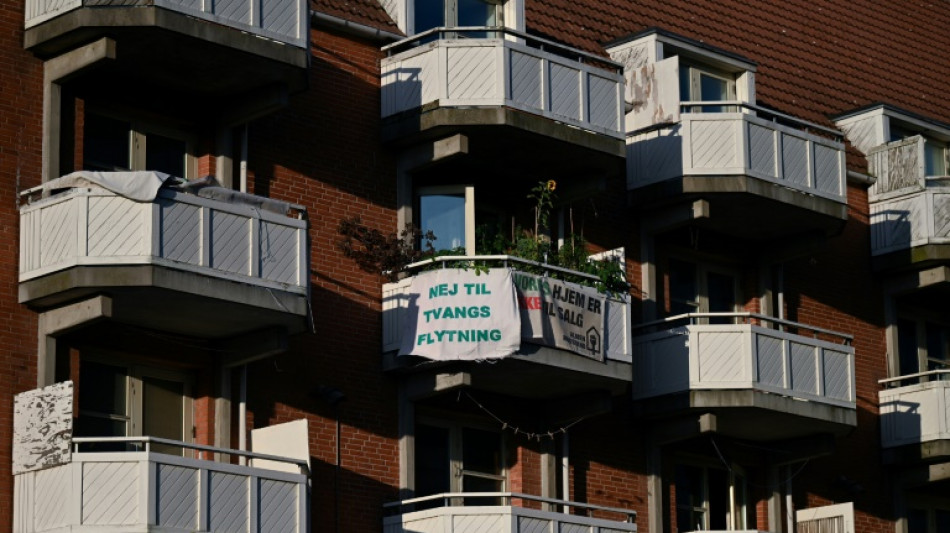
Families slam 'racist' Danish law to clear immigrant 'ghettos' / Photo: Sergei GAPON - AFP

 US to auction deep sea mining leases off American Samoa

 Australian lawmaker hurt in car attack underwent surgery overnight: PM

 Japan launches rocket for potential world first Mars moon mission

 Ethiopia PM warns Eritrea of 'severe consequences' if supports enemies

 Boland grabs opportunity for Australia as South Africa struggle in second Test

 Ronaldo handed 30-day suspension: Portuguese federation

 France announces curfews as government grapples with unrest

 Boland sets pace as South Africa struggle

 Ukraine on back foot as Kremlin moots US, China meeting

 'Stay home!': Tourists find themselves in a France convulsed by protests

 Kenyan cult leader guilty on all charges over 191 starvation deaths

 Eagles star Hurts to miss rest of NFL season: reports

 Oil-rich Alberta votes on Canada breakup

 Israel announces arrests after West Bank settler attacks on Westerners

 Guehi insists players have 'trust and belief' in Man City after charges

 UN climate panel head wants swift end to deadlock over key scientific report

 PM calls for curfews in France as govt grapples with unrest

 Man City's Semenyo out for up to eight weeks

 Australian lawmaker critically hurt in 'violent' vehicle attack

 England women's coach Wiegman signs two-year contract extension
 Louvre blocked as France grapples with unrest

 Bollywood actor Tiger Shroff shot at in Mumbai, three suspects held: police

 UN biodiversity summit opens with nature goals off track

 'Physical hell': Hong Kong hosts gruelling underwater hockey tournament

 Police 'lost control' during French protests, says interior minister

Outraged residents say they will resist a "racist" Danish law which allows large numbers of people to be evicted from social housing in areas where the authorities say there are too many immigrants.
"It's straight up racism," said Jawad, a doctor from Mjolnerparken in central Copenhagen, which is surrounded by rapidly gentrifying areas.
"Even though I was born and raised in Denmark, in the statistics I'm a non-Western immigrant," the 29-year-old told AFP.
Denmark passed a controversial law in 2018 to redevelop poor urban "ghettos" with high concentrations of immigrant populations by 2030.
It involves rebuilding and renovating rundown estates and changing the social mix by renting at least 60 percent of the homes at market rates.
For decades Denmark has had one of Europe's most restrictive immigration policies, with populist right-wing parties often stoking anti-immigrant rhetoric.
"Our apartments are not for sale!" said banners strung across Mjolnerparken, with locals saying that using their ethnicity to decide where they can live is discriminatory and illegal.
Eight out of 10 people in Mjolnerparken are deemed "non-Western", with people from non-EU countries in the Balkans and Eastern Europe also falling into that category.
The Mjolnerparken residents are suing Denmark, with European Court of Justice due to rule in the coming months.
- People left hopeless -
Thomas Monberg, spokesman on housing issues for the ruling left-wing Social Democrats, insisted that the aim of the law -- which will compel 11,000 people to move -- is good.
"We don't want to force people out," he said.
"We want to give them a better life so they can have the same opportunities as any other Dane," he told AFP.
But for Jawad, whose parents were born in Pakistan, the so-called "ghetto law" is emblematic of Denmark's relationship with immigrants.
Instead of improving integration, it has left many feeling hopeless.
"A lot of people here have just given up hope of the government actually being on their side," he said.
The law aims to eradicate "parallel societies" in poor neighbourhoods that often struggle with crime.
This means that 295 of Mjolnerparken's 560 homes will have to be replaced by market-rate rentals -- which are out of reach for most locals.
Experts say some 11,000 people across Denmark will have to leave their apartments and find new housing elsewhere in the next seven years.
Majken Felle, the head of Mjolnerparken's renters' association, said that before the law was passed residents had agreed to be temporarily relocated to allow the renovation of their apartments.
Even if they could afford to return after the work, they've been strongly encouraged not to, she said.
To avoid being moved around several times, many agreed to leave the neighbourhood, which is surrounded by some of Copenhagen's most desirable areas.
"Even if they want to stay, some families said to themselves, 'There's too much uncertainty, I can't live like this for years. Maybe it would be better to move and get on with my life,'" Felle added.
- 'Second class citizens' -
"Residents are living in a construction site even though they're paying rent, it's scandalous," said Hassan, a 25-year-old raised in Mjolnerparken, who left because of the renovation work but wants to move back once it is done.
The "ghetto" law is in stark contrast with Denmark's image as "an egalitarian, democratic society with strong social and economic systems," said Susheela Math, a lawyer from the Open Society Justice Initiative which is helping residents bring their case.
Yet in this wealthy Scandinavian nation, their fight has gone largely ignored.
"Eighty percent of the Danish population doesn't have any personal contact with ethnic minorities," said sociologist Aydin Soei, an expert on disadvantaged areas, "and an even smaller number of Danes have set foot in one of these areas."
Rather than helping integration, he argued, the law had left many feeling like "second-class citizens".
M.King--AT