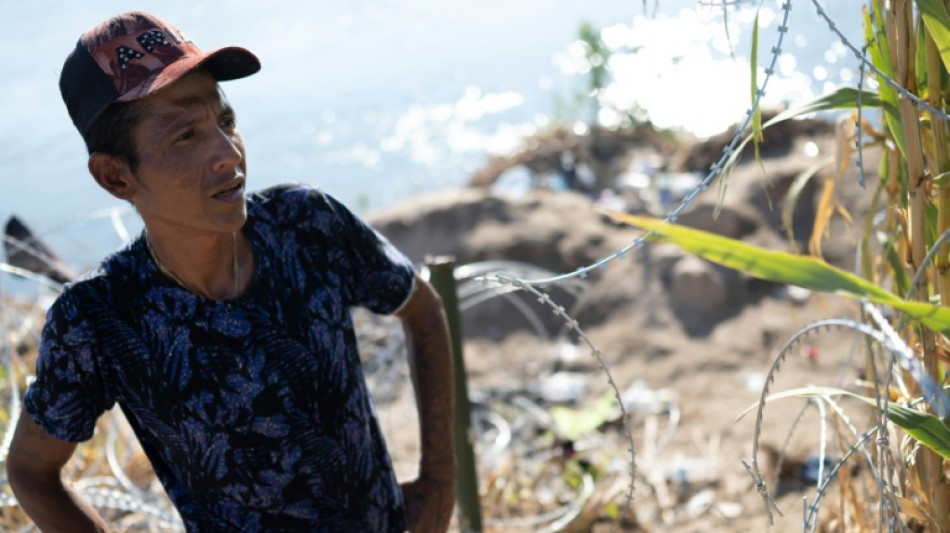
Foragers and popsicle sellers: a micro-economy among US migrants / Photo: ANDREW CABALLERO-REYNOLDS - AFP

 Macron denounces 'unbridled' violence as France hit by new clashes

 Hurzeler lauds 'hard worker' Gomez after Brighton goal from halfway line

 Toulouse hold off Exeter, Northampton save English Champions Cup blushes

 Arsenal snatch late win to keep pressure on Man City as Man Utd held

 Arsenal strike late to keep pressure on Man City as Man Utd held

 Four soldiers dead, dozens injured in fire at Canada military base
 Ton-up Agha helps Pakistan down Sri Lanka in tri-series opener

 Man Utd draw at Leeds keeps pressure on Carrick

 Barca defenders Garcia, Kounde injured before key games
 Lula, Bolsonaro to face off in first debate of bruising election
 Maza and Schick help Leverkusen clip Freiburg's wings

 Leeds hit back to deny Man Utd morale-boosting win

 Zelensky tells NBC 'thankful' US has unblocked intelligence sharing

 Pau see off Leicester in Champions Cup

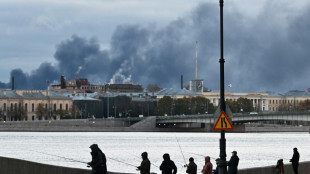 Kremlin says Ukrainian attacks won't change war aims as Kyiv hits Saint Petersburg

 Martinez starts for Man Utd after outburst
 Alberta separatists rally ahead of independence vote

 Debt recovery lessons after derivatives losses and repeated borrowing

 RCom professional asks Supreme Court to revisit spectrum insolvency ruling
 India’s services surplus narrows as import growth overtakes exports

 PSG rally past Strasbourg to take Ligue 1 lead

 Gold closes week near $4,165 as US inflation outlook pressures market

 Two pilots die in Saudi coalition helicopter crash near Yemen border
 Riyadh skyscraper shifts tenants online as Houthi attacks intensify

 Qatar and Norway review bilateral ties at Oslo consultations

Marco Gonzalez used to fish the river between Mexico and Texas, but now he has a more lucrative harvest -- possessions abandoned by the thousands of migrants crossing the border from the south.
Crowds of people reach the border every day, after long, dangerous and difficult journeys from Africa, Asia or South America.
Their discarded backpacks, clothes or blankets sustain a cottage industry of foragers, part of a micro-economy that feeds off the stream of humanity desperate to get into the United States.
"Once, when I was fishing, I found $100 in a bag, and so I started coming here," 37-year-old Gonzalez told AFP on the banks of the Rio Grande.
"And since now there's a ton of clothes here all over... I thought, I'm staying."
- 1.8 million -
In the last 11 months, at least 1.8 million people have reached the southern US border, many of them searching for safety and economic opportunity they could not find in their own countries.
The soaring numbers are a political headache for President Joe Biden, whose Republican opponents are hammering the issue, a year out from an election.
Thousands enter the country illegally every day, some swimming across the perilous waters of the Rio Grande. As they do, they often abandon possessions that weigh them down.
"I only kept my papers and some shoes," Venezuelan Francis Ibarra told AFP.
"I left the clothes from the river there because they were all wet."
For officers patrolling the US side of the banks and islands on the Rio Grande, the scavenging is now just part of the daily landscape.
"It's become a way of life for people who live on the border," one Texas National Guardsman told AFP, on condition of anonymity because he was not authorized to speak to the media.
"You see them in cities -- they come to look for things to sell or exchange. Some make a living from it; others do it to help migrants."
Clothes and bags dot the island that lies halfway between the Mexican city of Piedras Negras and Eagle Pass in Texas, cast off by people who stopped to rest after their first dash into the current.
As an AFP team watched, a man and two children picked through the detritus, looking for anything worth having.
Even more accumulates on the US side of the river, where migrants believe they will be ordered to leave their possessions if they meet Customs and Border Protection officers on the other side of the razor wire.
For Gonzalez, it is here that offers the richest pickings.
What he gathers, he can give to an NGO that helps migrants in Piedras Negras.
"The woman there, since she already knows me, gives me a good meal, rice, beans, oil, and toilet paper," he said.
More enterprising still is Sixto Gomez, who used to sell popsicles in Piedras Negras, but now plies his trade on the river.
"I sell more here than in the city, and no one bothers me, who is going to come here?" he asks.
On the island in the middle of the river he asks 15 pesos (85 US cents) for a popsicle, but on Sunday when a logjam formed at the razor wire, he crossed to the US bank to peddle his wares -- and raised his price to 20 pesos.
"Here it is more expensive," he told AFP. "This is America."
H.Romero--AT