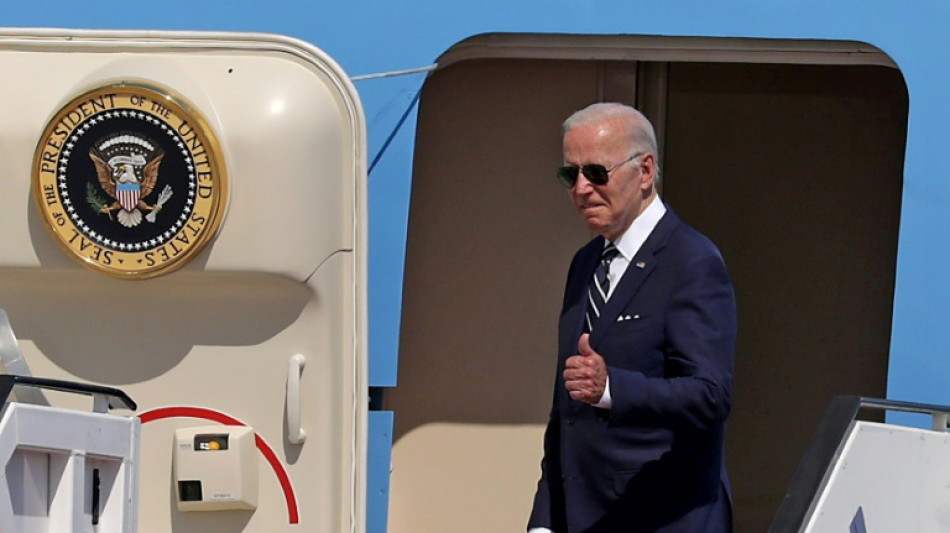
Will lingering obstacles derail a Saudi-Israeli pact? / Photo: ABIR SULTAN - POOL/AFP/File

 McGregor loses in 69 seconds on UFC return from five-year layoff

 Car crisis takes toll on Germany's young engineers

 Argentina sink 10-man Swiss to set up blockbuster England World Cup semi-final
 West Afghanistan female dress-code crackdown hits businesses

 Bhutan battles 'existential' population crisis with birth drive

 Norway coach says ball hit camera cable for crucial England goal

 Growing list of countries move to ban social media for children
 Schmidt aims to leave Wallabies 'in good order' for incoming Kiss

 Rennie says All Blacks must improve with 'smart' Ireland awaiting

 Eddie Jones says 'pretty obvious' Japan on right track

 Bellingham double as 'lucky' England beat Norway to reach World Cup semi-finals

 NFL Seahawks sold to India-born billionaire Khosla's group

 Argentina beat porous Wales in Nations Championship

 New heat wave blasts US, could break records

 Scotland third best team in world, says Erasmus after Boks win

 Former skipper Knight to retire from England women's duty after Lord's Test

 England boss Borthwick coy over starting Pollock after Fiji hat-trick

 Myanmar film wins top prize at Czech festival

 Ton-up Buttler takes new No 1 England to T20 series sweep of India

 Death toll in Venezuela earthquakes surpasses 4,300

 Noskova survives tearful meltdown to win first Wimbledon title

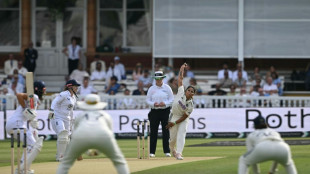 Five-wicket Gaud stars before India run riot in women's Test at Lord's

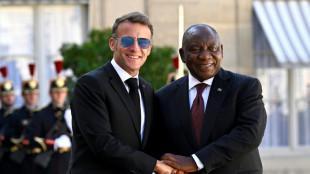 France hosts S.Africa leader for talks, war remembrance

 Pollock a hat-trick hero as England hammer Fiji to end losing streak

 Ryu loses count as she blasts 60 for Evian lead

Recent bullish statements by Saudi and Israeli leaders have fuelled speculation that a landmark normalisation deal is in the offing, despite daunting hurdles that have yet to be cleared.
Saudi Crown Prince Mohammed bin Salman, the Gulf kingdom's de facto ruler, said in a rare interview last week with Fox News that talks were progressing and "every day we get closer" to a breakthrough that could reorder the Middle East.
Israeli Prime Minister Benjamin Netanyahu followed that up by telling the United Nations General Assembly "we are at the cusp" of "an historic peace".
US President Joe Biden, whose aides are driving the push, wants a deal locked in before he becomes consumed by his re-election campaign next year, according to people briefed on the talks.
Here's a look at how the terms might take shape and whether success is feasible:
- Who stands to benefit? -
Meeting with Biden in New York last week, Netanyahu said a deal would "go a long way for us to advance the end of the Arab-Israeli conflict".
It would also represent an enormous political win for a leader dogged at home by corruption charges and protests over judicial reform plans.
Yet Saudi Arabia refused to go along with the 2020 Abraham Accords under which Bahrain, Morocco and the United Arab Emirates normalised relations with Israel -- a milestone strongly denounced by the Palestinians.
Last year, Saudi officials laid out for Washington their conditions for taking a similar step: security guarantees and assistance with a civilian nuclear programme with uranium enrichment capacity.
Biden appears enticed by the prospect of a major foreign policy achievement that could help stabilise the Middle East and mitigate the threat posed by Iran.
His team is also driven by a desire to reassert Washington's influence in a region where Beijing has made inroads, said former US diplomat Dennis Ross.
"The Saudi asks of the administration are high, but it's clear the administration has embraced the concept and is prepared to try to produce an outcome," said Ross, a former Middle East peace negotiator now with the Washington Institute for Near East Policy.
- Can Washington deliver? -
It remains unclear what form a potential Washington-Riyadh security arrangement would take.
The Foundation for Defense of Democracies think tank has suggested Washington consider designating Riyadh a "major defence partner" or a "major non-NATO ally", neither of which would involve the same commitments Washington has to its NATO allies.
The New York Times reported last week that US officials were exploring a "mutual defence treaty" modelled on existing pacts with Japan and South Korea, though the paper noted this would be "sure to draw strong objections in Congress".
Nuclear assistance would also attract close scrutiny from lawmakers.
Riyadh says its programme would be peaceful, though in his Fox interview Prince Mohammed reiterated the kingdom's position that if Iran obtains a nuclear weapon, "we have to get one".
Given objections to Saudi Arabia's human rights record, any deal that deepens US ties to Saudi Arabia could be a hard sell.
"Lawmakers in the US should never allow a security pact that commits the US army to spill blood in order to protect a brutal dictatorship," said Abdullah Alaoudh, Saudi director for the Washington-based Freedom Initiative.
- What about the Palestinians? -
Saudi Arabia long said it would not recognise Israel without a two-state solution to the Israel-Palestinian conflict and a just settlement for Palestinian refugees.
Normalisation talks initially focused on other elements, but that has recently begun to change.
In August, Saudi Arabia named its first non-resident ambassador to the Palestinian Territories, and the two sides have since exchanged delegations.
Speaking to Fox, Prince Mohammed insisted the Palestinian issue was "very important" for Riyadh.
"We need to solve that part. We need to ease the life of the Palestinians," he said.
It is unclear whether Netanyahu can deliver meaningful concessions while heading a government Biden has described as "extremist".
"This will test all of his talents, for sure," said Ross, the former Middle East peace negotiator.
"I don't know if it is possible."
- How would the region respond? -
Getting Saudi Arabia, home to Islam's holiest sites, to recognise Israel would provide cover to countries that joined the Abraham Accords or are considering such a move.
Yet the kingdom's reputation could take a big hit in a region where hostility towards Israel runs deep.
The revelation last month that Libya's foreign minister met her Israeli counterpart sparked protests resulting in her dismissal.
Such incidents, combined with domestic support for Palestinians, are no doubt on the minds of Saudi leaders, analyst Hesham Alghannam wrote this month in Al Majalla magazine.
"Establishing relations with Israel before it agrees to make substantial concessions to the Palestinians is not an added value to Saudi security and national interests," he wrote.
K.Hill--AT