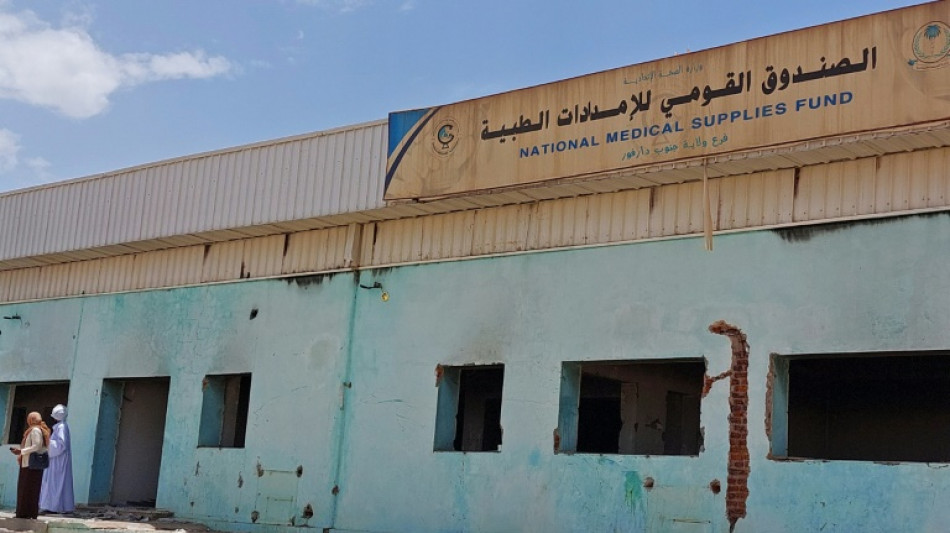
Handwritten letters a lifeline in war-devastated Darfur / Photo: - - AFP/File

 West Indies crush Bangladesh by eight wickets in first Test

 France on alert as Halloween protests raise risk of violence

 Abhishek Sharma: Indian cricket's 'new-generation superstar'

 Marquez stretches MotoGP championship lead after Martin pulls out
 In-form Fernandez reaches Tokyo final

 James, Maxey fuel 76ers over Knicks in NBA Cup thriller

 High-speed, high-risk Route du Rhum yacht race sets off Sunday
 Fears of violence as France braces for Halloween protests

 OKC's Holmgren to miss at least eight weeks as Thunder injury woes deepen
 'Not very smart' - Verstappen slams Red Bull stable-mate after clash

 Leclerc quickest in Mexico GP practice
 Polish riot police deployed as deposed court chief sets off crisis

 Young Canadians focus on mental health at key climate trial

 'Breath of fresh air' truce brings hope to Ukraine's ravaged Kherson

 British king reflects on colonial atrocities in Guyana

 Nations agree crucial texts in overtime at UN nature summit

 NBA Trail Blazers lose guard Morant for four weeks
 UN nature summit in extra time as nations grapple for deal

 Complaints upheld against Swiss TV commentary on Israeli bobsleigher

 Tielemans glad Man Utd sticking with Carrick

 Scottish police probe Andrew, Epstein stay at royal castle: UK media

 Medvedev into Vienna semis and books ATP Finals place
 UN nature talks in extra time as nations struggle to reach deal

 Meta settles, leaving Snap sole defendant in new social media trial
 Chelsea manager Alonso dismisses talk of Estevao loan deal

With no cell service or phone calls, people in Sudan's war-ravaged western region of Darfur are resorting to a bygone means of communication: handwritten letters, carried by taxi drivers.
Ahmed Issa, 25, sits on a plastic chair in a roadside cafe, penning a message to relatives he left behind in Nyala, the capital of South Darfur state.
In the safety of El Daein, 150 kilometres (93 miles) southeast, he told AFP the letters are often the only way to get news in and out of his hometown, the second-biggest city in Sudan and the site of brutal battles between the regular army and the paramilitary Rapid Support Forces (RSF).
"Even at the start of the fighting, it was hard to get in touch with people in other neighbourhoods inside Nyala," he said, nearly five months after the war began.
The situation has only grown worse since, with horrific violence reported across Darfur, a region the size of France that is home to around a quarter of Sudan's 48 million people.
They remember all too painfully the years-long war and atrocities that began in 2003. Hundreds of thousands were killed and more than two million displaced after the government of Omar al-Bashir unleashed the Janjaweed militia in response to a rebel uprising.
Hunched forward in a black patterned shirt and a neat crew cut, Issa carefully folds his letter over and over.
"You wait a week for the letter to arrive, and you don't know for sure if they'll get it," he told AFP.
"And if they do, there's no guarantee they can send one back" through the treacherous roads in and out of Nyala.
Three months ago, the West Darfur state capital of El Geneina seemed to be the nucleus of the fighting, becoming a symbol of the return of ethnic violence in Darfur. Western countries and the UN linked the violence to the RSF and its allies.
It triggered the International Criminal Court to open a new investigation into alleged war crimes.
Now Nyala is the centre of clashes between the army and the RSF.
On one day last week 39 civilians, most of them women and children, were killed when shelling hit their homes in Nyala, medics and witnesses said.
Over 10 days in August, more than 50,000 people fled Nyala's violence, according to the United Nations.
Water and electricity networks quickly failed, compounding threats in a city where one in four people already needed humanitarian aid before the war, the UN said.
- The messenger -
Residents on Sunday looked up to see a new escalation of the violence: air force fighter jets -- whose strikes have been largely limited to the capital Khartoum -- were flying overhead.
Their bombs struck both RSF bases and the residential neighbourhoods they inhabit, witnesses told AFP.
People will do anything to make sure their loved ones are alright, according to human rights defender Ahmed Gouja, who left Nyala but is trying to inform the world of the gruesome violence unfolding.
Last week, he reported on Twitter, which is being rebranded as X, that five entire families were "killed in one day".
He himself spent 16 days "with no info" about his family in Nyala, before finally reaching "one of my brothers who arrived at El Daein, searching for an internet signal".
"We die every moment that passes while we are deprived" of news of loved ones, he wrote.
For weeks, Suleiman Mofaddal has seen families like Gouja's walk through his El Daein office, a small room with yellow walls, anxious for news of those who cannot or refuse to leave their homes in Nyala.
On his desk sits a pile of small, neatly folded paper rectangles, each with a name scrawled in blue ink.
Some have a phone number, just in case the recipient gets cell service for even a moment.
All wait to be handed to drivers on Mofaddal's team, who will carry the letters on their way to Nyala.
"Most often, the recipient immediately writes a response and hands it back to the driver before he leaves," Mofaddal told AFP.
Then the driver heads back out, hoping the road ahead won't be closed -- by either the bombs, militia checkpoints, or the downpours of Sudan's rainy season.
M.Robinson--AT