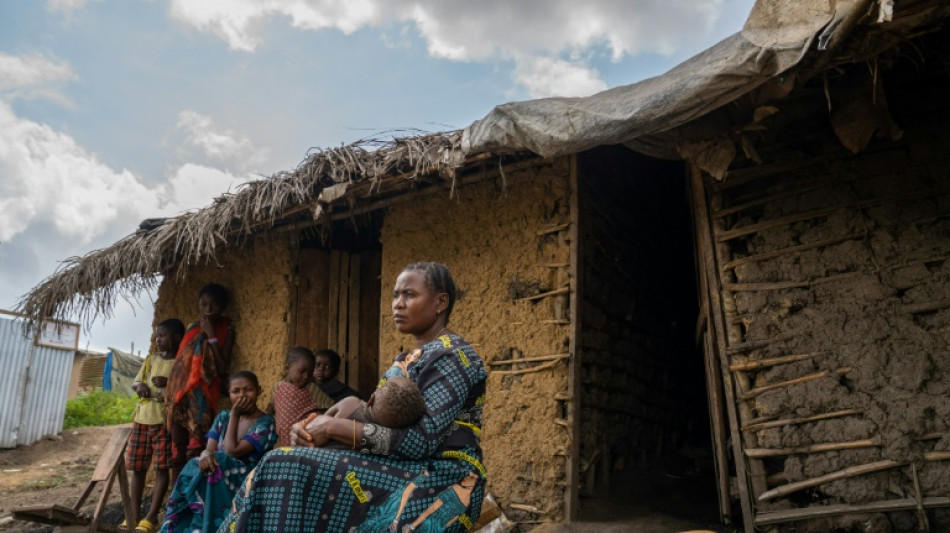
Violence, lack of aid foster despair among DR Congo displaced / Photo: GLODY MURHABAZI - AFP

 'Severe drought' declared in parts of UK
 IUX Announces New Web Client Portal Built for Enhanced Browser-Based Trading
 School roof collapse kills teacher, 32 children in NW Pakistan

 Inter skipper Martinez facing month out with thigh injury

 Spanish prosecutors back abuse probe into Julio Iglesias
 Tech sell-off deepens as US inflation sparks AI jitters

 Southgate does not forsee a return to management
 Two dead as Istanbul endures heaviest rainfall in 80 years
 After latest Nepal flood, survivors fear for future

 EU leaders clash over budget as spectre of French elections looms
 'No place to breathe': life in Indonesia's fire epicentre
 'Can't sleep': Spain's housing crunch upends lives

 Musk calls on Ukraine's Zelensky to 'go' after satellite slowdown row
 Still smiling at 117, Albanian may be world's oldest woman
 Pope has 'good night' in hospital: Vatican
 China's economy seen missing target as global shocks bite: AFP poll

 Costa Rica opens jail inspired by El Salvador mega-prison
 Same-sex couple takes fight for equality to Slovakian court
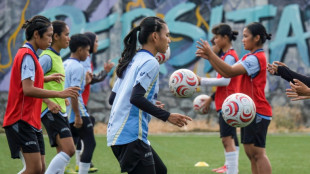 'High hopes' as Indonesian women get a football league, again

 'Expectations high' for Bordeaux-Begles' Champions Cup hat-trick bid, says Depoortere
 Rennie urges All Blacks to stay focused against 'hurting' Wallabies

 Palmeiras beat Fluminense 2-1 in Libertadores semi-final first leg

 Brewers blasts leave Dodgers on brink
 Tech stock lead rout after US inflation fuels rate hike bets
 Al-Fayed survivors say UK police missing 'bigger picture'

Peace seems out of reach and aid is in short supply. In camps for displaced people in DR Congo's war-torn eastern province of Ituri, despair is growing on the back of violent horrors experienced amid a feeling of abandonment.
"I had six children, three were hacked to death by machete by ADF" rebels, said Henriette Lofaku, 60, who has taken refuge in the town of Komanda, 75 kilometres (45 miles) from provincial capital Bunia.
The Islamist ADF, affiliated to the Islamic State group, has been wreaking havoc since the 1990s in the north of the country's neighbouring province of North Kivu but has in recent years spread its tentacles to Ituri.
They compete with a shoal of local militia to outdo each other in barbarity -- one such group being Codeco (Cooperative for the Development of Congo), which is accused of killing at least 15 people last month in a fishing camp.
Lofaku and her family lived in Walense-Vokutu, a village on the border between the two provinces. One evening in April 2021, the ADF attacked.
"We fled and abandoned everything... They burned everything," she recalled.
Like her, Justine had tears in her eyes as she recounted the death of her sister, killed with her son with the family on the run.
"Bombs were exploding everywhere," she said, sitting outside her clay-walled shack.
The locality of Komanda, a destination for those fleeing the violence, hosts around 40,000 displaced people who, according to the local humanitarian community, get by with very little assistance.
"We are suffering hugely. Under these tarpaulins, we have no medicine, no food, nothing. The authorities have to know that we exist!" said Christine Dida, a mother of eight, who fled Djugu territory three years ago.
Bahati Letakamba, who has nine children, has also spent three years in Komanda.
"We have to make do and work in native fields to live," he said, gesturing to a little cassava flour left over to feed his family.
- Critical situation -
"The situation for the displaced is really critical," said Serge Mahunga from the NGO group Solidarites Internationales active in Komanda.
In Bunia, another displacement camp set up in the town in 2019 is home to more than 14,000 whose already worrying situation has been getting even worse given an ongoing spate of attacks on several nearby villages.
UN estimates say there are around 1.7 million people displaced in Ituri.
"That represents 40 percent of the population of the province. It's a truly shocking figure," Bruno Lemarquis, coordinator for UN humanitarian agencies in the DRC after a visit to Komanda.
"This humanitarian crisis has been going on for 25 years in the DRC. It's one of the world's most serious, most complex and longest -- but also most neglected," Lemarquis told AFP.
Clashes between different militia between 1999 and 2003 left thousands dead in Ituri and, after a decade of calm, the unrest resumed in 2017.
Over the past year, humanitarian needs have risen still further "owing to new conflicts or the resurgence of others", according to Lemarquis, such as the M23 rebellion in North Kivu.
Soldiers moved out from neighbouring provinces, including Ituri, to intervene there and this created a "security vacuum that other armed groups rushed into," said Lemarquis.
Displaced people criticise the government for not coming to their aid.
Provincial governor General Johnny Luboya N'kashama has said the state has "limited resources" and is doing what it can.
Lemarquis said humanitarian groups are doing all they can but that their response plan is "for the time being less than 30 percent funded", leading him to call on the international community to mobilise.
Overall, the DRC has more than six million internally displaced people, mainly concentrated in Ituri, North and South Kivu.
The UN Office for Humanitarian Coordination says that of $2.25 billion required to help them, only $747 million was available as of August 16.
K.Hill--AT