US sees wake-up call, if not threat, as BRICS bloc expands / Photo: Phill Magakoe - AFP/File

 France roar back to overwhelm Australia 42-26 in Nations Championship

 France overwhelm Australia 42-26 in Nations Championship

 Nigerian forces suffered casualties in kidnap rescue: army

 Over 900,000 people flee in China as typhoon lashes Taiwan, Japan islands
 MSF Ebola training in Kenya prepares doctors for 'intense' job

 Duplantis thrives on new home turf in Monaco

 England battle Norway as Argentina face Swiss in World Cup last eight
 Iran hits back at Trump after insists truce over

 Scaloni wants 'never-say-die' legacy for Argentina
 Scaloni wants Argentina's legacy to be 'never say die'

 Spain into World Cup semi-final with France after late strike against Belgium

 Boeing unveils new 737 MAX production line as aviation giant charts comeback

 Wemby inks Spurs extension, tells fans 'I'm here to stay'

 Courtois backs Lammens to bounce back after World Cup blunder

 NBA T-Wolves add Ball and Green as James eyes options

 England's Rice, Guehi and James train ahead of Norway World Cup clash

 Merino strikes late as Spain beat Belgium to set up France World Cup semi

 Ohtani to miss All-Star Game for treatment on knee

 Hundreds of Peruvian newborns named after Norway striker Haaland

 Wall Street gets small boost from SK hynix debut

 Deschamps leads France to familiar territory in final World Cup

 Alfred goes third in 200m all-time list, Wanyonyi smashes 1km mark

 Trump agrees to more Iran talks but insists truce is over

 'No secret' that Kane v Haaland the key to England clash, says Norway coach Solbakken

 Prince Harry and family meet King Charles: UK media
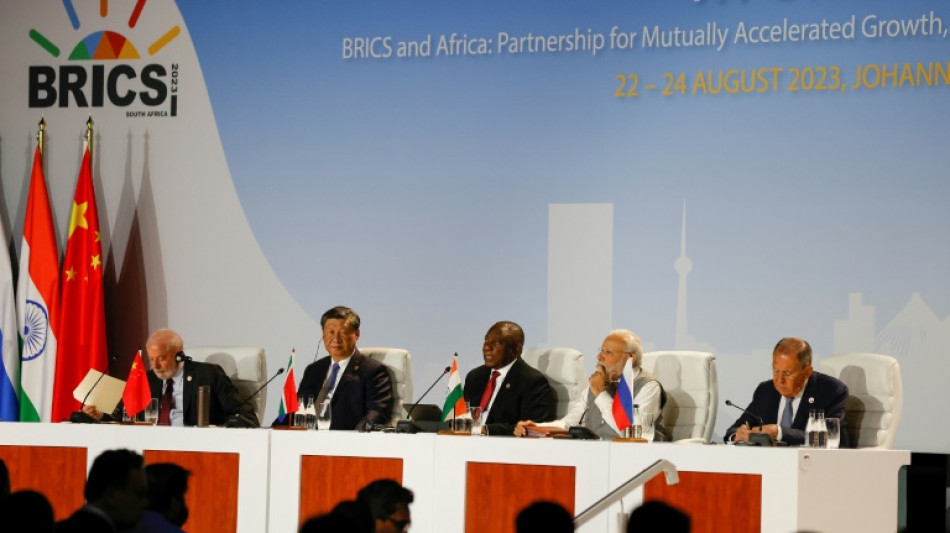
The United States is racing to improve its messaging to the developing world as the BRICS group grows, although few in Washington view an immediate threat from the Chinese-backed club.
The BRICS -- Brazil, China, India, Russia and South Africa -- agreed at a summit last week to add six more members, in what Chinese President Xi Jinping billed as a historic moment among large emerging economies contesting the Western-led order.
As the BRICS leaders met in Johannesburg, President Joe Biden's administration renewed promises to step up funding for the developing world through the World Bank and International Monetary Fund.
Biden's national security advisor, Jake Sullivan, vowed to fight to reform the Washington-based lenders at an upcoming summit in New Delhi of the Group of 20 -- boosting the roles both of the US-backed organization, which brings together both rich and poor nations, and of India, a key member of both clubs.
The United States has also been highlighting Russia's withdrawal from a UN-backed deal to allow grain exports from Ukraine to the developing world, where some countries have questioned the Western priority of sending billions of dollars in weapons to Kyiv.
Publicly, Washington played down the BRICS expansion, saying only that countries can choose their own partners.
Sullivan, noting the wide policy differences among the countries, earlier told reporters, "We are not looking at the BRICS as evolving into some kind of geopolitical rival to the United States or anyone else."
- 'Alternatives, not replacements' -
But experts said the BRICS expansion at least showed demand for a new way to address unmet needs, on the economic if not security front.
Emerging nations are "looking for alternatives, not replacements" to the US-led order, said Sarang Shidore, director of the Global South program at the Quincy Institute, which advocates a less military-focused US foreign policy.
"It's a message to the United States that these gaps are hurting and our countries are not just complaining about them or carping from the sidelines, but actually taking action to try and fill these gaps," he said.
A BRICS summit statement pointed to the breakdown of the World Trade Organization's dispute settlement system, where Washington since Donald Trump's presidency has blocked appointments as it alleges unfair treatment.
Biden has ramped up climate action at home but, faced with opposition from Trump's Republican Party, the United States -- the largest historical carbon emitter and second currently to China -- is unlikely to come close to the president's promises of more than $11 billion a year by 2024 to help developing countries hardest hit by climate change.
"I think the US is starting to take it seriously," Shidore said of developing countries' concern. "But those are statements -- is there money attached to it?"
- Even less cohesive? -
For Washington, the most concerning addition to the BRICS is Iran, which has hailed membership as a way to break out of US-driven isolation over the clerical state's contested nuclear work and clampdown on protesters.
But the new members do not see eye to eye. Also joining are three Arab countries with historically rocky ties with Iran -- Egypt, Saudi Arabia and the United Arab Emirates.
Tensions also divided the original BRICS. China has a difficult relationship with India, which has been warming to the United States while insisting on "strategic autonomy."
While the BRICS statement backed reform of the UN Security Council, a major priority for India and Brazil, few expect veto-wielding China and Russia to dilute their power willingly.
Henry Tugendhat, an economist at the US Institute of Peace, said that China in promoting the expansion had inadvertently made the BRICS even less cohesive -- more akin to the G20 than the Group of Seven, the club of major industrial democracies that largely share principles.
"What's striking is that they there are many issues in which they do not align," he said of the G20.
Conspicuously absent from the BRICS expansion was any Southeast Asian country -- despite Indonesia's leadership in the Cold War-era Non-Aligned Movement -- at a time that China has been increasingly assertive on maritime disputes.
Colleen Cottle, a former CIA analyst now at the Atlantic Council, said that for China, BRICS expansion was "more about the rhetoric" of showing that developing countries were rallying to its side, rather than concrete plans to work together.
Still, she said, the BRICS expansion showed the demand for change.
The United States, she said, needs a more effective strategy than its oft-stated insistence on working with "like-minded countries" -- but also is unlikely to find success just replicating China's approach of raw infrastructure spending.
"You need to have the whole package -- the articulated long-term vision as well as the concrete funds to back it up," she said.
A.Anderson--AT