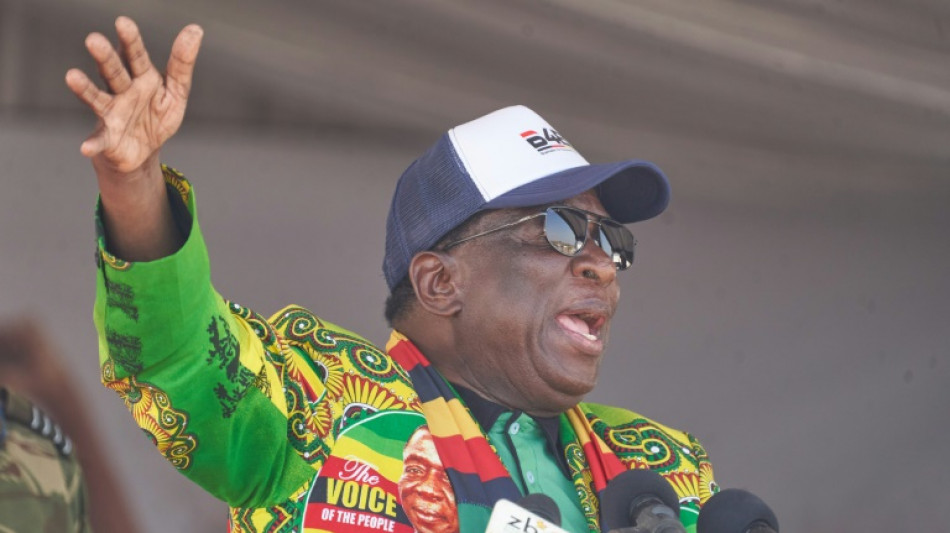
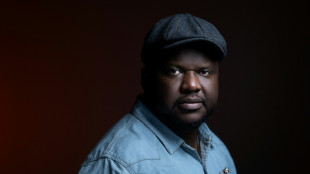
Zimbabwe's 80-year-old 'Crocodile' president wins new term / Photo: Zinyange AUNTONY - AFP

 Govt takes control of Turkey's most-watched news channel
 FIFA to offer members $6.35-billion development fund windfall

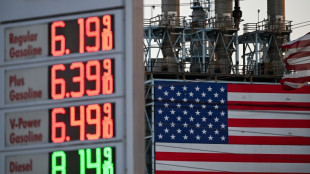 US consumer inflation hotter than expected as midterms loom

 INmune Bio Inc. and Quantum Computing Inc. Partner to Apply Quantum Optimization and AI to Advance Alzheimer’s Drug Research and Explore New Applications for XPro
 Hot US inflation data dents Wall Street stocks
 India sends 'cockroach' leaders to jail after protest
 'Sinners' director Ryan Coogler to reboot 'X-Files' for Disney
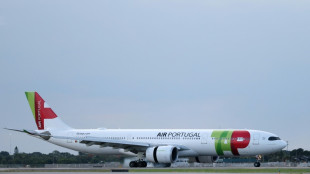 Lufthansa wins contest for TAP Air Portugal stake
 AI worms, 'major' incident fears spur safety calls at industry summit
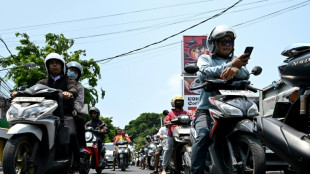 Fuel shortage triggers queues on Indonesia's Bali island
 Evolution Metals & Technologies Corp. Reaffirms $400 Million to $460 Million FY2027 Revenue Guidance, Unveils Eight Sintered Magnet Grades Covering an Estimated 75% of Global NdFeB Revenue, and Moves to Answer U.S. Army Call for Rare Earth Magnets

 Trial defence says Russia used Nord Stream pipelines as 'weapon'
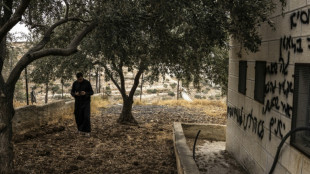 Israeli settlers set fire to mosque in occupied West Bank
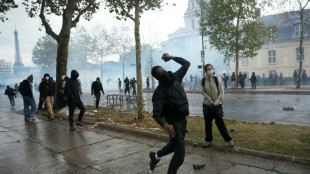 Macron says French student protesters 'exploited' by political forces: spokeswoman
 Stocks diverge ahead of key US inflation data
 Japan summons Russian ambassador to protest journalist's arrest
 Workers to strike at world's largest copper mine in Chile
 Ukraine accuses US of helping Russia as missiles hit Kyiv
 Drone hits data centre of Russia's largest bank
 Bivial AG Brings Its Complete Dashboard to Mobile
 Mont Blanc nearly two metres taller than in 2023: French surveyors
 Pope recovering after lung cancer operation that rattles Church
 Indonesia haze spikes Singapore pollution, shuts East Timor schools
 Higher borrowing costs an 'alarm signal' for France: finance minister
 Zelensky accuses Putin of disrespecting Trump after latest attacks
Emmerson Mnangagwa, who became Zimbabwe's second president after outmanoeuvring long-time ruler Robert Mugabe with a military-backed coup in 2017 -- won a second term on Saturday in a vote that international observers said fell short of democratic standards.
Nicknamed "The Crocodile" because of his ruthlessness, Mnangagwa, 80, who analysts judge more autocratic than his predecessor and lacking Mugabe's intellectual flair and ideological vision, won 52.6 percent of the ballots according to official results.
Having presided over a collapsing economy marked by hyperinflation, unemployment, and corruption allegations, critics say Mnangagwa moved to silence dissent and clamp down on the opposition in the run-up to the election.
"He is a very repressive, authoritarian figure," said Brian Raftopoulos, a Zimbabwean political researcher.
Mnangagwa was appointed president after a battle to secure the top job ahead of Mugabe's wife Grace that he initially looked to have lost.
In 2017, then 93-year-old Mugabe dismissed Mnangagwa as vice president, clearing the way for the first lady.
Fearing for his life, the veteran hardliner made a dramatic escape across the border to Mozambique.
His son, who was with him, described Mnangagwa sitting at a bus stop wearing a dusty suit and tattered shoes after a night-time mountain trek.
He had no belongings except a briefcase containing dollars.
But the situation turned on its head within weeks when military chiefs launched a brief takeover and Mnangagwa emerged as their chosen successor.
- International isolation -
Mugabe's 37-year rule was brought to an end and Mnangagwa made a triumphant return home.
Lawmakers with the ruling ZANU-PF swung behind him and he was sworn into office.
"I never thought he whom I have nurtured... that one day he would turn against me," a mournful Mugabe said afterwards.
Mnangagwa won an election the following year with a wafer-thin majority of 50.8 percent.
The army cracked down on opposition protests, shooting dead six people, and although youthful opposition leader Nelson Chamisa challenged the results in court, he lost.
The two squared off for a second bout on August 23, which yielded a similar result.
The 2018 vote came with gargantuan expectations of more freedom and economic revival, but these were swiftly dispelled.
Zimbabwe remains internationally isolated, its leadership targeted by Western sanctions.
Mnangagwa blames the sanctions for the country's woes.
His supporters credit him for infrastructure projects including building schools, bridges and repairing roads.
Mnangagwa's rise to the presidency came following decades of working closely with Mugabe after Zimbabwe won independence from Britain in 1980.
In 2008, he allegedly supervised a wave of violence that forced the opposition to pull out of a run-off vote.
He then became defence minister in a troubled power-sharing government formed with the opposition in 2009, and vice president in 2014.
- Scarves and massacres -
Since taking office, he has tried to fashion himself as a down-to-earth politician.
Often wearing a suit, he always sports a striped scarf in Zimbabwe's national colours at public appearances.
He has been the target of several apparent assassination attempts including a blast at a 2018 rally that killed two people.
In 2017 he was flown to South Africa for emergency treatment after eating ice cream from a dairy company owned by his arch-rival Grace Mugabe that his allies said was laced with poison.
Laconic, thick-set and with dyed black hair, Mnangagwa describes himself as a born-again Christian. He says he abstains from alcohol for six months each year.
Born in 1942, as Emmerson Dambudzo Mnangagwa (his middle name means "adversity" in the Shona language), he completed his early education in Zimbabwe before his family relocated to neighbouring Zambia.
In 1966, he joined the struggle for independence from British colonial rule, becoming one of the young combatants who helped direct the war after undergoing training in China and Egypt.
His nickname can be traced back to his ferocious "Crocodile Gang" guerrilla unit.
After blowing up a train, he was arrested in 1964 and sentenced to death, later commuted to 10 years in prison because of his young age -- leaving him a life-long vocal opponent of the death penalty.
Following independence, he was allegedly partially responsible for a brutal crackdown on opposition supporters that claimed thousands of lives of mainly the minority Ndebele ethnic group in what is commonly known as the "Gukurahundi massacre".
The massacre remains one of the biggest stains on his reputation. Mnangagwa has admitted it was "a bad patch" in Zimbabwe's history.
Since taking power he has held talks with tribal chiefs in a bid to settle the longstanding grievances.
Two years ago he set up a panel of chiefs to probe the massacres which the Zimbabwe Catholic Commission for Justice and Peace estimates claimed 20,000 lives.
But the hearings are yet to open.
K.Hill--AT