China's allies lead Pacific criticism of Fukushima water release / Photo: Prerna PRIYANKA - AFP

 Lufthansa wins contest for TAP Air Portugal stake
 AI worms, 'major' incident fears spur safety calls at industry summit
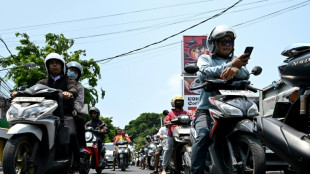 Fuel shortage triggers queues on Indonesia's Bali island

 Evolution Metals & Technologies Corp. Reaffirms $400 Million to $460 Million FY2027 Revenue Guidance, Unveils Eight Sintered Magnet Grades Covering an Estimated 75% of Global NdFeB Revenue, and Moves to Answer U.S. Army Call for Rare Earth Magnets

 Trial defence says Russia used Nord Stream pipelines as 'weapon'

 Israeli settlers set fire to mosque in occupied West Bank

 Macron says French student protesters 'exploited' by political forces: spokeswoman

 Stocks diverge ahead of key US inflation data
 Japan summons Russian ambassador to protest journalist's arrest

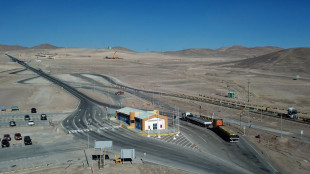 Workers to strike at world's largest copper mine in Chile

 Ukraine accuses US of helping Russia as missiles hit Kyiv

 Drone hits data centre of Russia's largest bank

 Bivial AG Brings Its Complete Dashboard to Mobile

 Mont Blanc nearly two metres taller than in 2023: French surveyors

 Pope recovering after lung cancer operation that rattles Church
 Indonesia haze spikes Singapore pollution, shuts East Timor schools
 Higher borrowing costs an 'alarm signal' for France: finance minister
 Zelensky accuses Putin of disrespecting Trump after latest attacks

 Japan PM says housework makes her busier than male predecessors

 Top Indian 'cockroach' leaders sent to jail after protest
 Ukraine ex-military officer to stand trial over Nord Stream sabotage
 IMF chief says Saudi attacks could have negative spillover 'everywhere'
 Premier League move a Sage decision for new Palace boss

 South Korean FA condemns 'personal attacks' as rift rumours grow

 Japan urges 'impartial treatment' of journalist arrested in Russia

China's Pacific allies -- from Solomon Islands' government to Fiji's opposition -- on Friday echoed Beijing's criticism of Japan releasing wastewater from its disaster-hit Fukushima nuclear plant.
More than 500 Olympic swimming pools' worth of treated wastewater will be released into the Pacific over decades in a plan endorsed by the International Atomic Energy Agency.
But China has issued a furious response, and its allies in the Pacific have backed that criticism despite safety assurances from Japan and the IAEA.
Solomons' Prime Minister Manasseh Sogavare -- who has delayed elections and scolded Western powers while embracing Beijing's chequebook diplomacy -- issued a "strong statement against Japan's decision".
The water release, he said, "has an impact on our people, ocean, economy and livelihood."
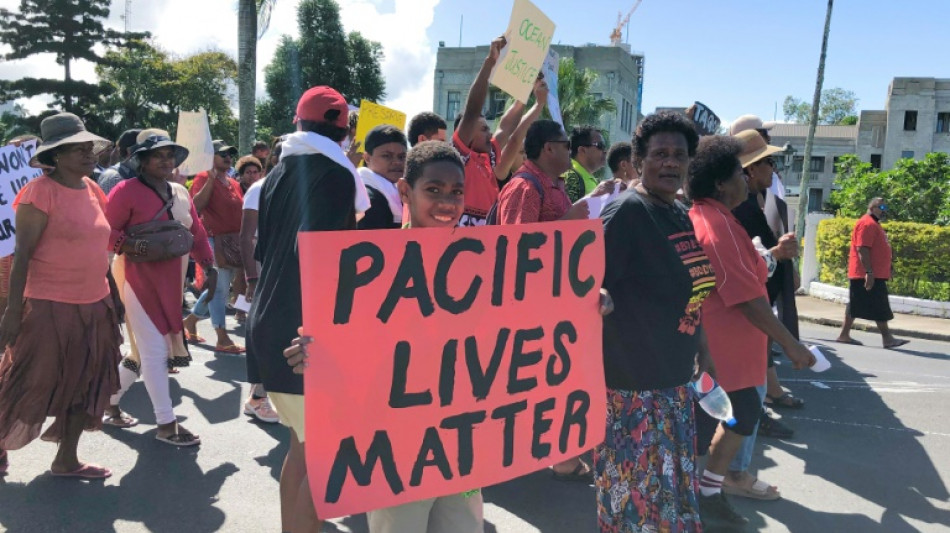
There was a similar message in the Fijian capital Suva on Friday, where a rare protest attracted hundreds.
Demonstrators carried placards saying "Nuclear-free sea!" and "Pacific Lives Matter".
The protest was promoted by FijiFirst, an opposition party whose leader, ousted prime minister Frank Bainimarama, courted closer ties with China while in office.
The party accused Fiji's government of "failing future generations by allowing Japan to dump its nuclear waste into our ocean".
Other leaders appeared convinced by the safety assessments.
"Japan has reassured the region that the water has been treated," said Cook Islands Prime Minister Mark Brown, who is currently chair of the Pacific Islands Forum, a regional bloc.
"I believe that the discharge meets international safety standards."
- An opening for Beijing -
China has repeatedly and strongly criticised the release plan, banned Japanese seafood imports and cast doubt on the expert assessments that concluded the operation poses no harm to the environment.
Nigel Marks, a physics professor at Australia's Curtin University, said the released water contains negligible amounts of radioactive tritium.
"The Pacific Ocean contains 8,400 grams of pure tritium, while Japan will release 0.06 grams of tritium every year," he said.
"The minuscule amount of extra radiation won't make the tiniest jot of difference."
Regardless of the science, the Fukushima release has created a political opening for Beijing, according to Mihai Sora, a former Australian diplomat who is now with the Lowy Institute in Sydney.
Japan has "done a lot of diplomacy to win over as many Pacific leaders as they can", he said, but "almost universally this will be an unpopular decision among Pacific communities".
"You can imagine Beijing using its diplomatic access to encourage some of its partners to speak out about this strongly, because it serves Beijing's interests."
As well as fears about damaging vital fish supplies and sensitive marine ecosystems, the Fukushima water release has caused disquiet in a region where nuclear issues are highly sensitive.
For decades, major powers including the United States, Britain and France used the sparsely populated South Pacific to test atomic weapons -- with consequences that linger to this day.
A.Ruiz--AT